

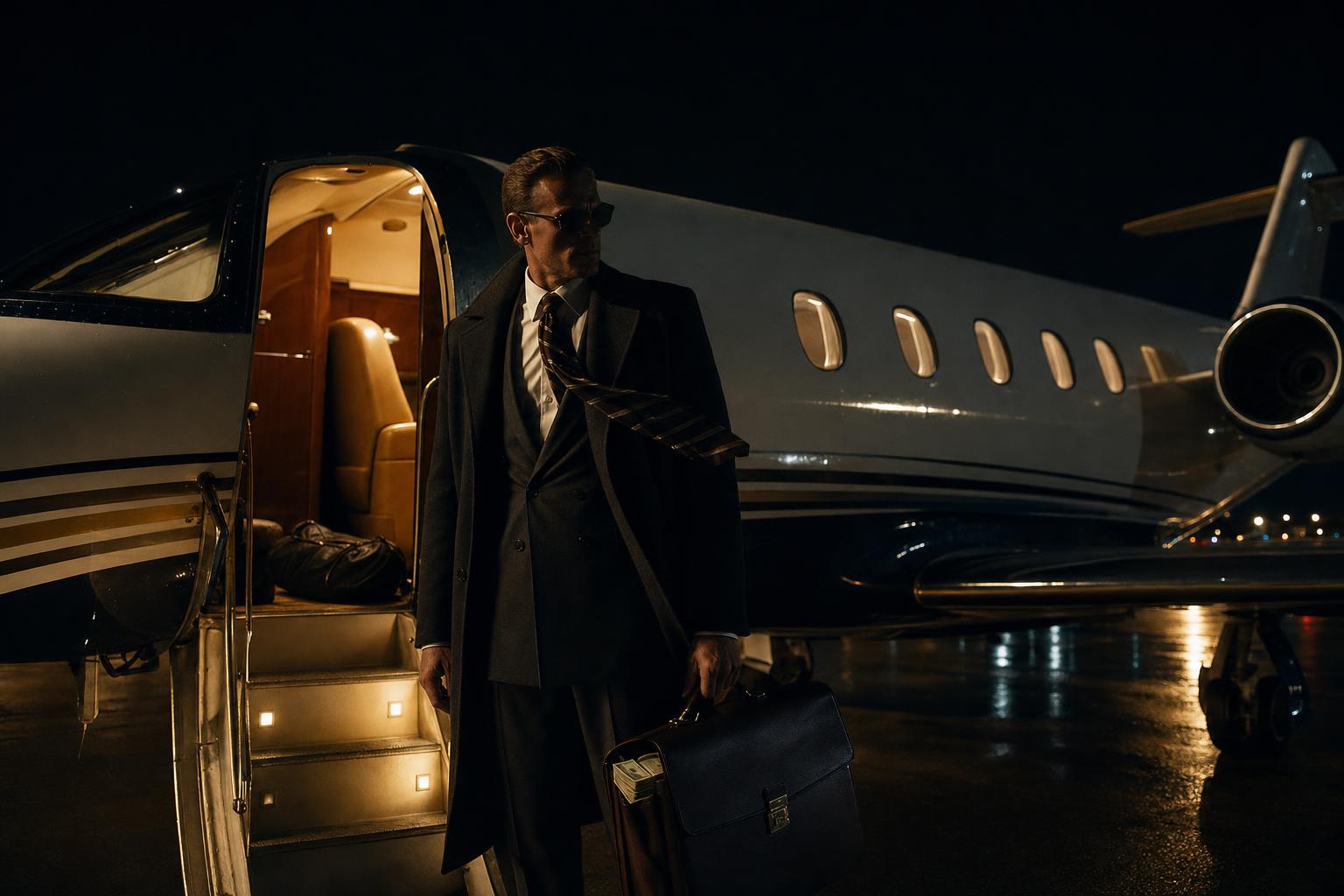
Introduction to the D. B. Cooper Mystery
Few criminal cases in American history have captured the public imagination like the D. B. Cooper mystery. More than five decades after the crime, the identity of the man who hijacked a commercial airplane, collected ransom money, and vanished into the night remains unknown. The case has become a rare blend of true crime, aviation history, and modern folklore, inspiring books, documentaries, and endless amateur investigations.
The Crime That Made Headlines
On November 24, 1971, a man using the name Dan Cooper boarded Northwest Orient Airlines Flight 305 in Portland, Oregon, bound for Seattle, Washington. He was described as middle-aged, calm, and neatly dressed in a business suit with a black tie. Shortly after takeoff, he handed a note to a flight attendant claiming he had a bomb in his briefcase. He demanded $200,000 in cash, four parachutes, and a fuel truck standing by in Seattle.
The airline complied after the plane landed. Authorities released the passengers, and Cooper ordered the crew back into the air, directing the pilots toward Mexico at a low altitude and reduced speed. Somewhere over the rugged Pacific Northwest, he lowered the rear airstair of the Boeing 727 and jumped into stormy darkness with the ransom strapped to his body.
Why the Case Endures
What makes this story extraordinary is not only the boldness of the hijacking, but also the fact that Cooper was never definitively found. Despite one of the most extensive manhunts in FBI history, investigators failed to identify him or determine whether he survived the jump. In 2016, after 45 years of investigation, the FBI officially suspended active efforts, though the file remains open for credible leads.
A Mystery Fueled by Missing Answers
Several details continue to fascinate researchers. The ransom money consisted of 10,000 unmarked $20 bills, and in 1980, a boy discovered $5,800 of decaying Cooper cash along the Columbia River. Yet no confirmed trace of Cooper himself ever surfaced. His clip-on tie and a few parachute-related clues provided evidence, but not enough to solve the case.
From Criminal to Cultural Legend
The name “D. B. Cooper” itself came from a media error, but it stuck and became legendary. Over time, Cooper evolved from wanted fugitive into a near-mythic figure, often portrayed as a daring outlaw who outwitted the system. That image persists even though the event was a serious federal crime involving real danger to passengers and crew.
The Opening Questions
At the heart of the mystery are several enduring questions: Who was Cooper, why did he do it, and did he survive? Those questions continue to drive debate among historians, investigators, and curious readers alike.
America in 1971: The Perfect Moment for a Hijacking
A Nation in the Air
In 1971, the United States had created the ideal conditions for an airline hijacking. Commercial aviation was booming, with roughly 200 million passengers flying annually on U.S. carriers by the early 1970s. Air travel had become faster, more accessible, and culturally glamorous, yet airport security remained astonishingly light. A passenger could often buy a ticket with cash, use a false name, and walk straight to the gate with little more than a glance from airline staff. There were no routine metal detectors in most airports, no baggage X-ray machines, and no standardized passenger screening system.
That environment mattered enormously in the case of D. B. Cooper. A man carrying a briefcase and claiming to have a bomb did not need to overcome sophisticated security barriers. He only needed to blend in, and in 1971, blending in at an airport was remarkably easy.
Security Before the Security Age
Minimal Screening, Maximum Vulnerability
Before the major anti-hijacking reforms of the 1970s, airport security was largely reactive rather than preventive. Airlines worried more about customer convenience than about systematic threat detection. The idea of subjecting every passenger to a search was widely seen as impractical and bad for business. As a result, hijackers exploited a system built on trust.
The numbers reveal the scale of the problem. Between 1968 and 1972, the United States experienced a wave of hijackings so frequent that they became a national crisis. In 1969 alone, more than 40 attempted or successful hijackings involving U.S. aircraft were recorded. Many were politically motivated, especially diversions to Cuba, which had become so common that crews sometimes carried special route maps for such incidents.
Why Cooper Chose His Moment
A Crime Tailored to the Era
Cooper’s plan fit the vulnerabilities of 1971 perfectly. He boarded a short Northwest Orient flight from Portland to Seattle, paid cash for his ticket, and attracted little notice. Once in the air, he handed a flight attendant a note stating that he had a bomb and demanded $200,000, four parachutes, and a fuel truck standing by in Seattle. His requests showed careful understanding of airline procedures and law enforcement assumptions.
The Aircraft Advantage
The Boeing 727 also made the era uniquely favorable. Its rear airstair could be lowered during flight, a rare design feature that gave Cooper a practical escape route. After receiving the ransom, he ordered the plane back into the air and later jumped somewhere over the Pacific Northwest. Investigators eventually concluded that the combination of low-altitude flight, reduced speed, and the 727’s stairway made the escape technically possible in a way few other aircraft would have allowed.
A Culture of Anxiety and Opportunity
America in 1971 was marked by distrust of institutions, the Vietnam War, political unrest, and a media environment hungry for sensational stories. Hijackings captured public attention because they combined modern technology, danger, and mystery. Cooper understood that authorities would prioritize passenger safety over immediate confrontation, giving him leverage.
Just weeks after the Cooper hijacking, federal pressure for reform intensified. By 1973, the U.S. had introduced widespread passenger screening and metal detectors, transforming aviation security. Cooper struck in the narrow window before those defenses became standard, when the skies were crowded, the system was porous, and one calm man with a plan could still vanish into legend.
The Flight and the Hijacking
A Routine Trip Turns Historic
On November 24, 1971, Northwest Orient Airlines Flight 305 departed Portland, Oregon, bound for Seattle, Washington, on what should have been a short, uneventful trip. The aircraft was a Boeing 727-100, a model well suited to brief regional routes and notable for one unusual feature: a rear airstair that could be lowered during flight. That design detail, largely irrelevant to ordinary passengers, would become central to one of the most famous unsolved crimes in American history.
The man later known to the world as D. B. Cooper boarded using the name Dan Cooper. He purchased a one-way ticket for $20, paid in cash, and appeared outwardly unremarkable. Witnesses described him as a middle-aged white man, roughly in his forties, wearing a dark business suit, white shirt, black tie, and raincoat. He carried a briefcase and ordered a bourbon and soda, blending in with the era’s common image of a traveling businessman.
The Note That Changed Everything
Shortly after takeoff, Cooper handed a note to flight attendant Florence Schaffner. At first, she assumed it was a phone number from a passenger trying to flirt, and she tucked it into her purse without reading it. Cooper then leaned toward her and quietly told her that she should look at the note because he had a bomb. When she opened it, she saw a direct message stating that he wanted her to sit beside him.
A Calm and Calculated Threat
Once Schaffner sat down, Cooper opened his briefcase just enough for her to see what appeared to be eight red cylinders, wiring, and a battery. Whether the device was genuine has never been conclusively proven, but in the moment it was convincing enough. Cooper’s demeanor remained controlled and polite, which made the threat even more chilling. He did not shout, panic, or behave erratically. Instead, he presented his demands with the confidence of someone who had thought through every step.
He requested $200,000 in cash, four parachutes, and a fuel truck standing by in Seattle for immediate refueling upon landing. Adjusted for inflation, $200,000 in 1971 would equal well over $1.5 million today, underscoring the scale of the ransom. Cooper instructed the crew not to alert the passengers to the seriousness of the situation, helping preserve calm inside the cabin.
Managing the Crisis in the Air
The flight crew quickly informed the cockpit, and the pilots relayed the hijacking to air traffic control. From there, federal authorities and airline officials began coordinating the response. Rather than refusing the demands, officials chose negotiation and compliance, a decision shaped by the presence of passengers and crew whose safety came first.
Because Flight 305 was scheduled for a trip of only about 30 minutes, the plane remained in the air longer than normal while authorities in Seattle gathered the ransom money and parachutes. During this time, the aircraft circled the Puget Sound area. Passengers were told that their arrival was being delayed by a minor mechanical issue. Most had no idea they were sharing the cabin with a hijacker orchestrating one of the boldest extortion attempts in aviation history.
The Seattle Landing
When the plane landed at Seattle-Tacoma Airport at approximately 5:39 p.m., law enforcement and airline personnel were ready, though kept at a distance to avoid provoking Cooper. The ransom was delivered in a knapsack, and the money consisted of 10,000 unmarked $20 bills whose serial numbers had been recorded by the FBI. The four parachutes included two main chutes and two reserve chutes, a choice Cooper had specifically demanded. Investigators later believed this request may have been intended to suggest he might force a hostage to jump with him, discouraging authorities from sabotaging the equipment.
Releasing the Passengers
After receiving the money and parachutes, Cooper allowed the 36 passengers to leave the aircraft, along with some crew members. This transformed the standoff. What had begun as a hostage crisis involving dozens of civilians became a more focused confrontation between Cooper and the remaining flight crew. Even then, he maintained a composed manner, reportedly polite in speech and precise in instruction.
He ordered the plane to take off again, this time heading generally toward Mexico City, with a refueling stop planned in Reno, Nevada. Cooper specified unusual flight conditions: the plane was to fly at a relatively low altitude of 10,000 feet, at a speed of about 170 knots, with the landing gear down, wing flaps set at 15 degrees, and the cabin unpressurized. These demands suggested at least some familiarity with aircraft performance, especially with the Boeing 727’s rear stair system.
Into the Night Sky
Only the pilot, copilot, flight engineer, and one flight attendant remained aboard as Flight 305 departed Seattle. Two military aircraft, including fighter jets, followed from a distance, though poor visibility and darkness limited their ability to observe the 727 closely. Rain, cloud cover, and night conditions combined to create a near-perfect environment for disappearance.
The Rear Stairs Open
At some point during the flight, Cooper instructed flight attendant Tina Mucklow to go into the cockpit and remain there with the crew. Left alone in the cabin, he prepared for his escape. Around 8:00 p.m., the crew noticed a warning indicator showing that the rear airstair had been activated. Soon after, they felt a sudden change in air pressure, suggesting that Cooper had lowered the stairs and exited the aircraft.
Somewhere over the rugged wilderness of the Pacific Northwest, carrying the ransom and wearing a parachute, Cooper jumped into the stormy darkness. The exact location remains uncertain, though investigators narrowed the probable drop zone to an area in southwestern Washington. By the time the plane landed in Reno, Cooper was gone, leaving behind only a black clip-on tie, tie clasp, and a mystery that would outlive the decade, the century, and nearly every lead that followed.
The Jump into the Night
The Moment Cooper Made His Move
On the night of November 24, 1971, the mystery of D. B. Cooper transformed from a tense hijacking into one of America’s most enduring criminal legends. After Flight 305 took off from Seattle bound for Mexico, with a refueling stop already completed in Reno, Cooper waited until the aircraft was airborne again before carrying out the final stage of his plan. He had already collected $200,000 in ransom, equivalent to well over $1 million today when adjusted for inflation, along with four parachutes. What happened next would cement his place in history.
Cooper instructed the remaining crew to stay in the cockpit and closed the cabin curtain behind them. He appeared calm, deliberate, and familiar with the Boeing 727’s unusual rear stairway, a feature that made the aircraft central to his escape. Investigators later believed this knowledge was significant, because the 727 was one of the few commercial jets that allowed someone to exit from the back while in flight. That technical detail gave Cooper an opportunity almost no hijacker before or since could have exploited.
Conditions in the Sky
The jump itself was extraordinarily dangerous. Flight 305 was flying through the Pacific Northwest at night, in late November, under poor weather conditions. Reports indicate the plane was traveling at roughly 170 knots at an altitude of about 10,000 feet, configured according to Cooper’s demands. Outside, there was heavy cloud cover, rain, and freezing wind. Temperatures at that altitude likely hovered near or below 0 degrees Celsius, creating a brutal environment for anyone attempting a parachute descent.
Why the Jump Was So Risky
Even trained paratroopers would have considered such a leap hazardous. Cooper was wearing a business suit, loafers, and a trench coat rather than protective jump gear. He also carried the ransom money, reportedly packed into a bank bag and weighing around 20 pounds. The combination of darkness, rough weather, and limited equipment has led many experts to question whether he could have survived without serious injury. Yet others argue that his composure and specific instructions suggest at least some practical knowledge of aviation or parachuting.
The Last Confirmed Moments
At approximately 8:13 p.m., the crew noticed a sudden change in air pressure, indicating that the rear stairs had been deployed. That moment is widely accepted as the point when Cooper exited the aircraft. The plane later landed safely in Reno, where FBI agents found that Cooper was gone. Left behind were a black clip-on tie, tie clasp, and two of the parachutes, along with clues that would fuel decades of investigation.
A Vanishing Act Without Witnesses
No one actually saw Cooper jump. That absence of direct observation has made the event uniquely difficult to reconstruct. Search teams combed the suspected landing zone in southwestern Washington, focusing on wooded terrain near the Lewis River and Mount St. Helens region. Despite extensive efforts involving aircraft, ground crews, and later forensic review, no confirmed trace of Cooper was found in the immediate aftermath.
The Beginning of the Legend
The jump was not merely an escape attempt; it was the birth of a myth. In a single act, Cooper disappeared into darkness, weather, and uncertainty, leaving behind a case defined by missing evidence, conflicting theories, and remarkable audacity. Whether he died in the wilderness or escaped successfully, the leap from Flight 305 remains the pivotal moment that turned a criminal act into an enduring American mystery.
The Investigation Begins
A Crime Unlike Any Other
When Northwest Orient Flight 305 landed in Seattle on November 24, 1971, the hijacking entered a new phase. The mysterious passenger who had called himself Dan Cooper had already released the other travelers, collected $200,000 in ransom, and demanded four parachutes before ordering the plane back into the air. What followed transformed a dramatic extortion case into one of the most enduring investigations in American criminal history. By the time the aircraft touched down in Reno, Nevada, Cooper was gone, apparently having leapt into the night somewhere over the Pacific Northwest.
The FBI immediately recognized that this was no ordinary skyjacking. During the late 1960s and early 1970s, hijackings had become disturbingly common in the United States, but most involved political motives or demands to be flown to Cuba. Cooper’s case was different. He was calm, methodical, and focused entirely on money and escape. His disappearance from a commercial jet in stormy weather created a puzzle with almost no precedent, forcing investigators to combine traditional detective work with aviation analysis, forensic science, and an enormous ground search.
Securing the Evidence
The first stage of the investigation centered on the aircraft itself. FBI agents, local police, and airline personnel searched the Boeing 727 for anything Cooper might have touched or left behind. They recovered several key items, including his black clip-on tie, a tie clasp, and eight cigarette butts from Raleigh filter-tip cigarettes he had smoked during the flight. At the time, these seemed like promising pieces of evidence. Investigators also interviewed the flight crew in detail, especially flight attendant Florence Schaffner and chief flight attendant Tina Mucklow, who had spent the most time with him.
Witness Descriptions
The crew described Cooper as a white man in his mid-40s, around 5 feet 10 inches to 6 feet tall, weighing roughly 170 to 180 pounds. He wore a dark business suit, white shirt, black tie, and loafers, presenting the appearance of a quiet middle-management professional rather than a desperate criminal. Witnesses consistently emphasized his composure. He did not rant, panic, or display recklessness. That calm demeanor shaped the investigation from the beginning, because agents believed they were dealing with someone disciplined, intelligent, and possibly familiar with aircraft operations.
Tracing the Money and the Flight Path
One of the FBI’s most important early steps was recording the serial numbers of the ransom money. The 10,000 twenty-dollar bills had been photographed and cataloged before being handed over in Seattle. This gave authorities a way to track the cash if it ever entered circulation. Banks, casinos, racetracks, and law enforcement agencies across the country were alerted. In theory, the money trail could reveal Cooper’s identity or at least indicate whether he had survived the jump.
At the same time, investigators worked to determine where he had likely parachuted from the aircraft. The Boeing 727 was uniquely suited to Cooper’s plan because it had a rear airstair that could be lowered in flight. Based on cockpit data, airspeed, altitude, and crew observations, the FBI estimated that the jump occurred around 8:13 p.m. somewhere between Seattle and Reno, likely over southwestern Washington. Weather conditions were terrible, with rain, darkness, freezing temperatures, and winds that would have made a nighttime jump extraordinarily dangerous.
The Search on the Ground
Into the Wilderness
Once the probable drop zone was identified, the search effort expanded dramatically. FBI agents, sheriff’s deputies, military personnel, and civilian volunteers combed rugged forests, riverbanks, and mountain terrain. Helicopters surveyed remote areas, while search teams looked for parachute fabric, money, footprints, or human remains. The challenge was immense. The suspected landing area included dense woodland and uneven ground, and winter weather quickly complicated any attempt to preserve evidence.
Despite the scale of the operation, the search produced no confirmed trace of Cooper. No parachute was found in the initial sweeps, and no body was recovered. That absence of evidence fueled two competing theories almost immediately. One camp believed Cooper had died during the jump and simply had not yet been found. The other argued that his planning suggested survival was possible, perhaps even likely.
Building the Suspect List
As news of the hijacking spread, tips poured in by the hundreds and then the thousands. The FBI investigated military veterans, parachutists, former airline employees, ex-convicts, and men whose appearance resembled the composite sketch. Over time, more than 800 suspects would be considered in the case. Agents examined backgrounds, alibis, financial records, and technical knowledge, trying to identify someone with the nerve and skill to attempt such an escape.
Early Investigative Limits
The investigation was energetic, but it was also constrained by the era’s technology. Fingerprint analysis was available, yet the prints recovered from the plane were incomplete and difficult to match with certainty. DNA testing did not exist in 1971, and crucial evidence such as the cigarette butts was later lost, eliminating what might have become a powerful forensic link. As a result, the case depended heavily on witness memory, physical searches, and circumstantial patterns rather than definitive scientific proof.
A Mystery Takes Shape
Within days, the hijacking had evolved from an urgent manhunt into a national obsession. The FBI gave the case its own designation, NORJAK, short for Northwest Hijacking. That label reflected both the seriousness of the crime and the unusual complexity of the pursuit. Investigators had a suspect description, a probable jump zone, and a fully documented ransom payment, yet they lacked the one thing every major case needs most: the man himself.
Suspects, Theories, and Dead Ends
The mystery of D. B. Cooper has endured not simply because of the hijacking itself, but because every promising lead seems to dissolve under scrutiny. Over the decades, investigators, journalists, amateur sleuths, and documentary producers have proposed dozens of suspects. Some appeared convincing for a time, backed by circumstantial evidence, military backgrounds, or family stories. Yet the case remains unresolved because none of the leading theories has fully matched the known facts.
Why the Suspect List Grew So Large
One reason the Cooper suspect pool expanded so dramatically is that the crime seemed to require a rare combination of traits. The hijacker appeared calm under pressure, familiar with aircraft terminology, and confident enough to parachute into darkness over rugged terrain. That profile naturally pointed investigators toward former paratroopers, military veterans, airline employees, and men with aviation knowledge. Because the hijacking occurred in 1971, an era before modern surveillance and digital tracking, thousands of tips had to be pursued through interviews, paper records, and physical evidence.
The FBI reportedly examined more than 800 serious suspects over the life of the investigation, while receiving many more speculative tips. Most were eliminated because they did not match the physical description, lacked the necessary skills, or could not be placed near the relevant locations. Others remained intriguing but unprovable.
Richard Floyd McCoy Jr.
Among the most discussed names is Richard Floyd McCoy Jr., a former Army helicopter pilot and Vietnam veteran. In April 1972, only a few months after the Cooper hijacking, McCoy carried out a remarkably similar skyjacking. He boarded a Boeing 727, extorted $500,000, and escaped by parachute through the rear stairs. The similarities were so striking that many believed the FBI had found its man.
Why McCoy Seemed Plausible
McCoy had military parachuting experience and clearly understood the 727’s aft stair system. His later crime demonstrated both nerve and planning. To many observers, it seemed unlikely that two men would independently conceive such a specific method within months of each other.
Why Investigators Rejected Him
Despite the parallels, the FBI concluded McCoy was probably not Cooper. Witness descriptions did not align well with McCoy’s appearance, and he was significantly younger than the man described by flight attendants. There were also alibi issues related to the night of the Cooper hijacking. For many investigators, McCoy looked less like Cooper and more like a copycat inspired by the original crime.
Kenneth Christiansen
Kenneth Christiansen became a high-profile suspect years later, largely because of media attention and claims from family members. A former Army paratrooper and Northwest Orient Airlines employee, Christiansen possessed several traits that seemed to fit the Cooper profile. He knew the airline industry, had military training, and reportedly developed an unusual amount of wealth after the hijacking.
His brother publicly suggested that Kenneth may have been Cooper, pointing to his knowledge of aircraft and alleged deathbed implications. Christiansen was also physically closer to the witness descriptions than some other suspects. However, the case against him remained largely circumstantial. Critics noted that his height and build may not have matched key accounts, and no physical evidence tied him to the hijacking, the ransom money, or the tie left on the plane.
Duane Weber
Duane Weber entered the Cooper narrative because of a dramatic confession claim. According to his widow, Weber told her shortly before his death, “I am Dan Cooper.” Such statements naturally attracted attention, especially because Weber had a criminal background and a history of deception.
The Problem with Confession-Based Theories
Confessions in famous unsolved cases are notoriously unreliable. Some come from people seeking attention, while others are filtered through memory, grief, or misunderstanding. In Weber’s case, investigators found certain details that supporters considered suggestive, including his familiarity with aspects of the crime. Yet forensic testing did not produce a definitive link, and many of the alleged connections could not withstand close examination. As with many Cooper suspects, the story was compelling, but the evidence was thin.
Robert Rackstraw and the Media Effect
Robert Rackstraw became one of the most publicly debated suspects in the modern era. A Vietnam veteran with parachute training, explosives knowledge, and a reputation for deception, Rackstraw seemed to embody the daring image many people associated with Cooper. Television documentaries and private investigators helped elevate his profile, arguing that coded letters and behavioral clues pointed toward him.
Evidence Versus Narrative
Rackstraw’s appeal as a suspect shows how strongly narrative can shape public belief. He had the right kind of background, and his life story sounded cinematic. But sounding plausible is not the same as meeting evidentiary standards. The FBI never named him as Cooper, and many claims surrounding him relied on interpretation rather than hard proof. His case illustrates a recurring pattern in the investigation: a suspect can fit the legend better than the facts.
Physical Evidence and Investigative Limits
The strongest path to solving the case should have been physical evidence, but even that produced frustration. Cooper left behind a black clip-on tie and tie clasp, which later yielded trace materials including particles associated with metals such as titanium. Some researchers argued that these particles suggested Cooper worked in aerospace or metal processing. While intriguing, that clue was too broad to identify one man conclusively.
In 1980, a boy named Brian Ingram discovered $5,800 of the ransom money buried along the Columbia River at Tena Bar. The bills matched the serial numbers recorded by investigators, proving that at least part of the ransom had reached the riverbank area. Yet the find raised as many questions as it answered. No one could explain with certainty how the money got there, whether it drifted naturally, was buried intentionally, or arrived through some other process.
Theories About Cooper’s Fate
The central divide in Cooper theories is simple: did he survive the jump or die in the wilderness? Those who believe he died point to brutal weather, darkness, heavy clothing, difficult terrain, and the possibility that he lacked a steerable parachute. Those who believe he survived argue that his composure suggests preparation and that no body, parachute, or substantial cache of money was ever found.
The absence of definitive remains has kept both possibilities alive. In practical terms, that uncertainty has allowed almost any suspect theory to continue circulating, even when evidence is weak. The result is a case defined by possibility rather than proof, where every lead seems to open a door only to reveal another dead end.
The Money, the Evidence, and What Was Found
The ransom that made the case unforgettable
The most tangible element in the D. B. Cooper mystery was the $200,000 ransom, a huge sum in 1971. Adjusted for inflation, that amount would equal well over $1.4 million today, underscoring how bold the hijacking was. The money was delivered in 20-dollar bills, a practical choice because it allowed a large amount of cash to be packed into a relatively compact bundle. Investigators carefully recorded the serial numbers of all 10,000 bills, creating one of the most important evidentiary trails in the case.
That decision to log the serial numbers was crucial. Unlike eyewitness descriptions, which can shift over time, the bills offered a fixed and verifiable link to the crime. Banks, casinos, racetracks, and businesses were alerted to watch for the currency, and the FBI distributed the serial numbers widely. In theory, any attempt by Cooper to spend the ransom openly could have exposed him. Yet for years, almost none of the money surfaced, deepening the mystery and suggesting either remarkable caution, bad luck, or a fatal end before the cash could be used.
Physical evidence from the plane
Beyond the ransom, investigators recovered several pieces of physical evidence from Northwest Orient Flight 305. Cooper had left behind his black clip-on tie, a tie clasp, and several cigarette butts. At the time, these items seemed promising. The tie in particular became one of the most discussed artifacts in the case because it could potentially reveal details about Cooper’s background, habits, and even occupation.
What the tie suggested
Later forensic analysis of the tie found tiny particles including titanium and other rare metallic residues. Some researchers argued that these particles hinted Cooper may have worked in aerospace, electronics, or metal manufacturing, industries where such materials were more common in the early 1970s. This did not identify him, but it helped shape the profile of a man who may have had technical knowledge and access to industrial environments.
The cigarette butts might have provided decisive DNA evidence, but they were reportedly lost before modern testing could be fully applied. That loss remains one of the most frustrating aspects of the investigation. In a case built on fragments and probabilities, every preserved item mattered.
The parachutes and the jump
Cooper requested four parachutes, likely to imply he might force a hostage to jump with him and thereby prevent authorities from sabotaging the equipment. Investigators later determined that he took two parachutes with him when he left the aircraft. One was used for the jump, while another appears to have been cut open, possibly so Cooper could use its cords. This detail suggested at least some improvisation during the escape.
Was the jump survivable?
The conditions were extremely dangerous. Cooper jumped at night, in November, over rough terrain in the Pacific Northwest. The plane was flying at roughly 10,000 feet and about 170 miles per hour, with rain, cold temperatures, and limited visibility. He wore a business suit and loafers rather than proper jump gear. To many investigators, those facts suggested he may not have survived. Others argued that his calm behavior and specific demands indicated planning and some familiarity with aircraft procedures.
The discovery at Tena Bar
The only confirmed recovery of ransom money came in 1980, nearly nine years after the hijacking. A boy named Brian Ingram, vacationing with his family on the Columbia River at a place called Tena Bar, uncovered $5,800 in decaying 20-dollar bills. The serial numbers matched Cooper’s ransom money exactly. The bills were found in three packets, still partially bundled together.
This discovery electrified the case because it proved that at least some of the ransom had entered the environment. Yet it also created new questions. Tena Bar was not an obvious location based on the FBI’s primary flight path estimates. Investigators debated whether the money had drifted there naturally, been buried deliberately, or arrived through some other process. Even today, the find remains one of the most puzzling clues in the entire investigation.
What was never found
Despite decades of searching, the FBI never recovered Cooper himself, the remaining $194,200, or the main parachute used in the jump. No verified spending pattern of the ransom emerged, and no body was conclusively linked to the hijacker. That absence of evidence is part of what keeps the story alive. In many famous crimes, the mystery narrows over time. In the Cooper case, the evidence is substantial enough to invite analysis, yet incomplete enough to resist certainty.
Why the evidence still matters
The Cooper investigation became a landmark case in American criminal history because it combined traceable money, physical artifacts, and a vanished suspect. Each item told part of the story, but never the whole story. The money established a measurable trail, the tie hinted at identity, and the Tena Bar discovery proved that at least one piece of the escape ended not in legend, but in mud and sand beside a river.
How D. B. Cooper Became a Legend
A Crime Perfectly Designed for Myth
Few unsolved crimes have embedded themselves in popular culture as deeply as the D. B. Cooper hijacking. On November 24, 1971, a man using the name Dan Cooper boarded Northwest Orient Airlines Flight 305 from Portland to Seattle, handed a flight attendant a note claiming he had a bomb, and demanded $200,000 in cash and four parachutes. After the plane landed in Seattle, authorities delivered the ransom, released the passengers, and watched as Cooper ordered the aircraft back into the air. Somewhere over the dark, rainy Pacific Northwest, he parachuted from the rear stairs and vanished.
The basic facts are dramatic enough, but Cooper’s legend grew because the story contains all the elements of enduring folklore: danger, mystery, intelligence, and disappearance. Unlike many criminals, he was not remembered for cruelty or chaos. Instead, witnesses described him as calm, polite, and controlled, which helped create the image of a composed outlaw rather than a reckless hijacker.
The Power of an Unsolved Ending
What transformed Cooper from a criminal into a legend was the absence of resolution. The FBI investigated the case for 45 years, following thousands of leads, yet never conclusively identified him. In 1980, a young boy found $5,800 of the ransom money along the Columbia River, confirming that at least some of the cash survived, but the discovery only deepened the mystery. No body was found, no parachute was definitively tied to his landing site, and no verified trace of Cooper ever emerged.
Why Mystery Outlasts Facts
An unsolved case invites public participation in a way solved crimes do not. People speculate, compare suspects, and imagine alternate endings. Did Cooper die in the jump, or did he escape and live quietly for decades? Because no final answer exists, each generation can reinterpret the story through its own lens. That open space is where legends thrive.
Media, Misnaming, and Cultural Reinvention
The name “D. B. Cooper” was itself born from a reporting error. Early media coverage confused the alias “Dan Cooper” with a suspect named D. B. Cooper, and the mistaken name stuck. Ironically, the sharper, more memorable label helped cement the hijacker in the public imagination. Newspapers, television specials, books, documentaries, and later internet forums turned the case into a permanent cultural puzzle.
From News Story to Folk Hero
Cooper’s image evolved beyond the crime report. He became a symbol of anti-establishment daring during a turbulent American era marked by Vietnam, political distrust, and social unrest. Some viewed him as a rogue who outsmarted the system, even though his act was undeniably criminal and dangerous. That tension between lawbreaker and folk hero gave the story unusual staying power.
A Legend Kept Alive by Details
Small details continue to fascinate audiences: the black clip-on tie left on the plane, the bourbon and soda he drank, the businesslike tone of his demands, and the risky jump into stormy night conditions. These specifics make the event feel cinematic, yet real. In 2016, the FBI officially suspended active investigation, but public interest never faded. Cooper remains legendary not because people know who he was, but because they still want to know.
Conclusion: Why the Case Still Fascinates Us
A Mystery That Refuses to Fade
More than five decades after the hijacking, D. B. Cooper remains one of America’s most enduring criminal mysteries. The case continues to fascinate because it sits at the intersection of fact, legend, and unanswered questions. Unlike many crimes that are eventually explained by arrests, confessions, or forensic breakthroughs, this one still resists a final answer. That uncertainty keeps the story alive for every new generation of readers, investigators, and skeptics.
The Perfect Blend of Crime and Myth
Part of the case’s power lies in its unusual details. Cooper was calm, polite, and methodical, a striking contrast to the violent image often associated with hijackers. He demanded $200,000 in ransom, equivalent to well over $1 million today when adjusted for inflation, then vanished into a stormy night after parachuting from a Boeing 727. Few cases offer such cinematic elements while remaining grounded in documented history.
Why the Public Keeps Returning
The mystery also invites participation. Amateur detectives study flight paths, weather reports, parachute equipment, and FBI files, searching for clues that professionals may have missed. In 1980, a boy discovered $5,800 of the ransom money along the Columbia River, a finding that deepened the puzzle rather than solving it. Each fragment of evidence seems to raise new questions instead of closing the case.
A Lasting Cultural Obsession
Cooper endures because he represents something larger than a fugitive. He has become a symbol of escape, rebellion, and the tantalizing possibility that someone could outwit an entire system. As long as the central question remains unanswered—**who was D. B. Cooper, and did he survive?**—the case will continue to capture imaginations around the world.
FAQ: Common Questions About D. B. Cooper
Who was D. B. Cooper?
D. B. Cooper was the alias used by an unidentified man who hijacked Northwest Orient Airlines Flight 305 on November 24, 1971. He bought a one-way ticket under the name Dan Cooper, but a reporting error popularized the name D. B. Cooper. Despite one of the most famous investigations in FBI history, his true identity has never been confirmed.
What exactly happened during the hijacking?
Cooper claimed he had a bomb, demanded $200,000 in ransom, four parachutes, and fuel, then released the passengers after the plane landed in Seattle. Later, while the aircraft flew toward Mexico at low altitude, he parachuted from the rear stairs somewhere over the Pacific Northwest and disappeared.
Was the money ever found?
Only a small portion was recovered. In 1980, a boy found $5,800 in decaying $20 bills along the Columbia River at Tena Bar in Washington. The serial numbers matched the ransom money, but the rest has never surfaced.
Did D. B. Cooper survive the jump?
That remains the central mystery. Some investigators believed the harsh weather, darkness, and rugged terrain made survival unlikely. Others argue Cooper appeared calm, prepared, and knowledgeable about aviation, suggesting he may have planned the escape carefully.
Why does the case still fascinate people?
The case combines crime, mystery, and folklore in a way few unsolved stories do.】【。


