

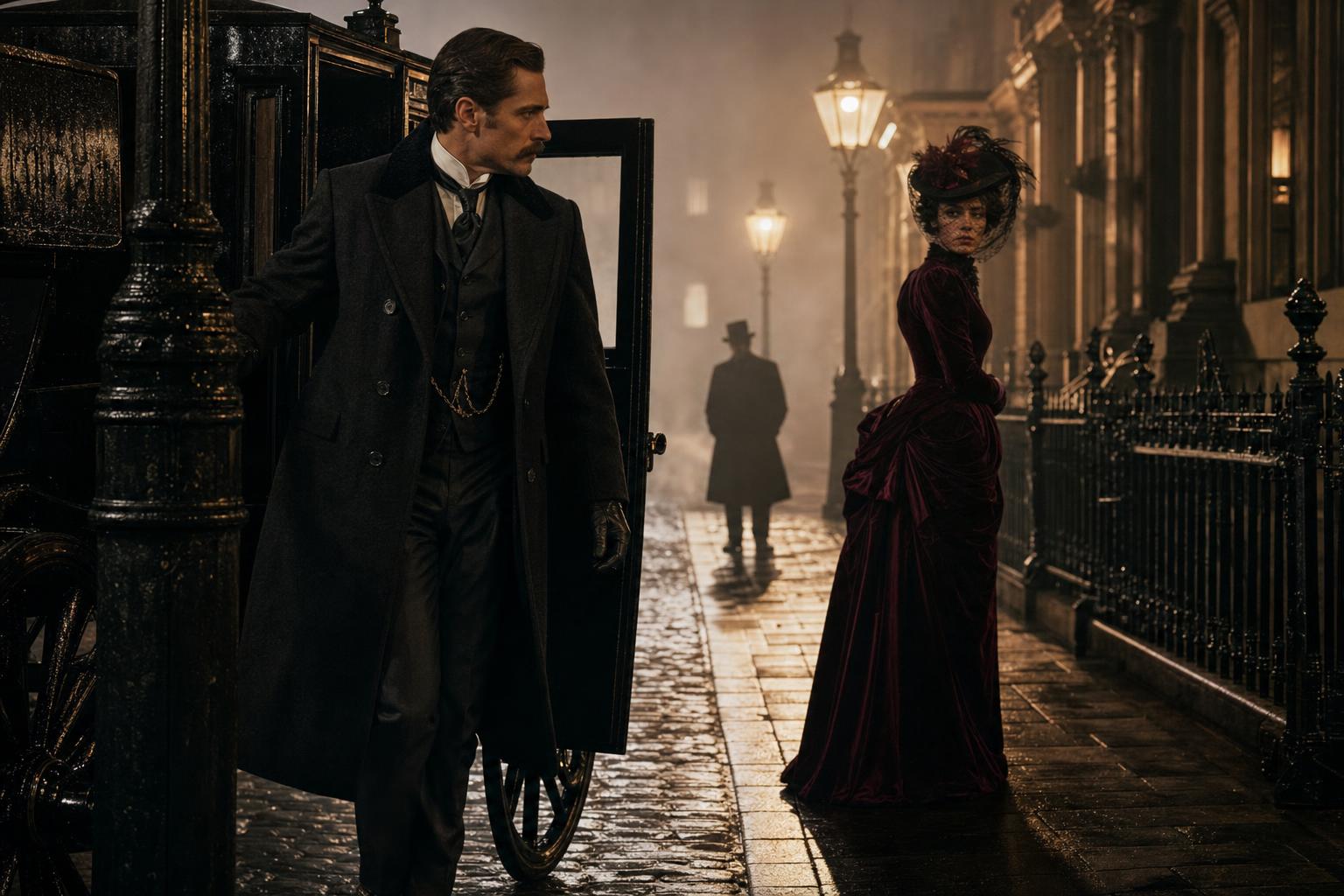
Introduction: Murder in the Fog
Victorian London was a city of striking contrasts, where glittering wealth stood only streets away from grinding poverty. Beneath the glow of gas lamps and the grandeur of imperial confidence, the capital carried a darker reputation. Fog-choked alleys, overcrowded tenements, and uneven policing created an atmosphere in which fear could spread quickly and justice could vanish just as fast. In a murder mystery set in this world, the city is never just a backdrop. It becomes an active force, shaping every clue, every witness, and every dangerous misstep.
A City Built for Secrets
By the late nineteenth century, London was the largest city in the world, with a population that exceeded 5 million by the 1890s. Such rapid growth brought opportunity, but it also produced confusion and anonymity. A person could disappear into Whitechapel, Clerkenwell, or Southwark with alarming ease. Crowded lodging houses, poorly lit streets, and maze-like courts made investigation difficult, especially after dark. The very scale of London protected criminals, while ordinary residents often learned to keep their heads down and ask few questions.
The Fog as More Than Weather
The famous London fog was not merely a poetic image. It was often thickened by coal smoke, creating the yellow-gray smog Victorians sometimes called “pea soup.” Visibility could drop so sharply that faces became shadows only a few feet away. For a killer, this offered perfect cover. For investigators, it distorted timelines, concealed movements, and made eyewitness testimony unreliable. In fiction and in history alike, fog symbolizes uncertainty, turning the city into a shifting stage where truth is always half hidden.
Murder, Fear, and Public Imagination
Victorian Britain was fascinated by violent crime. Newspaper circulation expanded dramatically during the century, and sensational reporting transformed local tragedies into public obsessions. Readers followed inquests, police statements, and whispered rumors with intense interest. Cases such as the Ratcliff Highway murders earlier in the century and the Whitechapel murders of 1888 showed how quickly homicide could grip the national imagination. Murder was not only a crime; it was a spectacle, exposing anxieties about class, morality, immigration, and the limits of modern law enforcement.
The Detective in a Divided Society
Any deadly case in the fog must also reckon with the era’s fragile systems of order. The Metropolitan Police, founded in 1829, was still evolving, and forensic science remained limited compared with modern standards. Detectives relied heavily on interviews, observation, informants, and instinct. Yet every investigation was shaped by Victorian social codes. Servants knew household secrets, aristocrats could bury scandals, and the poor were often treated as suspects before they were treated as victims. In such a world, solving a murder required more than intelligence. It demanded the courage to see through appearances.
Victorian London at Night
A City Transformed After Sunset
When darkness fell over Victorian London, the city became something altogether different from its daytime self. By the late nineteenth century, London was the largest city in the world, with a population that surpassed 5 million by the 1890s. Its streets, alleys, markets, and riverbanks did not simply go quiet at night; instead, they shifted into a more uncertain, theatrical, and often dangerous version of urban life. For anyone imagining a murder mystery set in this era, the nighttime city offered the perfect stage.
The contrast between wealth and poverty became especially stark after dusk. In the West End, gas lamps glowed outside gentlemen’s clubs, theaters, and elegant townhouses, casting a warm but limited light over polished carriages and well-dressed pedestrians. In the East End, however, many streets remained dim, crowded, and poorly maintained. Darkness pooled in courts and narrow lanes, where a person could vanish within seconds. This uneven geography of light and shadow shaped how Londoners experienced fear.
Fog, Smoke, and Gaslight
One of the most defining features of Victorian London at night was its atmosphere. The city’s infamous fog was often not natural mist alone but a mixture of moisture, coal smoke, and industrial pollution. These thick yellow-gray smogs, later nicknamed “pea-soupers,” could reduce visibility to only a few yards. In such conditions, even familiar streets became disorienting.
The Limits of Illumination
Gas lighting had spread widely across London during the nineteenth century and was considered a mark of modern progress. Yet gas lamps did not banish darkness as completely as electric lighting would later do. Their glow was localized and fragile, leaving long stretches of shadow between pools of light. A figure standing beneath a lamp might be clearly visible, while someone only a short distance away could remain almost invisible.
This mattered greatly in a city obsessed with crime. Witnesses often gave uncertain descriptions because they had seen a suspect only in partial light. Faces blurred, clothing colors became unreliable, and movement itself could be deceptive. In a murder mystery, this visual uncertainty creates natural tension, because what a character thinks they saw may not be what actually happened.
The Sounds and Movements of the Night
Victorian London after dark was far from silent. The city echoed with the rattle of carriage wheels, the cries of street sellers, the footsteps of policemen on their beats, and the distant whistles from the Thames. Public houses spilled noise into the streets, while music halls and late-night coffee stalls drew crowds from different social classes.
For working people, night was often still part of the laboring day. Market porters, dock workers, printers, factory hands, and servants might all be moving through the city at unusual hours. The Thames in particular remained active, with barges, ferries, and riverside commerce continuing long after sunset. This constant movement meant that London at night was crowded enough to feel alive, yet chaotic enough to conceal criminal acts.
Crime, Policing, and Public Anxiety
The Victorian period saw growing public fascination with urban crime. Newspapers eagerly reported murders, robberies, and scandals, often turning real neighborhoods into landscapes of dread. The Metropolitan Police, founded in 1829, had established a more organized presence by the later century, but policing such a vast city remained difficult. A constable on foot could only observe so much, especially in districts packed with lodging houses, alleys, and hidden yards.
The East End as a Setting of Fear
Areas such as Whitechapel became notorious in the public imagination, particularly after the Jack the Ripper murders of 1888. Whether fairly or not, the East End was portrayed as a labyrinth of vice, poverty, and menace. Overcrowding was severe; in some lodging houses, dozens of people slept in cramped, unsanitary rooms. Such conditions made anonymity easy and investigation difficult.
In narrative terms, Victorian London at night offers more than scenery. It provides motive, opportunity, and concealment all at once. Fog obscures the truth, gaslight distorts appearances, and the city’s social divisions ensure that some lives are protected while others are ignored. Within that darkness, every footstep, every shadow, and every unanswered cry becomes charged with suspicion.
The Crime Scene
A Street Swallowed by Fog
The crime scene lay in one of Victorian London’s countless narrow streets, where fog, soot, and gaslight turned ordinary corners into places of menace. In the late nineteenth century, London’s coal smoke frequently mixed with damp river air to create the infamous “pea-souper” fogs that could reduce visibility to only a few yards. Such conditions did more than shape atmosphere; they complicated policing, obscured witnesses, and preserved a criminal’s anonymity. On this particular night, the lane behind a row of lodging houses appeared almost theatrical in its stillness, with slick cobblestones reflecting the weak glow of a single lamp.
The victim had been discovered shortly after midnight by a carman returning from work. His first impression, according to the sort of testimony commonly recorded in metropolitan police reports of the era, was that he had stumbled upon a drunk sleeping in the road. Only when he drew closer did the darker truth emerge. The body rested near a brick wall, one arm bent awkwardly beneath the torso, hat several feet away, and coat collar turned up as if against the cold. There were no signs of a prolonged struggle in the immediate vicinity, yet the arrangement felt unnervingly deliberate, as though the killer had either acted with speed or known exactly how to avoid drawing attention.
What the Investigators Would Have Seen
Victorian detectives did not possess modern forensic science, but they were far from helpless. By the 1880s, the Metropolitan Police had developed increasingly methodical habits of observation, especially in murder cases. An experienced inspector would have noted the position of the body, the state of the clothing, the presence of mud, ash, blood, or torn fabric, and the location of any personal effects. In a city where thousands walked the same streets daily, small irregularities mattered enormously.
The Body and Its Position
The victim’s clothing suggested he was neither destitute nor wealthy. His boots were worn but serviceable, his waistcoat of decent cloth, and his watch chain conspicuously absent despite a faint impression where one had likely rested. That missing detail immediately raised a troubling question: was this a robbery, or had theft been staged to disguise a more personal motive? The wound itself, a deep injury just below the ribs, implied close contact. Knife violence was tragically familiar in Victorian urban crime, yet the precision of the strike hinted at either experience or determination.
There was surprisingly little blood spread across the stones. That fact could suggest the fatal blow had been delivered elsewhere, with the body moved after death, or that heavy outer garments had absorbed much of the bleeding before the corpse collapsed. Such distinctions were difficult to prove in the period, but sharp investigators often relied on practical reasoning. If blood pooled beneath the body, death likely occurred where the victim fell. If not, the lane might be only the final stage in a longer sequence of events.
The Surroundings
The wall beside the victim bore a fresh smear, dark against the brick, at shoulder height. Nearby, a broken clay pipe lay in two pieces, and one glove had been found in the gutter half-filled with rainwater. None of these objects alone solved anything, yet together they created a pattern of interruption. A man pausing to smoke, a sudden confrontation, a hand raised against the wall for balance or defense: the scene invited reconstruction.
Evidence in a Pre-Forensic Age
Without fingerprint databases, DNA analysis, or surveillance cameras, Victorian investigators depended heavily on material clues and human memory. That made the crime scene both precious and fragile. Curious onlookers, poorly controlled crowds, and even the boots of constables could contaminate evidence within minutes. Newspaper reports from the era often describe murder sites packed with spectators before sunrise, a reminder that public fascination frequently competed with police procedure.
Light, Weather, and Time
Weather shaped every interpretation. Fog muffled sound, while recent drizzle softened mud enough to preserve footprints, though only briefly. A partial boot mark near the curb may have belonged to the killer, the victim, or any passerby from the previous hour. Gas lamps cast uneven light, distorting color and depth. Even estimating the time of death was uncertain. Victorian doctors could examine body temperature, stiffness, and the condition of wounds, but such methods were imprecise, especially outdoors on a cold night.
The Social Meaning of the Scene
A murder in Victorian London was never just an isolated act; it exposed the tensions of a city approaching 5 million inhabitants by the 1890s. Overcrowding, poverty, casual labor, and stark class divisions shaped how crimes were committed and interpreted. A body in a respectable square suggested scandal. A body in a working-class alley risked being dismissed as routine brutality. That bias influenced witnesses, police urgency, and press coverage alike.
Why the Scene Matters
What makes this crime scene compelling is not merely its darkness or violence, but its layered uncertainty. Every object seems to point in two directions at once. The missing watch chain suggests theft, yet the careful wound suggests intent. The lack of chaos implies control, yet the broken pipe hints at surprise. In that fog-bound lane, the city itself becomes an accomplice, hiding truth behind smoke, silence, and shadow.
The Victim and Suspects
The Victim at the Center of the Case
Every compelling murder mystery begins with the victim, because the life that was lost often explains the danger that surrounded it. In this Victorian London case, the victim is Edmund Harrow, a 42-year-old solicitor with chambers near Chancery Lane and a townhouse in Bloomsbury. On paper, Harrow appeared respectable, prosperous, and well connected. He handled estate disputes, private contracts, and discreet financial arrangements for merchants, minor aristocrats, and ambitious businessmen. In 1888, a successful London solicitor could earn between £300 and £1,000 a year, placing Harrow comfortably within the professional middle class. That status gave him influence, but it also exposed him to secrets many men would pay to protect.
Harrow’s body was discovered shortly after midnight in a narrow passage off Holborn, an area where commerce, legal business, and crowded lodging houses met under the constant haze of coal smoke and fog. He had attended a private supper earlier that evening and was last seen leaving alone, though witnesses disagreed about whether he appeared calm or preoccupied. His pocket watch remained on his person, and a small amount of cash was untouched, suggesting that robbery was not the primary motive. More telling was the absence of his leather document case, which clerks said he rarely allowed out of reach.
A Respectable Man with Dangerous Knowledge
To his colleagues, Harrow was methodical and discreet. To those who knew him less well, he could seem cold, even severe. Victorian professional culture prized restraint, and men in Harrow’s position often built reputations on silence. Yet silence can be valuable for the wrong reasons. Records from the period show that legal professionals frequently acted as intermediaries in matters involving debt, inheritance, and private scandal. In a city of more than 4 million people by the late nineteenth century, anonymity and proximity existed side by side, making London fertile ground for blackmail, hidden alliances, and quiet ruin.
The Secrets He May Have Carried
Several details make Harrow a particularly provocative victim. First, he had recently taken possession of papers linked to a contested inheritance involving a wealthy widow and her late husband’s estranged relatives. Second, one clerk reported that Harrow had received three agitated visitors in the week before his death, each refusing to leave a name. Third, his housekeeper stated that he had begun locking his study door even during the day, an unusual habit in a respectable household dependent on servants’ routine access. These facts suggest not merely professional pressure, but fear.
The Circle of Suspects
Because Harrow moved between legal, commercial, and social worlds, the suspect pool is broad. That complexity is typical of Victorian crime narratives, where class boundaries were rigid in theory but constantly crossed in practice. A gentleman could owe money to a tradesman, a servant could overhear a family secret, and a business partner could become a mortal enemy overnight.
Suspect One: The Business Rival
The first major suspect is Nathaniel Price, a rival solicitor known for aggressive tactics and questionable ethics. Price had recently lost a lucrative probate case to Harrow, and witnesses described a heated argument between the two men at the Inns of Court only days before the murder. Professional rivalry in Victorian London was no small matter. Legal disputes over estates could involve thousands of pounds, and reputation was often worth as much as the fee itself. If Harrow possessed documents capable of exposing Price’s misconduct, motive becomes stronger than wounded pride.
Why He Draws Attention
Price had the means, the intelligence, and a clear grievance. He also understood exactly what papers Harrow might have been carrying and why they mattered. However, his social visibility may work against the theory of direct involvement. Men of his class often preferred hired intermediaries to personal violence.
Suspect Two: The Grieving Widow
The second suspect is Mrs. Eleanor Wainwright, the widow connected to Harrow’s most sensitive inheritance case. Publicly, she presented herself as a dignified woman defending her late husband’s wishes. Privately, rumors suggested she feared the emergence of letters that could damage both her claim and her reputation. In Victorian society, a widow’s legal and social position could be precarious despite outward respectability. Scandal could destroy marriage prospects for daughters, weaken property claims, and invite relentless gossip.
Mrs. Wainwright had met Harrow twice in the days before his death. According to a servant, one meeting ended with raised voices. If Harrow intended to reveal information she believed should remain buried, she had reason to stop him. Whether that reason extended to murder remains uncertain.
Suspect Three: The Disgraced Clerk
A more intimate suspect is Thomas Bell, Harrow’s former clerk, dismissed six months earlier for irregularities in account books. Bell knew Harrow’s routines, clients, and habits better than almost anyone. He also knew the city’s back passages, taverns, and cheap lodgings where a desperate man could disappear. Clerks occupied an unstable social position: educated enough to understand power, but often poorly paid and vulnerable to debt. In late Victorian London, many lower-middle-class workers lived one missed wage packet away from collapse.
Means and Opportunity
Bell had both personal resentment and practical opportunity. He could have known about the missing document case, anticipated Harrow’s route, and approached him without causing alarm. Unlike the more respectable suspects, Bell fits the physical circumstances of the crime more naturally.
Suspect Four: The Unknown Blackmailer
Finally, there is the most unsettling possibility: Harrow was killed by someone still unnamed, a figure tied to the hidden economy of blackmail that thrived in Victorian cities. Historians have noted that blackmail flourished where reputation carried enormous value and private behavior could mean public destruction. If Harrow held letters, contracts, or testimony capable of ruining a client, a marriage, or a business concern, then the missing case may be the true victim’s shadow. In that reading, Harrow was not simply a man attacked in the fog, but the keeper of evidence someone could not afford to let survive.
The Detective’s Investigation
Entering the Fog of Victorian London
The investigation begins in a city built for secrets. Victorian London in the late nineteenth century was the largest city in the world, with a population that passed 5 million by the 1890s. Its crowded alleys, gaslit streets, and thick industrial fog created ideal conditions for crime and confusion. For a detective, every case was shaped not only by the victim and the suspect, but also by the city itself. In a murder mystery set against this backdrop, the investigator must work through social divisions, unreliable witnesses, and limited forensic science while trying to separate rumor from fact.
The detective’s first task is to secure the scene and establish a timeline. In a London murder case, this is rarely simple. Streets remained active late into the night, and many residents lived in close quarters, meaning several people may have heard a cry, seen a shadow, or noticed a stranger. Yet witness statements often conflict. One person may swear the victim was last seen at ten o’clock, while another insists it was closer to midnight. The detective must compare these accounts with physical evidence, weather conditions, and the routines of the neighborhood.
Reading the Crime Scene
A skilled detective in Victorian London relies on observation above all else. Before modern crime scene units existed, investigators had to notice details that others dismissed. Mud on a boot, ash on a sleeve, or a torn glove caught on a fence could become crucial clues. The crime scene is not merely a location; it is a silent witness. Every object, stain, and disturbance may reveal movement, motive, or method.
Physical Clues and Their Meaning
Blood patterns, though not yet studied with modern precision, could still suggest whether a victim was attacked suddenly or after a struggle. A broken watch might indicate the approximate time of the assault. A missing purse could point toward robbery, but an untouched wallet might suggest revenge, blackmail, or personal hatred. In Victorian investigations, detectives also paid close attention to clothing. Fine fabric, repaired cuffs, or monogrammed accessories could reveal class, occupation, and social connections.
A detective would also examine the victim’s hands. Ink stains might suggest clerical work, calluses could indicate manual labor, and defensive wounds might prove the victim knew the attacker. These details matter because London’s rigid class structure influenced every relationship. A servant’s murder in Whitechapel would be investigated differently from the death of a gentleman in Mayfair, even if the evidence demanded equal seriousness.
The Role of Early Forensics
Victorian detectives worked at a fascinating turning point in criminal investigation. Scientific policing was emerging, but many methods remained inconsistent. Fingerprinting was not widely adopted in Britain until the early twentieth century, though anthropometric measurement and careful record keeping were gaining importance. Toxicology, however, had already become valuable. Arsenic, opium, and laudanum were common enough to make poisoning a realistic and terrifying possibility.
Medical Evidence and the Post-Mortem
The post-mortem examination often provides the detective with the first dependable facts. A doctor could estimate time of death by body temperature, stiffness, and stomach contents, though these estimates were less exact than modern readers might expect. Even so, medical testimony could narrow a window from several hours to one or two, which might eliminate or implicate a suspect.
Limits of Science
Science in this era could illuminate a case, but it could also mislead. Contamination was common because scenes were not sealed with modern rigor. Curious neighbors, constables, and even reporters might enter before evidence was preserved. Chemical tests existed, yet false assumptions remained a danger. The detective therefore cannot depend entirely on laboratory certainty. Reasoning must bridge the gap between what science suggests and what the facts can truly support.
Interviewing Witnesses and Suspects
No investigation advances without conversation. In Victorian London, interviewing witnesses required patience and social intelligence. People feared the police, distrusted authority, or worried that speaking openly would damage their reputation. Women in particular risked scandal if their names became linked to a murder inquiry, while working-class witnesses might fear losing wages if repeatedly summoned for questioning.
The detective must therefore listen for more than words. Hesitation, overconfidence, and selective memory all matter. A witness who recalls the color of a stranger’s scarf but forgets the direction he walked may be hiding something, or simply embellishing. A suspect who answers every question too smoothly may have rehearsed a story. The best investigators understand that lies are rarely flawless. They crack under repetition, contradiction, and detail.
Following Motive Through Society
Murder in a Victorian mystery is rarely random. The detective traces motive through money, inheritance, romance, and reputation. London’s expanding middle class created new opportunities for fraud and ambition, while strict moral codes made private scandals especially dangerous. An affair, an illegitimate child, gambling debts, or forged documents could destroy a family’s standing overnight.
Hidden Networks
The investigation often widens from one body to an entire network of secrets. A housemaid may know her employer’s habits better than his friends do. A pawnbroker may recognize stolen jewelry. A cab driver may remember an unusual fare. Detectives in this period depended heavily on such informal intelligence, especially in districts where official policing had limited reach. The Metropolitan Police, founded in 1829, had transformed urban law enforcement, but detectives still needed local knowledge to navigate neighborhoods shaped by poverty, vice, and silence.
Building the Case
As evidence accumulates, the detective’s challenge is to assemble a coherent narrative. Each clue must fit not only the theory of the crime but also the practical realities of time, place, and behavior. Could the suspect have crossed the city quickly enough? Would a respectable banker really visit that alley after midnight? Why was a letter burned but not destroyed completely? A convincing case emerges when physical evidence, witness testimony, and motive reinforce one another.
The Final Pressure Point
Before an arrest, the detective often seeks one final test. This may be a reconstructed timeline, a confrontation between suspects, or the revelation of a hidden document. In fiction as in history, confessions were powerful but not always reliable, especially under pressure. What matters most is whether the investigator can expose the contradiction at the heart of the crime, the single fact the murderer believed would remain buried in the fog
Secrets, Motives, and Red Herrings
In any compelling Victorian murder mystery, secrets are the true currency of suspense. Fog may conceal a killer’s footsteps, but hidden relationships, financial pressures, and private shames are what give a crime its emotional force. In a setting like Victorian London, where class divisions were rigid and public respectability mattered intensely, almost every character has something to protect. That social pressure makes the era especially fertile ground for tangled motives and misleading clues.
Why Secrets Matter in a Victorian Mystery
Secrets do more than decorate the plot; they shape the investigation itself. A housemaid may hide a pregnancy, a solicitor may conceal forged documents, and a gentleman may suppress gambling debts that threaten his family name. None of these secrets necessarily make a person a murderer, yet each one creates suspicion. The detective’s challenge is not simply to uncover what people hide, but to determine which hidden truth actually connects to the crime.
Victorian society was built on appearances. According to historical studies of nineteenth-century Britain, domestic service was one of the largest employment sectors, and many servants lived under strict expectations of obedience and silence. At the same time, the middle and upper classes depended heavily on reputation. A whisper of scandal could ruin marriage prospects, business arrangements, or political ambitions. That means even innocent characters often lie, not because they killed, but because exposure would still destroy them.
Building Credible Motives
A strong motive feels personal, plausible, and rooted in the world of the story. In Victorian London, motives often emerge from a mix of economic vulnerability and social constraint. Money was frequently tied to inheritance, property law, and male authority, while women in particular had fewer legal and financial protections for much of the century. These realities create believable tensions that can escalate into violence.
Financial Desperation
Debt is one of the most effective motives in a period mystery. London in the nineteenth century was a city of immense wealth and severe poverty existing side by side. A clerk embezzling funds, a widow facing eviction, or an aristocrat drowning in unpaid wagers all have reasons to manipulate, deceive, or panic. Financial motive works best when it is specific. A vague need for money is less convincing than a looming deadline, a blackmailer’s demand, or a contested will due to be read the next morning.
Social Survival
Not every motive is about profit. Sometimes the greater threat is disgrace. An affair, an illegitimate child, a forged academic credential, or a hidden criminal past can be enough to drive desperate action. In a society obsessed with moral respectability, preserving one’s place could feel as urgent as preserving one’s life. This is especially effective when the suspect’s fear is understandable, even if their choices are not.
Revenge and Resentment
Victorian households and businesses were deeply hierarchical, which makes resentment a natural source of motive. A dismissed governess, an underpaid assistant, or a relative cut out of a legacy may carry years of humiliation beneath a calm exterior. These motives resonate because they are emotional rather than merely practical. Readers recognize that murder mysteries become richer when the crime grows from old wounds instead of sudden impulse alone.
The Art of the Red Herring
A red herring is a misleading clue that draws attention away from the truth. Used well, it creates tension and surprise. Used poorly, it feels like cheating. The key is fairness. A good red herring must make sense within the character’s life, even after the real solution is revealed.
For example, if a bloodstained glove is found in a maid’s room, the obvious implication is guilt. But the truth may be that she discovered the body first, touched evidence in panic, and hid the glove because she feared dismissal. The clue misleads the detective and the reader, yet remains psychologically credible. That is what makes the deception satisfying rather than arbitrary.
Balancing Suspicion Among Characters
An effective mystery spreads suspicion widely without making every character equally dramatic. Variation is essential. One suspect may act evasively because he is protecting a brother. Another may appear cooperative while quietly altering correspondence. A third may seem cold simply because grief affects her differently. These distinctions prevent the cast from blending together and help each false lead feel distinct.
Layering Clues and Counterclues
The best red herrings are paired with partial truths. A suspect should have a reason to lie, but not necessarily about the murder itself. This creates a layered structure in which each revelation answers one question while raising another. The reader learns that the victim was being blackmailed, then discovers the blackmailer was not the killer, then realizes the blackmail concealed an entirely different crime. Such sequencing keeps momentum high and encourages active reader participation.
Using Setting as Misdirection
Victorian London itself can function as a red herring. Dense fog, crowded streets, unreliable gaslight, and labyrinthine alleys all distort perception. Witnesses misidentify strangers, carriage times are misremembered, and sounds travel strangely through narrow courts and row houses. Historical London was noisy, polluted, and unevenly lit, especially before widespread electric lighting in the late nineteenth century. Those conditions make mistaken testimony believable and allow the environment to deepen uncertainty without replacing solid plotting.
Making the Reader Doubt the Obvious
The most memorable mysteries encourage readers to question their first assumptions. A respectable doctor may seem trustworthy because of his profession. A nervous servant may seem guilty because of her fear. Yet Victorian fiction and history alike remind us that status often masks corruption, while vulnerability can resemble deceit. The interplay of secrets, motives, and red herrings works best when every revelation changes not just what happened, but what the reader believes about the people involved.
When these elements are carefully woven together, the murder mystery becomes more than a puzzle. It becomes a portrait of a society where silence protects power, appearances conceal danger, and every whispered lie leaves a trace in the fog.
The Final Reveal
Unmasking the Killer
After pages of false leads, whispered alibis, and gaslit streets, the final reveal must feel both shocking and inevitable. In a Victorian London murder mystery, that balance is especially important because the setting itself encourages suspicion. Fog conceals faces, class divisions distort testimony, and the era’s limited forensic science leaves room for intuition, observation, and manipulation. The best reveal does not simply name the murderer; it reorders everything the reader thought they understood about the crime.
In Victorian London Murder Mystery: A Deadly Case in the Fog, the reveal should draw together every clue planted earlier, from a misplaced glove to a contradictory train schedule. Victorian readers and modern audiences alike respond to revelations that reward attention. A hidden inheritance, a forged letter, or a servant who moved too quietly through the household can all become decisive once the detective exposes their true significance. What matters is that the solution emerges from evidence rather than coincidence.
Why the Reveal Matters
A strong ending transforms the entire narrative. According to common mystery-writing principles established by authors such as Wilkie Collins and later refined by Agatha Christie, the detective’s final explanation works best when the reader can look back and see that the truth was always present. Fair play is essential. If the killer is revealed through information withheld until the last page, the ending may surprise, but it rarely satisfies.
Victorian mysteries are particularly suited to layered reveals because social respectability often hides corruption. A philanthropist may be a blackmailer. A grieving widow may be protecting a family scandal. A police inspector may overlook evidence because of class prejudice. These tensions allow the final scene to expose not only the murderer, but also the fragile moral structure of the world surrounding them.
Building Tension in the Last Scene
The setting of the reveal should heighten drama while reflecting the novel’s themes. A candlelit drawing room, a church crypt, or a fogbound railway platform can all serve as memorable stages for confrontation. In 19th-century fiction, enclosed spaces were often used to intensify suspense, forcing suspects into close proximity while the detective dismantled each lie. Atmosphere becomes part of the logic, not just decoration.
The detective’s method also shapes the impact. Some sleuths reveal the truth through calm reconstruction, laying out the timeline with surgical precision. Others provoke the killer into confession by exposing a single emotional weakness, such as jealousy, greed, or fear of disgrace. In Victorian society, where reputation could determine survival, the threat of public exposure was often as powerful as physical evidence.
The Emotional Payoff
A memorable final reveal should answer more than the question of who committed the murder. It should also explain why the crime happened and what it cost everyone involved. Murder in Victorian fiction was rarely random; it grew from inheritance disputes, social ambition, romantic betrayal, or desperation caused by poverty. By grounding the killer’s motive in the realities of the era, the story gains depth and credibility.
The emotional effect is strongest when the revelation alters the reader’s understanding of key relationships. The trusted friend may have engineered the crime. The apparent villain may have been protecting someone else. The victim, too, may be revealed as morally compromised, complicating any simple sense of justice. In that moment, the fog lifts, and London appears not cleaner, but clearer.
Conclusion: Justice in the Shadows
The Case Beneath the Fog
In the end, Victorian London Murder Mystery: A Deadly Case in the Fog reveals more than a single crime. It exposes a city shaped by contradiction, where elegance and poverty stood only streets apart, and where justice often depended as much on class, influence, and timing as on evidence. The murder at the heart of this story becomes a lens through which readers can see the wider machinery of nineteenth-century London: the dim gaslit alleys, the anxious public, and the fragile trust placed in investigators working without modern forensic science.
What the Investigation Truly Uncovered
Crime, Society, and Silence
As the clues gathered and suspicions narrowed, the mystery demonstrated how violence in Victorian London rarely existed in isolation. Historical records show that by the late nineteenth century, London had grown into a metropolis of more than 4 million people, creating overcrowded districts where anonymity could shield both victim and killer. In such an environment, witnesses were unreliable, rumors spread quickly, and official inquiries were often slowed by fear or social pressure. The shadows in this case were not only physical; they were institutional and cultural as well.
The investigation also highlights the limitations and strengths of the era’s detectives. Without DNA analysis, surveillance footage, or computerized records, they relied on observation, interviews, timelines, and intuition. That dependence on human judgment made every overlooked detail significant. A misplaced glove, an inconsistent statement, or a delayed carriage could alter the entire direction of the case.
Why the Mystery Endures
What makes this tale compelling is not simply the identity of the murderer, but the unsettling realization that justice was never guaranteed. It had to be pursued through fog, deception, and deeply rooted inequality. That tension gives the story its lasting power. Readers are left with the sense that solving the crime was only part of the battle; understanding the world that allowed it to happen was equally important.
From here, the lingering questions around motive, morality, and memory invite a deeper look at how Victorian crime stories continue to shape modern fascination with darkness, detection, and truth.
FAQ: Victorian Murder Mysteries
What makes Victorian murder mysteries so compelling?
Victorian murder mysteries fascinate readers because they combine social history, urban danger, and psychological suspense in a setting that feels both elegant and threatening. Nineteenth-century London was the world’s largest city by 1900, with more than 6 million residents, and that scale created anonymity, overcrowding, and fear. Foggy streets, gaslight, horse-drawn cabs, and rigid class divisions gave crime stories a dramatic backdrop that still feels distinctive today.
Were Victorian murder investigations really as limited as fiction suggests?
In many ways, yes. Detectives worked without modern DNA testing, digital records, or surveillance cameras, so they relied heavily on witness statements, physical observation, and local knowledge. However, policing was becoming more organized. The Metropolitan Police had been founded in 1829, and the Criminal Investigation Department followed in 1878. That means a believable Victorian mystery should show both investigative limitations and growing professional methods, rather than portraying detectives as either helpless or fully modern.
What forensic methods existed?
Victorian investigators used early forensic techniques such as handwriting comparison, examination of footprints, analysis of bloodstains, and post-mortem medical reports. Fingerprinting only began gaining official acceptance in Britain near the end of the nineteenth century, with police use expanding after 1901. Poison detection also improved during the era, especially in arsenic cases, which appeared frequently in sensational trials and newspaper reports.
Why is Jack the Ripper so often linked to the genre?
The 1888 Whitechapel murders became one of the most famous criminal cases in history because they combined media frenzy, public panic, and unsolved brutality. Newspapers helped transform the killer into a mythic figure, and that legacy shaped later fiction. Still, Victorian murder mysteries are much broader than Ripper-inspired stories. Many focus on domestic secrets, inheritance disputes, blackmail, or crimes hidden behind respectable appearances.
How can a Victorian mystery feel authentic?
Authenticity comes from accurate social detail as much as crime plotting. Dialogue, class behavior, gender expectations, and neighborhood differences all matter. A wealthy Mayfair drawing room should feel very different from a Whitechapel lodging house. Strong stories also reflect real Victorian concerns, including poverty, empire, morality, and scientific change, allowing the mystery to emerge naturally from the world around it.
Did the public really follow murder cases closely?
Absolutely. Sensational trials filled newspapers, penny publications, and public conversation. Murder was not just criminal news; it was also entertainment, moral warning, and social commentary.


