

Introduction to the Whodunit
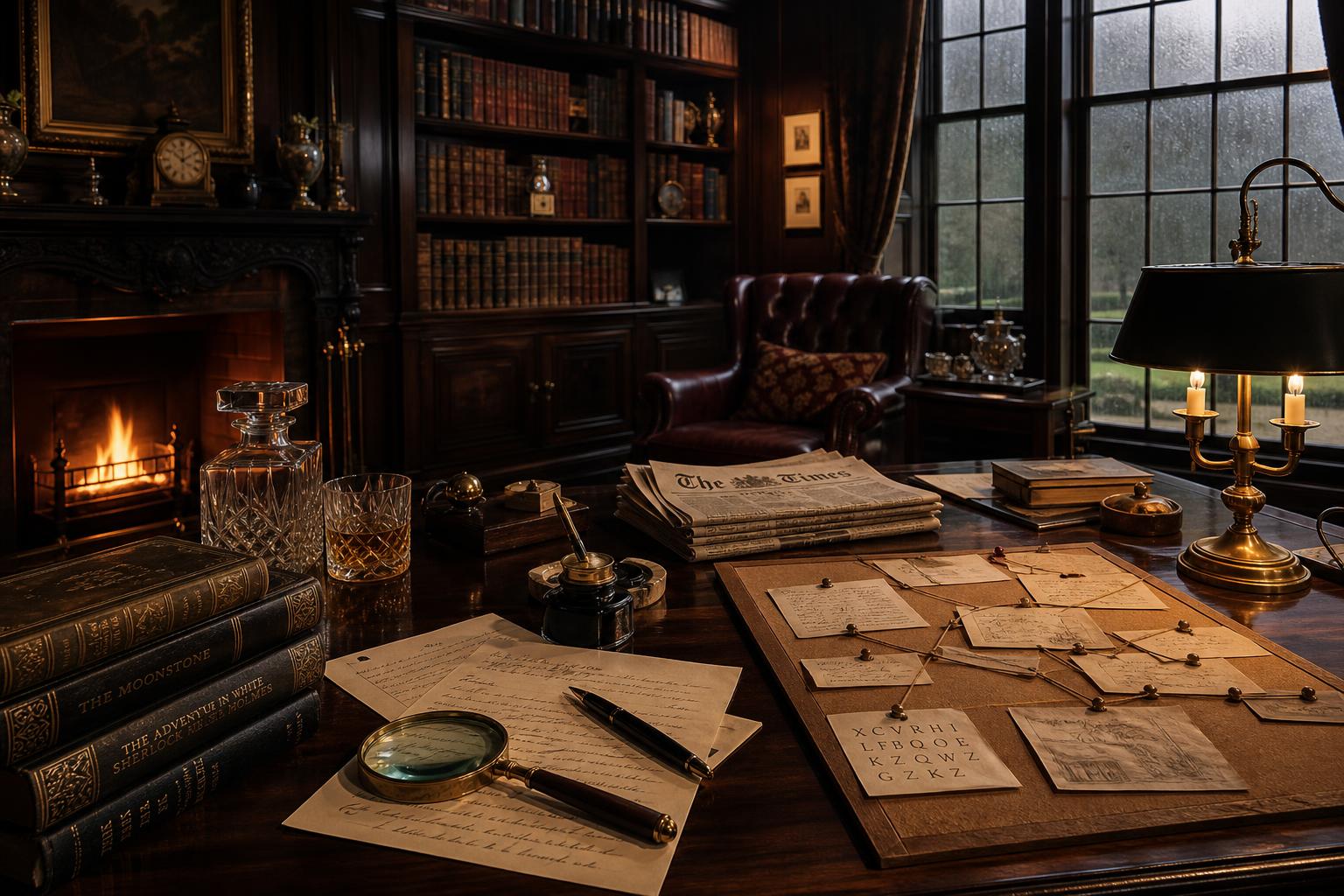
The whodunit is one of the most enduring forms of popular storytelling, built around a simple but irresistible question: who committed the crime? In this kind of mystery, the reader is invited to follow clues, weigh motives, and test suspicions alongside a detective or investigator. The pleasure comes not only from the final revelation, but from the intellectual game that unfolds along the way. For generations, that puzzle-like structure has made the whodunit a defining branch of crime fiction.
What Makes a Whodunit Distinct
At its core, a whodunit is a narrative organized around deduction, concealment, and revelation. A serious crime, usually murder, disrupts ordinary life. A limited cast of suspects is introduced, each with possible motives, secrets, or opportunities. The story then proceeds through interviews, physical evidence, false leads, and carefully placed clues until the truth is uncovered. Unlike thrillers, which often emphasize danger and speed, the classic whodunit focuses on reasoning and fair play.
The Puzzle at the Center
The genre’s identity depends on the mystery functioning as a solvable puzzle. Readers expect that the author has provided enough information to make the answer possible, even if difficult. This “fair play” principle became especially important in the late nineteenth and early twentieth centuries, when detective fiction grew into a recognizable literary form. The best whodunits reward close attention, making seemingly minor details suddenly significant in hindsight.
Why Readers Are Drawn to It
Part of the whodunit’s appeal lies in its balance between disorder and resolution. Murder introduces fear, uncertainty, and moral disruption, but the investigation promises that truth can still be found. That structure offers a sense of control that many readers find satisfying. Scholars of crime fiction often note that detective stories became especially popular during periods of rapid social change, when readers were drawn to narratives in which logic could restore order.
More Than a Murder Story
A whodunit is rarely just about the crime itself. It also reveals the tensions of the world around it, including class divisions, family rivalries, inheritance disputes, and hidden identities. In works by writers such as Edgar Allan Poe, Wilkie Collins, Arthur Conan Doyle, and later Agatha Christie, the mystery becomes a way to explore how people behave under pressure and how appearances can deceive.
A Genre with Deep Roots
Although the term “whodunit” became common much later, the storytelling instinct behind it is older than the modern novel. Tales involving secrets, accusations, and the gradual uncovering of guilt appear in folklore, drama, and early prose fiction. The modern whodunit emerged when those older narrative instincts combined with structured investigation, memorable detectives, and a stronger emphasis on clue-based plotting. Understanding that evolution is essential to tracing who truly invented the murder mystery puzzle.
Before Detective Fiction
Crime, Curiosity, and the Prehistory of the Puzzle
Long before Sherlock Holmes, Hercule Poirot, or Miss Marple, readers were already fascinated by stories of crime, hidden motives, and the search for truth. Detective fiction did not appear out of nowhere in the nineteenth century. It grew from much older traditions in literature, law, religion, and folklore that taught audiences to enjoy mystery, interpret clues, and weigh competing explanations. The whodunit, as a formal genre, would come later, but its essential ingredients were already taking shape centuries earlier.
In ancient and medieval storytelling, crimes often appeared as moral tests rather than intellectual puzzles. Biblical narratives, Greek tragedies, and classical histories frequently turned on acts of violence, betrayal, or deception. Sophocles’ Oedipus Rex, first performed around 429 BCE, is often cited as an important precursor because it centers on an investigation into a murder and the gradual revelation of a hidden truth. Although it is not a detective story in the modern sense, it demonstrates a structure that later mystery writers would refine: a past crime, a determined seeker, and a final disclosure that reorders everything the audience thought it knew.
Early Investigators in Literature
By the early modern period, writers had begun experimenting more directly with investigation. In some tales from the Arabic, Chinese, and European traditions, clever judges, magistrates, or officials solved crimes through observation and reasoning. One especially significant example is the Chinese gong’an tradition, or courtroom fiction, which flourished during the Ming and Qing dynasties. These stories featured magistrates such as Judge Dee or Judge Bao, who interrogated suspects, uncovered conspiracies, and restored social order. Their methods mixed logic, intuition, and official authority, creating narratives that strongly resemble later detective plots.
The Role of Judge Dee
Judge Dee became especially influential in the West through twentieth-century translations and adaptations by Robert van Gulik, but the original stories are much older. They often revealed the criminal early, unlike the classic whodunit, yet they still emphasized evidence, motive, and reconstruction of events. This distinction matters because it shows that detective fiction evolved gradually. The pleasure of solving a crime could come either from identifying the culprit or from understanding how justice would expose them.
Real Crime and Public Appetite
Another major influence came from nonfiction. In seventeenth- and eighteenth-century Europe, printed pamphlets, trial reports, and sensational accounts of murders became widely popular. As literacy expanded and printing costs fell, readers consumed stories based on real crimes with intense interest. The Newgate Calendar in Britain, first developed in the eighteenth century, collected biographies of criminals and reports of executions. These publications blended fact, moral warning, and entertainment, helping create a public appetite for criminal narratives.
From Sensation to Structure
What these early crime accounts often lacked in formal puzzle design, they made up for in suspense and detail. Readers learned to pay attention to testimony, alibis, and circumstantial evidence. That habit of close reading would become central to detective fiction, where every object, statement, and timeline detail might matter. By the time Edgar Allan Poe introduced C. Auguste Dupin in “The Murders in the Rue Morgue” in 1841, audiences were already prepared to appreciate crime not just as tragedy or scandal, but as a problem to be solved.
Poe and the First Detective
The Birth of a New Literary Mind
When readers ask who invented the modern detective, the answer almost always leads to Edgar Allan Poe. Long before Sherlock Holmes, Hercule Poirot, or Miss Marple, Poe created a character who approached crime as an intellectual puzzle rather than a simple act of violence. In doing so, he helped establish the core structure of the murder mystery and laid the foundation for the whodunit as a recognizable genre.
Poe’s importance rests largely on three stories published in the 1840s: The Murders in the Rue Morgue in 1841, The Mystery of Marie Rogêt in 1842 to 1843, and The Purloined Letter in 1844. Together, these tales introduced methods, character types, and narrative patterns that would shape detective fiction for nearly two centuries. Although crime stories existed before Poe, they usually focused on criminals, sensational violence, or moral lessons. Poe shifted attention to analysis, deduction, and the pleasure of solving.
C. Auguste Dupin: The Prototype Detective
At the center of Poe’s innovation stands C. Auguste Dupin, a Parisian gentleman with an extraordinary analytical mind. Dupin is widely regarded as the first true fictional detective. He is not a police officer, nor is he driven by official duty. Instead, he investigates because he enjoys the challenge of untangling what appears impossible. That detail became essential to later detectives, many of whom stand partly outside formal institutions and succeed where authorities fail.
Dupin’s methods introduced several conventions that became standard in mystery fiction. He studies physical evidence, reconstructs motives, and pays close attention to what others overlook. More importantly, Poe presents detection as a form of reasoning. Dupin calls this process “ratiocination,” a term that emphasizes logical inference over guesswork. In The Murders in the Rue Morgue, he solves a brutal double murder that has baffled the Paris police, proving that intellect can penetrate even the most chaotic crime scene.
The Brilliant Amateur and the Admiring Narrator
Another major innovation appears in the relationship between Dupin and the unnamed narrator who accompanies him. This narrator is intelligent enough to appreciate Dupin’s genius but not brilliant enough to match it. That structure later reappears in famous pairings such as Holmes and Watson. It serves an important purpose: the narrator represents the reader, observing the detective’s unusual habits and gradually revealing the logic behind the solution.
By filtering the mystery through this companion, Poe creates suspense while preserving the detective’s aura of superiority. Readers are invited to solve the case, yet they are also meant to admire the detective’s mental precision. This balance between fair clues and dramatic revelation became one of the defining pleasures of classic whodunits.
“The Murders in the Rue Morgue” and the Locked-Room Puzzle
Poe’s most influential detective story is often called the first modern detective tale. The Murders in the Rue Morgue introduced the locked-room mystery, one of the genre’s most enduring forms. In the story, two women are found murdered in a room apparently sealed from the inside. Witnesses report strange voices, contradictory details, and impossible circumstances. The case seems supernatural until Dupin demonstrates that the answer, while bizarre, is entirely rational.
This was a crucial breakthrough. Poe showed that mystery fiction could thrive on the tension between the impossible appearance of a crime and its logical explanation. That formula became central to later puzzle-based mysteries, especially during the so-called Golden Age of detective fiction in the 1920s and 1930s.
From Sensation to Structure
Poe also helped define the architecture of detective storytelling. A baffling crime is presented early. The official investigators make little progress. The detective gathers facts, often quietly and independently. Finally, the detective explains the solution in a climactic reconstruction. This pattern still underlies countless novels, television series, and films.
Poe’s Lasting Influence on the Whodunit
Writers across generations borrowed from Poe, whether directly or indirectly. Arthur Conan Doyle acknowledged Poe’s influence when creating Sherlock Holmes, even though Holmes sometimes criticizes Dupin. Later authors such as Agatha Christie, Dorothy L. Sayers, and G. K. Chesterton expanded the form, but they inherited Poe’s central insight: murder mystery works best when crime becomes a test of reason.
Poe’s detective fiction also connected mystery to urban modernity. Newspapers, public fascination with violent crime, and growing police systems all shaped his stories. In The Mystery of Marie Rogêt, Poe even based the plot on a real unsolved New York case, transforming current events into analytical fiction. That blending of realism and puzzle gave the genre unusual power.
By inventing the detective as a thinker, Poe changed crime writing permanently. He did not simply write about murder; he taught readers to see murder as a problem that could be solved through observation, logic, and imagination.
Wilkie Collins and Sensation Fiction
A Pioneer of Suspense in Victorian Fiction
Before detective fiction fully emerged as a distinct genre, Wilkie Collins helped create the narrative machinery that made the modern whodunit possible. Writing in the mid-nineteenth century, Collins became one of the leading figures of sensation fiction, a popular Victorian form that blended domestic life with crime, secrecy, madness, and shocking revelations. His novels showed readers that mystery did not need to unfold in castles or distant landscapes; it could erupt inside respectable homes, among seemingly ordinary families, and behind the polished surface of middle-class society.
Sensation fiction flourished particularly in the 1860s, when serialized novels reached large audiences through magazines and weekly publications. Collins understood how to exploit serialization brilliantly. He used cliffhangers, withheld information, and shifting testimony to keep readers in suspense from installment to installment. This structure trained audiences to read actively, to speculate about motives, and to search for clues, habits that would later become central to detective and mystery fiction.
The Woman in White and the Architecture of Suspense
Collins’s 1859 novel The Woman in White is often cited as one of the defining works of sensation fiction. The novel opens with an eerie nighttime encounter and quickly develops into a tale of identity theft, conspiracy, wrongful confinement, and hidden inheritance. Its power lies not simply in its plot twists, but in the way Collins organizes information. Rather than presenting a single authoritative narrator, he constructs the story through multiple voices, including letters, statements, and personal accounts.
Multiperspectival Storytelling
This method was highly influential. By allowing different characters to narrate parts of the story, Collins created competing versions of truth. Readers had to compare accounts, notice contradictions, and judge reliability. This resembles the logic of later detective fiction, where testimony is rarely straightforward and every perspective may conceal something important. In this sense, Collins helped transform readers into investigators.
The Moonstone and the Birth of the Detective Novel
If The Woman in White established Collins as a master of suspense, The Moonstone (1868) brought him even closer to the modern murder mystery tradition. Frequently described as one of the first English detective novels, The Moonstone centers on the theft of a valuable diamond from a country house. The novel includes many features that would become genre staples: a country-house setting, a limited circle of suspects, red herrings, concealed motives, and a methodical investigation.
Sergeant Cuff and Investigative Logic
The character of Sergeant Cuff is especially important in literary history. Calm, observant, and analytical, he anticipates later fictional detectives such as Sherlock Holmes and Hercule Poirot. Rather than relying on brute force or coincidence, Cuff studies behavior, asks precise questions, and follows physical evidence. His presence marks a shift from melodramatic revelation toward structured detection.
Collins also explores the psychological dimensions of crime. In The Moonstone, guilt and innocence are complicated by memory, opium use, and unconscious action. This added depth distinguished his work from simpler crime tales and suggested that mystery fiction could examine the hidden workings of the mind as well as the mechanics of plot.
Why Collins Matters to the Whodunit Tradition
Wilkie Collins did not invent the fully formed whodunit on his own, but he supplied many of its essential tools. He demonstrated that suspense could be sustained through careful plotting, that clues could be embedded in narrative form, and that readers enjoyed solving puzzles alongside the characters. His fusion of domestic realism with crime and investigation helped bridge the gap between Gothic fiction and the classic detective story.
By the late nineteenth century, writers such as Arthur Conan Doyle would refine these elements into more recognizable detective formulas. Yet Collins’s influence remained unmistakable, especially in the use of hidden identities, documentary evidence, and suspense built from partial knowledge rather than simple action alone.
Sherlock Holmes and Popular Detection
The Detective Who Standardized Clue-Based Fiction
When Arthur Conan Doyle introduced Sherlock Holmes in A Study in Scarlet in 1887, he did more than create a memorable detective. He helped define popular detection as a recognizable literary form, one built on observation, logic, and the careful interpretation of clues. Earlier writers, especially Edgar Allan Poe and Wilkie Collins, had already explored crime-solving narratives, but Holmes brought the method to a mass audience with unmatched clarity and charisma.
Holmes appeared in four novels and 56 short stories, published between 1887 and 1927. These stories reached an enormous readership through The Strand Magazine, where illustrations by Sidney Paget helped fix Holmes’s image in the public imagination. The detective’s deerstalker cap and curved pipe were not fully described by Doyle in the text, yet they became visual shorthand for the entire genre. This broad circulation mattered because it transformed detective fiction from an interesting literary experiment into a mainstream entertainment phenomenon.
Holmes’s Method and the Reader’s Role
A crucial reason Holmes mattered to the history of the whodunit is that he made reasoning itself dramatic. His investigations often begin with apparently trivial details: mud on a boot, ash on a sleeve, handwriting on a note, or the wear pattern of a watch chain. Holmes then connects these details through inference, turning physical evidence into narrative revelation. In doing so, Doyle taught readers to value the clue not as decoration, but as the engine of the plot.
Observation, Deduction, and Performance
Although Holmes frequently speaks of “deduction,” many of his methods are closer to what modern readers would call inference or abductive reasoning. What matters in the stories is not technical philosophical precision, but the sense that crime can be solved through disciplined thought. This was a powerful cultural idea in the late nineteenth century, an era shaped by urbanization, scientific confidence, and expanding police systems.
Holmes also made detection theatrical. He does not simply solve mysteries; he stages solutions. He withholds his reasoning, tests suspects, adopts disguises, and reveals the truth at the perfect moment. That dramatic structure became central to later mystery fiction, where the pleasure lies not only in discovering the culprit but in watching how the detective controls knowledge.
Dr. Watson and the Shape of Suspense
Just as important as Holmes himself is Dr. John Watson, the friend, narrator, and admiring witness who accompanies him. Watson’s role solved a major storytelling problem. If Holmes had narrated his own cases in full, many mysteries would have ended too quickly. By filtering events through Watson, Doyle preserved suspense while allowing readers to follow the investigation from a position of partial understanding.
Why Watson Matters to the Whodunit
Watson became the model for the companion narrator who appears throughout detective fiction. He is intelligent enough to notice important developments, yet not so brilliant that he outpaces the audience. This balance lets readers participate in the puzzle. They see clues as Watson sees them, but they must wait for Holmes to assemble the pattern. The arrangement helped establish a key convention of the whodunit: fair concealment without total obscurity.
From Literary Detective to Cultural Icon
Holmes’s influence extended far beyond Doyle’s own stories. By the early twentieth century, detective fiction had become one of the most popular forms of mass reading in Britain and the United States. Writers of the so-called Golden Age, including Agatha Christie, Dorothy L. Sayers, and Freeman Wills Crofts, inherited Holmes’s emphasis on evidence, sequence, and rational explanation, even when they altered the tone or structure.
The character also shaped public ideas about real investigation. Holmes inspired interest in forensic science, fingerprinting, and analytical policing, even though actual police work was often slower and less elegant than fiction suggested. In that sense, Holmes did not merely reflect modern detection; he helped create its mythology. His stories persuaded readers that hidden truth could be uncovered if one looked hard enough, thought clearly enough, and refused to be misled by appearances.
By making the detective both a logician and a celebrity, Doyle gave the murder mystery puzzle one of its most durable foundations. Holmes turned crime-solving into a cultural language, and that language would guide the genre as it moved toward more formal, puzzle-centered whodunits in the decades that followed.
The Birth of the Classic Whodunit
The classic whodunit emerged when crime fiction shifted from sensational violence to intellectual puzzle-solving. Instead of asking only what terrible act had occurred, writers began asking a more tantalizing question: who committed the crime, and how can the truth be uncovered through reason? That change transformed murder stories into a game between author and reader, laying the foundation for one of literature’s most enduring forms.
From Sensation to Structure
Before the whodunit fully formed, crime narratives often focused on criminal confessions, courtroom drama, or lurid depictions of wrongdoing. Early nineteenth-century readers were fascinated by urban crime, but these stories rarely offered the carefully arranged clues and suspect lists that later became standard. The rise of modern policing, especially in cities like Paris and London, helped change that. As detectives became recognizable public figures, fiction found a new hero: the investigator whose mind could impose order on chaos.
Edgar Allan Poe is usually credited with a decisive breakthrough. In “The Murders in the Rue Morgue,” published in 1841, Poe introduced C. Auguste Dupin, a brilliant amateur detective who solves a baffling double murder through analytical reasoning. The story did more than present a mystery. It established key conventions of the genre, including the eccentric sleuth, the seemingly impossible crime, the less perceptive companion, and the dramatic final explanation. Many literary historians regard Poe’s tale as the first true detective story, and therefore a crucial ancestor of the whodunit.
The Puzzle Element Takes Shape
What distinguishes a whodunit from a general crime story is its emphasis on fair-play deduction. Readers are given evidence, misdirection, and a closed circle of suspects, then invited to solve the case before the detective reveals the answer. This structure developed gradually through the nineteenth century as writers refined the balance between suspense and logic.
Wilkie Collins played a major role in that evolution. His 1868 novel The Moonstone is often called the first great English detective novel. It features a stolen diamond rather than a murder, yet its narrative architecture strongly influenced later whodunits. Collins used multiple narrators, concealed motives, red herrings, and a methodical investigation to create a mystery that rewarded close reading. T. S. Eliot later praised The Moonstone as “the first, the longest, and the best of modern English detective novels,” a judgment that reflects its lasting influence.
Why Readers Were Hooked
The whodunit thrived because it offered a special kind of satisfaction. In an era shaped by industrialization and social change, these stories suggested that disorder could be decoded. A locked room, a missing inheritance, or a country-house murder might appear insoluble, but the detective’s reasoning restored coherence. Readers were not passive spectators. They became participants, scanning dialogue, alibis, and physical details for hidden meaning.
This interactive quality made the form especially appealing to magazine audiences. Serialized publication encouraged speculation between installments, while expanding literacy in Britain and America created a large readership eager for clever entertainment. By the late nineteenth century, mystery fiction was no longer a fringe curiosity. It was becoming a recognizable and marketable genre.
Sherlock Holmes and Popular Consolidation
If Poe invented the detective template, Arthur Conan Doyle made it internationally popular. Beginning with A Study in Scarlet in 1887 and exploding through The Strand Magazine stories from 1891 onward, Sherlock Holmes turned deductive investigation into mass entertainment. Holmes was not merely a detective; he was a cultural phenomenon. His methods of observation, forensic attention, and logical inference gave readers a vivid model of how mysteries could be solved.
Doyle’s stories helped standardize many whodunit expectations. The detective gathered clues overlooked by police, the Watson-like narrator preserved suspense, and the final reveal demonstrated that the solution had been present all along. Although not every Holmes story is a pure whodunit, the series popularized the idea that mystery fiction should challenge the reader intellectually while still delivering drama and atmosphere.
The Move Toward the Golden Formula
By the early twentieth century, the classic whodunit was nearing its mature form. Writers increasingly favored contained settings, limited suspect pools, and intricate clue patterns. This movement would later flourish during the so-called Golden Age of detective fiction in the 1920s and 1930s, when authors such as Agatha Christie, Dorothy L. Sayers, and Freeman Wills Crofts perfected the puzzle mystery.
What made that later flowering possible was the groundwork laid in the nineteenth century. Poe supplied the analytical detective, Collins expanded the long-form mystery, and Doyle brought the genre to a mass audience. Together, they transformed crime fiction into a structured literary puzzle. The birth of the classic whodunit was not a single moment but a progression, one in which storytelling, social change, and reader participation combined to create a form built on secrecy, suspicion, and the irresistible promise that every clue matters.
The Golden Age Puzzle Mystery
When the Murder Mystery Became a Game of Reason
The Golden Age of detective fiction, usually dated from the 1920s through the 1940s, transformed the murder mystery into a highly structured intellectual game. Earlier crime stories had already introduced brilliant investigators and shocking crimes, but Golden Age writers refined the form into what many readers now recognize as the classic whodunit. In these stories, the central pleasure did not come primarily from violence or psychological darkness. Instead, it came from solving a carefully designed puzzle.
This period emerged in the aftermath of World War I, when social upheaval, changing class structures, and new anxieties shaped popular entertainment. Readers wanted order restored. The detective novel offered exactly that: a closed circle of suspects, a baffling crime, a sequence of clues, and finally a rational explanation. The murder mystery became a literary mechanism for turning chaos into logic.
The Rules of Fair Play
One of the defining features of the Golden Age puzzle mystery was the principle of fair play. The reader was supposed to have, at least in theory, the same chance as the detective to solve the crime. Authors planted clues in plain sight, concealed meaning through misdirection, and challenged audiences to separate relevant evidence from distraction.
This approach was formalized by critics and writers who treated detective fiction almost like a competitive sport. Ronald Knox’s famous “Decalogue,” published in 1929, outlined rules for detective stories, discouraging supernatural solutions, hidden poisons unknown to science, and unexplained coincidences. S. S. Van Dine proposed similar principles in the United States. While authors often bent or broke these rules, the very existence of such guidelines shows how seriously the puzzle element was taken.
Why readers loved the challenge
Golden Age mysteries rewarded close reading. A missing teacup, a wrongly timed train journey, or a peculiar phrase overheard at dinner could become the key to the entire case. Readers were not passive consumers. They were participants, invited to test their own powers of observation against the detective’s.
That interactivity helps explain the era’s enormous popularity. Agatha Christie alone sold more than two billion books worldwide, making her the best-selling novelist in history. Although her career extended beyond the strict Golden Age, her greatest puzzle novels exemplify the period’s appeal.
The Architects of the Classic Whodunit
No discussion of the Golden Age is complete without Agatha Christie, whose work defined the genre for millions. Novels such as The Murder of Roger Ackroyd (1926), Murder on the Orient Express (1934), and And Then There Were None (1939) showed how elastic the puzzle mystery could be. Christie mastered the closed setting, the deceptive witness, and the devastating final reveal. Her detectives, Hercule Poirot and Miss Marple, solved crimes through psychology as much as physical evidence, yet the structure remained rigorously puzzle-based.
Christie was joined by a remarkable generation of writers. Dorothy L. Sayers brought literary sophistication and emotional depth, especially in her Lord Peter Wimsey novels. Margery Allingham created intricate social worlds around Albert Campion. Ngaio Marsh combined theatrical flair with procedural intelligence through Inspector Alleyn. Together with Christie, these writers are often called the “Queens of Crime.”
Beyond Britain
Although the British country house mystery became iconic, the Golden Age was not purely British. In the United States, writers such as Ellery Queen emphasized clue-driven plotting and reader challenge. Queen’s novels often included a “Challenge to the Reader” near the end, explicitly declaring that all necessary clues had been presented. This device perfectly captured the era’s confidence in detective fiction as a fair and solvable puzzle.
Signature Settings and Structures
Golden Age mysteries often relied on controlled environments. Country estates, isolated islands, snowbound trains, academic colleges, and small villages limited the suspect pool and intensified suspicion. These enclosed settings made the crime feel both intimate and theatrical. Everyone had a motive, everyone had secrets, and anyone could be lying.
The structure was equally recognizable. A crime occurred early, usually murder. A detective entered, interviewed suspects, gathered physical and verbal clues, exposed false assumptions, and assembled everyone for the final explanation. This ending became one of the genre’s most beloved rituals. The detective’s solution restored narrative and moral order, even if the underlying social tensions remained unresolved.
The importance of misdirection
A successful puzzle mystery depends not only on clues but on misdirection. Golden Age authors excelled at directing attention toward the obvious suspect, the dramatic motive, or the suspicious outsider, while hiding the truth in routine details. The best examples feel surprising yet inevitable. Once the solution is revealed, the reader can look back and see that the answer was present all along.
Criticism and Lasting Influence
By the mid-twentieth century, some critics began to see Golden Age mysteries as too artificial. Hard-boiled writers like Raymond Chandler argued that real crime was messier, more violent, and less tidy than the genteel puzzle novel allowed. This criticism had force, especially as fiction increasingly embraced realism and psychological complexity.
Yet the Golden Age puzzle mystery never disappeared. Its influence remains visible in modern novels, television series, films, and interactive games. Contemporary works such as Knives Out openly celebrate the classic formula while updating its social concerns. The enduring attraction lies in the same promise that captivated readers a century ago: a mystery that can be solved through attention, logic, and imagination.
Why the Golden Age Still Matters
The Golden Age established the murder mystery as a form of narrative design. It proved that suspense could be built not only through danger but through pattern, concealment, and revelation. More importantly, it gave readers a role inside the story. They were not merely watching a detective work. They were competing, interpreting, and judging.
That legacy is central to the history of the whodunit because it turned crime fiction into a shared puzzle between writer and reader, a contract built on clues, fairness, and the irresistible pleasure of being fooled before seeing the truth.
American Crime and Hardboiled Rivals
While the classic British whodunit refined the fair-play puzzle, American crime fiction pushed murder mystery in a grittier, more confrontational direction. In the United States, especially during the 1920s and 1930s, writers began shifting attention away from country houses, inherited fortunes, and neat parllor revelations. Instead, they placed crime in crowded cities, corrupt institutions, and morally unstable streets. This change did not replace the whodunit, but it created a powerful rival tradition that expanded what detective fiction could do.
From Puzzle to Pressure
The hardboiled style emerged partly from the social realities of modern America. Prohibition, organized crime, political corruption, and rapid urban growth gave crime fiction a new atmosphere. Magazines such as Black Mask, founded in 1920, became crucial outlets for stories that valued speed, danger, and sharp dialogue over intricate clue diagrams. In these tales, the detective was less likely to be an aloof genius and more likely to be a working professional navigating violence firsthand.
Writers like Dashiell Hammett and Raymond Chandler became central figures in this transformation. Hammett, who had worked for the Pinkerton Detective Agency, brought procedural detail and institutional cynicism to fiction. His 1929 novel Red Harvest and 1930’s The Maltese Falcon helped define a world in which truth was difficult to separate from greed. Chandler later deepened the form with Philip Marlowe, a detective whose moral code remained intact even when the society around him seemed rotten.
How Hardboiled Fiction Challenged the Whodunit
Unlike the traditional whodunit, hardboiled fiction often treated the identity of the killer as only one part of the story. The larger question might involve why corruption thrives, who profits from violence, or whether justice is even possible. This altered the reader’s role. Instead of simply gathering clues to solve a logical puzzle, readers were asked to interpret motive, power, and social decay.
A Different Kind of Detective
The hardboiled investigator differed sharply from Sherlock Holmes or Hercule Poirot. He was usually solitary, physically vulnerable, and emotionally scarred. He could be beaten, deceived, or outnumbered. Yet this vulnerability made him feel modern. Rather than standing above society, he moved through it, exposing its fractures from within.
Style as Substance
Language also marked the divide. Hardboiled prose favored compressed description, irony, and tough dialogue. Chandler’s similes became famous because they made urban life feel immediate and dangerous. The style itself suggested that crime was not an abstract puzzle but a lived experience.
Lasting Influence on Mystery Fiction
The rivalry between the whodunit and the hardboiled school proved enormously productive. By the mid-twentieth century, crime fiction included both the carefully structured puzzle and the morally charged urban investigation. Later writers blended the two approaches, combining clue-based plotting with psychological realism and social critique. Modern detective novels, police procedurals, and noir films all owe a debt to this American challenge, which ensured that murder mystery would never remain only a game of deduction.
Why Readers Love Murder Puzzles
The Pleasure of Pattern and Surprise
Murder puzzles captivate readers because they combine order, uncertainty, and emotional stakes in a uniquely satisfying way. At the center of every whodunit is a promise: the crime may seem chaotic, but the truth can be uncovered through attention, logic, and persistence. That structure gives readers a sense of control that many other genres do not. Even when the subject is dark, the reading experience often feels intellectually playful.
The appeal is also deeply psychological. Studies in cognitive science suggest that people are naturally drawn to pattern recognition and problem solving. A murder puzzle activates both instincts at once. Readers gather clues, test theories, and revise assumptions as new evidence appears. This process creates a rewarding tension between what is known and what remains hidden.
The Reader as Detective
One reason the genre endures is that it invites active participation. Unlike more passive forms of storytelling, a classic mystery encourages readers to compete with the detective. They are not simply watching events unfold; they are interpreting motives, alibis, and inconsistencies. That interactive quality helps explain why authors from Edgar Allan Poe to Agatha Christie built such loyal audiences.
Fair Play and Satisfaction
The most beloved murder puzzles often follow a principle of fair play. Essential clues are placed within the story, allowing attentive readers a genuine chance to solve the case. When the final reveal arrives, satisfaction depends on balance. The answer should be surprising, yet it must also feel inevitable in hindsight. That combination is rare and powerful.
Fear Made Safe
Murder puzzles also let readers explore danger from a protected distance. Crime fiction confronts betrayal, greed, revenge, and secrecy, but within a controlled narrative frame. The detective’s presence reassures readers that disorder can be examined and, in many cases, resolved. This transformation of fear into understanding is a major part of the genre’s enduring charm.
Just as importantly, murder puzzles reveal how people behave under pressure, turning every suspect into a study of character as well as guilt.
Modern Reinventions of the Whodunit
From Drawing Rooms to Digital Clues
The classic whodunit was built on a familiar architecture: a closed circle of suspects, a brilliant detective, and a final reveal that restored order. Modern storytellers still use that framework, but they have reinvented the genre to reflect contemporary anxieties, technologies, and audiences. Today’s murder mystery is just as likely to unfold through text messages, surveillance footage, podcasts, or social media posts as through handwritten letters and country-house interviews.
This evolution has helped the whodunit remain commercially powerful. Crime and mystery fiction consistently ranks among the world’s most popular genres, and streaming platforms have expanded its reach even further. Series and films now blend traditional puzzle-solving with psychological drama, satire, and commentary on class, race, gender, and media culture. The result is a form that feels both comfortingly familiar and sharply current.
The Rise of Meta-Mystery
One of the most notable reinventions is the self-aware whodunit. Modern works often acknowledge the genre’s own history, playing with audience expectations shaped by Agatha Christie, Arthur Conan Doyle, and decades of detective television. Rather than simply hiding the killer, these stories invite viewers to think about how mysteries are constructed.
Genre Awareness as Entertainment
Films such as Knives Out turned this approach into mainstream success. Released in 2019, it earned more than $300 million worldwide on a budget of about $40 million, proving that audiences still love a cleverly engineered mystery. Its appeal came not only from the central puzzle but from how it updated old conventions through sharp humor, social critique, and a detective who understood the theatricality of his own role.
Television has embraced similar strategies. Shows like Only Murders in the Building mix murder investigation with true-crime fandom, showing how modern audiences consume mystery as both story and cultural obsession. In these reinventions, the whodunit becomes a commentary on why people enjoy solving fictional crimes in the first place.
Technology Changes the Investigation
Digital life has transformed the mechanics of suspicion. In older mysteries, detectives searched for footprints, cigarette ash, or missing wills. In contemporary stories, they examine deleted messages, location data, search histories, and manipulated videos. This shift creates new possibilities for deception because technology can both reveal and distort the truth.
Broader Voices, Broader Stakes
Another major change is whose stories get told. Earlier whodunits often centered on elite settings and narrow social worlds. Modern writers have expanded the field by bringing in diverse investigators, victims, and communities, allowing the mystery to explore structural injustice alongside individual guilt. The crime is no longer just a private puzzle; it can expose institutional failures, family trauma, or public corruption.
Reinvention Without Abandoning the Core
Despite all these innovations, the essential pleasure remains the same. Readers and viewers still want clues, misdirection, and the thrill of discovery. The best modern whodunits succeed because they preserve that core logic while adapting the form to new realities. Whether set in a mansion, a suburb, or an online community, the genre continues to ask the same irresistible question: who did it, and how did we miss it?
Conclusion: Who Really Invented It?
Tracing the True Origin
Pinning the single inventor of the whodunit is harder than naming one author and closing the case. The form emerged gradually, shaped by several writers who introduced essential ingredients at different moments. Edgar Allan Poe is widely credited with establishing the detective story in 1841 through “The Murders in the Rue Morgue,” which gave readers the brilliant investigator, the baffling crime, and the pleasure of logical deduction. That foundation matters because the whodunit depends on structure as much as suspense.
The Writers Who Refined the Formula
From Detection to Puzzle
After Poe, Wilkie Collins expanded the genre’s complexity with The Moonstone in 1868, often called one of the first full-length English detective novels. Collins deepened characterization, multiplied suspects, and showed how mystery could sustain novel-length tension. Then Arthur Conan Doyle popularized the form on a global scale. Sherlock Holmes made deduction thrilling, accessible, and repeatable, helping transform detective fiction into a mass phenomenon by the late nineteenth century.
The Classic Whodunit Takes Shape
The version most readers now recognize as the classic whodunit was perfected in the early twentieth century, especially by Agatha Christie. Her novels combined fair-play clues, closed circles of suspects, red herrings, and elegant final revelations. Works like The Murder of Roger Ackroyd and Murder on the Orient Express demonstrated how the mystery puzzle could be both intellectually rigorous and immensely entertaining.
A Genre Invented by Many Hands
So who really invented it? The most accurate answer is that no single person did. Poe laid the groundwork, Collins expanded the architecture, Doyle popularized the detective, and Christie perfected the puzzle. The whodunit was not born in one stroke; it was assembled, clue by clue, by generations of writers.
FAQ
What makes a story a whodunit?
A whodunit is a mystery structured around identifying the culprit behind a crime, usually murder. The reader receives clues, meets multiple suspects, and is invited to solve the case alongside the detective. Its defining feature is fair-play puzzling: the solution should feel surprising yet logically supported by earlier details.
Who is credited with inventing the whodunit?
Many literary historians point to Edgar Allan Poe as the foundational figure. His 1841 story The Murders in the Rue Morgue introduced detective C. Auguste Dupin and established core genre mechanics, including close observation, deduction, and the locked-room puzzle. While earlier crime tales existed, Poe shaped the recognizable whodunit formula.
How did the genre become popular?
The form expanded through Wilkie Collins, Arthur Conan Doyle, and later the Golden Age writers. By the 1920s and 1930s, authors such as Agatha Christie turned murder mystery puzzles into a mass-market phenomenon, blending suspense, logic, and memorable detectives for broad audiences worldwide.


