
Introduction and Quick Verdict
Choosing between a murder mystery PDF and a boxed game sounds simple at first, but the better option depends heavily on how you host, how many guests you invite, and how much setup you can realistically handle. Both formats promise the same core experience, which is a social deduction party built around characters, clues, motives, and dramatic reveals. Yet in practice, they feel very different once you move from browsing product pages to actually running game night.
Why This Comparison Matters
The murder mystery party market has expanded well beyond traditional board game shelves. Hosts can now download printable kits instantly, often for less than the price of a restaurant meal, or buy polished boxed sets that arrive with physical evidence, invitations, props, and structured instructions. According to broader tabletop industry trends, convenience and replay value increasingly shape buying decisions, especially for casual hosts who may only run one or two events per year. That makes format just as important as theme.
A PDF murder mystery usually offers speed, flexibility, and lower cost. You can buy it, print it, and adapt it the same day. That is a major advantage for last minute planners, teachers, team leaders, or anyone hosting on a budget. A boxed murder mystery game, by contrast, often delivers a more tactile and premium experience. Physical components can make the event feel more special, especially for first time players who benefit from clear, ready made materials.
The Practical Difference in Real Use
The biggest difference is not just digital versus physical. It is host workload versus presentation quality. With a PDF, the purchase price is often lower, but the host usually takes on more responsibility. Printing character sheets, organizing clues, preparing envelopes, and sometimes trimming or assembling props all take time. If you already own a good printer and enjoy customizing events, this can be a strength rather than a weakness.
A Simple Example
Imagine hosting for ten guests on a Friday evening. A PDF can be purchased Thursday night, customized with guest names, and printed Friday afternoon. A boxed game may look better on the table, but if shipping is delayed or the player count does not fit your group, your options narrow quickly. In that scenario, flexibility matters more than polish.
Quick Verdict
For most people, the best all around practical choice is a murder mystery PDF. It usually wins on price, availability, customization, and ease of scaling for different groups. If your priority is getting a game running efficiently without waiting for delivery, PDF is the smarter buy.
When a Boxed Game Wins
A boxed game is the better choice when presentation is central to the event. If you are planning a birthday, corporate gathering, or themed dinner where physical props help create atmosphere, the extra cost can be justified. It is also a strong option for hosts who prefer a guided, less improvised setup.
What Readers Should Expect Next
The honest answer is that neither format is universally better. PDFs are usually more practical, while boxed games often feel more polished. The right choice depends on budget, guest expectations, prep time, and how important physical immersion is to your event. The rest of this comparison breaks those tradeoffs down in detail, so you can choose the format that fits your night rather than the one with the flashiest packaging.
What Each Format Includes
What You Get in a Murder Mystery PDF
A murder mystery PDF is a digital package designed for immediate access and home printing. In most cases, the host receives downloadable files that include the core script, character descriptions, invitation templates, clue sheets, solution notes, and a host guide. Many PDF kits also provide optional costume suggestions, printable name tags, and room setup instructions. The biggest appeal is convenience: after purchase, the files are usually available within minutes, making this format especially useful for last-minute party planning.
The exact contents vary by publisher, but a typical PDF game supports between 6 and 20 players, with some expandable versions offering extra character files. Because everything is digital, hosts can often print only what they need, which helps reduce waste and control costs. For example, a group of eight can avoid printing materials for twelve or more participants if the game includes modular roles. This flexibility is one of the strongest practical advantages of the PDF format.
Common Digital Components
Most downloadable games include a structured set of documents. The host guide usually explains the event timeline, how to assign roles, and when to distribute clues. Character packets often contain backstory, motives, secrets, and objectives for each guest. Some PDF products also include bonus assets such as themed recipes, playlists, or decorations, though these extras are not universal. What matters most is that the host is responsible for turning the files into a playable experience through printing, organizing, and presentation.
What Comes in a Boxed Murder Mystery Game
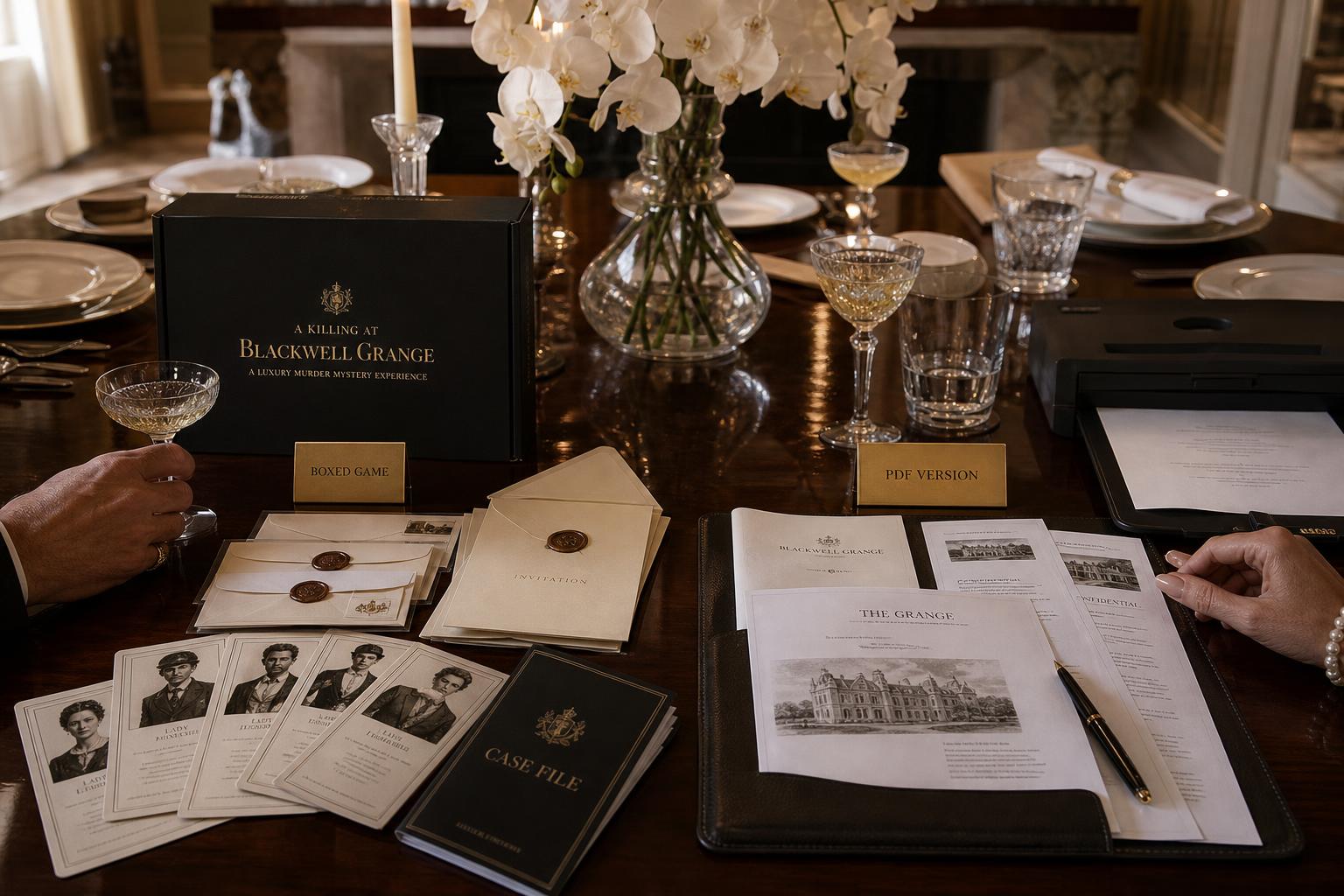
A boxed murder mystery game is a physical product that arrives with pre-printed materials ready to use. In many cases, the box contains character booklets, invitations, clue cards, envelopes, host instructions, and sometimes props such as evidence photos, maps, or themed accessories. The packaging itself often adds to the experience, giving the event a more polished and giftable feel. For buyers who value presentation, this can be a major selling point.
Because the materials are professionally printed, boxed games reduce the amount of preparation required before the party. Hosts do not need to manage printer settings, paper quality, or cutting and sorting pages. This can save significant time, especially for larger groups. A boxed set may also include sturdier components, such as laminated cards or sealed evidence packets, which can improve durability during play.
Physical Extras and Presentation Value
Some boxed games go beyond paper materials and include immersive elements that PDFs rarely match out of the box. These may include costume accessories, menus, place cards, or decorative props that help establish atmosphere. While not every product is this elaborate, the physical format often creates a stronger first impression. For parties centered on birthdays, holidays, or corporate events, that tactile quality can make the gathering feel more premium.
The Real Difference in Included Value
The most important distinction is not simply digital versus physical, but who handles the final presentation. A PDF usually includes the same essential story content as a boxed game, yet the host must assemble it. A boxed game includes more of the experience in finished form. In practical terms, PDFs often offer flexibility and speed, while boxed sets deliver convenience, polish, and a more ready-made event structure.
How Setup and Hosting Differ
Preparing a Boxed Murder Mystery Game
A boxed murder mystery game usually asks more from the host before guests arrive. Most physical kits include printed character booklets, clue cards, invitations, props, and sometimes decorations or themed extras. That tactile experience is part of the appeal, but it also creates a longer setup process. The host often needs to sort materials by player, read through the moderator guide, hide evidence at the right moments, and make sure nothing important is opened too early.
In practical terms, setup can take anywhere from 30 minutes to 2 hours depending on the complexity of the game and the number of players. A 6-player dinner-party mystery is generally easier to organize than a 12-player event with multiple rounds, costume prompts, and hidden envelopes. If any pieces are missing or damaged, the host may need to improvise replacements, which adds another layer of preparation.
Preparing a Murder Mystery PDF
A PDF-based game shifts the workload rather than eliminating it. Instead of unpacking and sorting physical components, the host typically downloads files, prints materials, and distributes them digitally or on paper. This makes the process faster for many people, especially if they are comfortable with home printing and basic file organization. There is no waiting for shipping, and last-minute planning becomes much more realistic.
However, PDF games still require attention to detail. The host may need to print character sheets, clue packets, and instructions in the correct order. Ink, paper quality, and printer reliability matter more than many buyers expect. If the game includes editable invitations or optional evidence files, some light customization may also be involved. For a host with a reliable printer, setup may take 20 to 60 minutes, but printer issues can quickly erase that convenience.
Hosting Experience During the Event
Physical Presence and Flow
During the actual party, boxed games often feel more structured. Because materials are already separated into tangible items, players can pass around cards, inspect props, and interact with the game world in a more immersive way. Physical objects naturally guide pacing, which can help first-time hosts feel more in control. A sealed envelope marked “Round Two” is hard to misunderstand.
PDF games can be equally effective, but they depend more on the host’s organization. If materials are printed cleanly and distributed well, the event can run smoothly. If pages are mixed up or guests are reading from phones with different file versions, the flow may become uneven. In other words, PDFs offer flexibility, while boxed games often offer built-in structure.
Managing Guests and Participation
Hosting also differs in how players engage with the format. Boxed games often encourage a premium, event-like atmosphere. Guests see props on the table and immediately understand that this is a planned experience. That visual cue can increase participation, especially among players who are new to roleplay or party games.
With PDF games, the host may need to create more of that atmosphere manually. Printed name tags, simple decorations, or themed music can help bridge the gap. This is not necessarily a drawback, because some hosts prefer that freedom. A PDF can be adapted for a casual living-room gathering, a classroom activity, or even a virtual event, while a boxed game is usually designed with a more specific format in mind.
Convenience, Space, and Troubleshooting
Practical Differences at Home
Storage and physical space matter more than buyers often realize. Boxed games take up shelf space and require the host to keep track of many separate components before and after the event. PDFs, by contrast, can be stored on a laptop or cloud drive and reprinted as needed. That makes them especially practical for smaller homes or repeat hosts who do not want stacks of game boxes.
The table below highlights common setup differences:
| Factor | PDF Game | Boxed Game |
|---|---|---|
| Purchase access | Instant download | Shipping or store pickup |
| Prep style | Print and organize files | Sort and stage physical components |
| Space needed | Minimal storage | Physical storage required |
| Last-minute hosting | Usually easier | Less convenient |
| Prop immersion | Depends on printing | Usually stronger out of the box |
When something goes wrong, troubleshooting also looks different. A boxed game may suffer from missing cards, while a PDF game may suffer from printing errors. Neither format is automatically easier in every situation, but the better choice depends on whether you value speed, structure, or physical presentation most.
Cost and Overall Value
Upfront Price vs Total Spend
At first glance, a murder mystery PDF almost always looks like the cheaper option. Most downloadable kits range from roughly $10 to $40, while a boxed game commonly falls between $25 and $60, with premium editions going higher. For buyers comparing only the sticker price, the PDF often wins immediately. However, the smarter comparison is not just purchase price, but total cost per event and how much usable value each format delivers.
A PDF kit usually gives you files to print at home, character sheets to distribute, and host instructions to organize the evening. That low entry price is attractive, especially for budget-conscious hosts or first-time planners. Yet printing can add noticeable expense. If a game includes 20 to 40 pages of materials, color ink, cardstock, envelopes, and reprints can push the real cost up by another $10 to $25, depending on your printer and local supply prices.
The Hidden Costs Behind Each Format
A boxed game tends to bundle physical components into one purchase. Invitations, clue cards, suspect profiles, and instructions are often ready to use straight out of the package. That convenience reduces prep spending, but the higher retail price reflects manufacturing, packaging, and shipping. In many cases, part of what you are paying for is not extra gameplay depth, but the cost of producing a polished physical product.
Printing, Shipping, and Replacement Value
With PDFs, there is no shipping fee and no waiting period, which can be a major advantage for last-minute events. If a player loses a sheet or spills a drink on a clue card, you can simply print another copy. That makes the format especially cost-effective for households that already own a reliable printer. By contrast, boxed games may require replacement purchases if key components are damaged or missing, unless the publisher offers downloadable backups.
For boxed games, shipping can materially affect value. A game priced at $35 may effectively cost $45 or more after delivery, particularly for international buyers. In that situation, the price gap between PDF and boxed formats becomes even wider.
Cost Per Player and Replay Potential
One of the most useful ways to judge value is by cost per player. A $20 PDF used for a party of 10 works out to about $2 per person, even before considering replay or reprints. A $40 boxed game for the same group costs $4 per person. For larger gatherings, PDFs often scale more affordably because extra copies are usually just additional printouts, not extra purchases.
When Boxed Games Offer Better Value
That said, boxed games can provide stronger value when presentation matters. If the game includes props, evidence items, themed decorations, or premium components that improve immersion, the higher cost may be justified. For hosts who want a low-effort, high-impact experience, paying more upfront can save time and reduce stress. Time has value too, especially for people organizing birthdays, team events, or holiday parties.
Replayability also changes the equation. Most murder mystery games, whether PDF or boxed, are designed for one main playthrough because the solution becomes known. However, PDFs can sometimes be reused with a different group more easily, since reprinting is simple and storage is digital. A boxed game can also be reused, but wear and tear may reduce its long-term usefulness.
Which Format Delivers Better Overall Value?
For purely financial efficiency, PDF murder mystery games usually offer the better value. They are cheaper to buy, easier to duplicate, and often more flexible for different group sizes. They are especially strong for practical hosts who do not mind a bit of setup work in exchange for lower overall spending.
Boxed games deliver value in a different way. Their strength lies in convenience, tactile appeal, and presentation. For some buyers, that polished experience is worth paying extra for, even if the cost per player is higher. The best choice depends on whether you prioritize budget, convenience, or atmosphere, and that trade-off becomes even clearer when you compare how each format handles setup and hosting effort.
Player Experience and Immersion
How format shapes the feeling of play
When people compare a murder mystery PDF with a boxed game, they often focus on price, convenience, or visual presentation. Yet the more meaningful difference usually appears at the table: how each format affects player experience and immersion. A murder mystery succeeds when guests stop feeling like readers of instructions and start feeling like suspects, detectives, and co-conspirators. The delivery format influences that transformation more than many hosts expect.
A boxed game tends to create immediate atmosphere. Physical invitations, printed character booklets, props, maps, and evidence cards give players something tangible to hold and react to. Research in game studies has repeatedly shown that tactile interaction can increase attention and memory retention, especially in social settings where physical objects anchor conversation. In practical terms, when a guest unfolds a stained letter or examines a fake newspaper clipping, the mystery feels more like an event and less like an activity packet.
A PDF version can still be immersive, but it usually depends more heavily on the host’s effort. If materials remain on screens or are printed on standard paper without styling, the experience may feel lighter and more functional. That does not mean worse. In fact, some groups prefer the flexibility of a PDF because the host can customize fonts, paper stock, music cues, and themed decorations to create a more personal atmosphere than many mass-produced boxed sets provide.
The role of physical components
Why tactile elements matter
Physical components support immersion by making information feel discovered rather than delivered. A clue card passed secretly across the room creates tension in a way that a plain text message or stapled printout often does not. Boxed games are designed around this principle. Many include sealed envelopes, item cards, suspect sheets, and occasionally costume suggestions, all of which help players stay in character.
This matters because immersion is fragile. In party games, interruptions break momentum quickly. If players must ask which page to read, whether they have the latest file version, or how to interpret a home printout, the fictional world weakens. Boxed games reduce this friction by packaging the experience into clearly labeled components. That ease can be especially valuable for first-time hosts or mixed-age groups.
PDF games, however, can narrow the gap when printed thoughtfully. Heavy paper, color printing, wax seals, folders, and simple props can dramatically elevate the experience. A host who invests an extra hour in presentation can turn a digital purchase into something nearly indistinguishable from a retail kit during actual play.
Social interaction and character engagement
Performance versus participation
Immersion is not only visual; it is social. The strongest murder mystery experiences encourage players to improvise, accuse, defend themselves, and reveal secrets naturally. Boxed games often support this with polished character briefs and structured clue timing. Because the materials are standardized, pacing tends to be more reliable. Players receive information in a sequence that has been tested across many groups, which can reduce awkward lulls.
PDF games vary more widely in this area. Some are brilliantly written, while others feel like downloadable scripts with minimal playtesting. The result is inconsistency. One PDF may produce energetic roleplay, while another may leave guests reading long backstories and waiting for direction. Hosts should remember that immersion depends on momentum, and momentum depends on how clearly the game tells players what to do next.
For highly theatrical groups, PDFs can actually outperform boxed games. Editable files allow hosts to rewrite names, localize jokes, or tailor roles to the personalities in the room. That customization can increase emotional buy-in because players feel the game was made for them rather than purchased off a shelf.
Accessibility and comfort
Not every player immerses in the same way. Some love costumes and dramatic accents; others prefer lighter participation. Boxed games often assume a certain performance level, which can be exciting but occasionally intimidating. PDFs can be easier to soften or adapt, letting hosts trim text, simplify roles, or adjust complexity for shy players.
This flexibility matters in real gatherings. A group of close friends may enjoy intense improvisation, while a family event may need clearer prompts and lower pressure. The most immersive format is often the one that matches the group’s comfort level, not simply the one with the best props.
Practical immersion in real-world hosting
In real use, immersion comes from the balance between presentation and smooth execution. A beautiful boxed game can lose players if setup is confusing. A simple PDF can feel vivid if the host manages pacing, music, and scene transitions well. According to event-planning surveys, guests consistently rate flow and engagement above décor alone, which reinforces a useful truth: immersion is created by experience design, not just packaging.
For hosts who want instant atmosphere with minimal preparation, boxed games usually have the advantage. For hosts who enjoy customization and are willing to build the mood themselves, PDFs offer surprising immersive potential at a lower cost.
Flexibility, Customization, and Replay
One of the biggest practical differences in a Murder Mystery PDF vs boxed game comparison is how much freedom each format gives the host. While both can deliver a fun, memorable evening, they differ sharply in adaptability, personalization, and long-term reuse. For hosts planning around changing guest counts, mixed experience levels, or themed events, this category often matters more than packaging or first impressions.
Why flexibility matters for hosts
A murder mystery party rarely happens under perfect conditions. Guests cancel, extra friends join late, and some players arrive ready to perform while others prefer a lighter role. In those real-world situations, flexibility becomes a major advantage. A rigid format can turn small changes into planning problems, while an adaptable one lets the host adjust without rewriting the whole evening.
PDF-based games usually perform well here because digital files are easier to edit, reprint, and distribute. If a host needs to swap character names, update clues, or send materials to remote participants, the process is typically straightforward. Many downloadable kits also include alternate role assignments or host notes for different group sizes, which can be especially useful for parties of 6 to 20 players.
Boxed games, by contrast, are often designed as fixed products. That structure can be helpful for beginners because everything is packaged and sequenced in advance. However, it may limit last-minute changes. If a character sheet is damaged, a clue card goes missing, or the guest list shifts beyond the intended player count, the host may have fewer options without buying replacement materials or improvising.
Customization potential in each format
Customization is where PDF games often stand out most clearly. Because the content exists in digital form, hosts can tailor the experience to fit the event. They may change character names to match the guest group, add inside jokes, adjust the tone from formal to comedic, or reformat invitations to suit a birthday, team-building event, or holiday party. That level of personalization can make the game feel far more immersive.
Practical examples of PDF customization
A host running a 1920s-themed mystery might edit invitation text to include a specific venue dress code, add custom cocktail names, or print character packets with matching art. For a corporate event, the same mystery could be adapted with company-friendly language and simplified role descriptions for first-time players. These are small changes, but they can significantly improve guest engagement.
Boxed games can still offer some customization, but usually in a more limited way. The host can decorate the room, assign roles strategically, and add themed food or music, yet the printed materials themselves are generally static. That means the atmosphere can be personalized, while the core script and evidence remain mostly unchanged.
Replay value and long-term use
Replay is another area where the two formats diverge. Most murder mystery games, regardless of format, are not endlessly replayable with the same group because the solution becomes known. Once players know the murderer, key surprises disappear. Still, replay value is not only about repeating the exact same experience. It also includes whether the host can reuse the product with a different group, adapt it for another occasion, or extract ongoing value from the purchase.
PDF games often provide stronger long-term utility because they can be stored indefinitely, printed again when needed, and reused for future events with new guests. Some publishers even bundle multiple endings, optional clues, or expandable roles, which increases variety. If a host runs social events regularly, that convenience can lower the effective cost per party over time.
Replay limitations of boxed games
A boxed game may feel premium on first use, but replay can be constrained by wear and tear. Once envelopes are opened and components handled, the set may lose some of its polished presentation. Missing cards, written-on sheets, or damaged props can reduce usability. In practical terms, that means a boxed game may function more like a one-time event product unless the materials are carefully preserved.
Which format suits different hosting styles
Hosts who value convenience, tactile props, and a guided setup may still prefer boxed games. They work well for one-off celebrations where presentation is a priority and customization is less important. On the other hand, hosts who want to tweak details, accommodate changing circumstances, or reuse materials across several gatherings will often find PDFs more versatile.
The honest trade-off
The trade-off is simple: boxed games usually offer structure and presentation, while PDF games offer control and adaptability. For many practical hosts, especially those managing unpredictable guest dynamics, that flexibility can be the deciding factor when choosing between the two formats.
Practical Buying Factors
Budget, Reusability, and Overall Value
For most buyers, the first practical question is simple: how much entertainment do you get for the price? A printable murder mystery PDF usually costs far less than a boxed game. In today’s party-game market, downloadable kits often range from roughly $10 to $30, while boxed murder mystery games commonly sit between $25 and $60, with premium editions going higher. That gap matters if you are planning a casual gathering, a one-time birthday party, or a last-minute event.
However, price alone does not define value. A boxed game often includes printed invitations, character booklets, props, and sometimes decorative evidence cards or themed accessories. Those physical components can make the experience feel more polished straight out of the package. A PDF, by contrast, may require home printing, envelopes, name tags, or optional prop assembly, which adds both time and a small extra cost in paper and ink.
Reusability is another key factor. Most murder mystery games, whether digital or boxed, have limited replay value for the same group because the solution becomes known after one session. Still, PDFs can offer better long-term value if the host wants to run the game again for a different group, since the files can usually be reprinted without repurchasing the product. With a boxed game, replacement of lost or damaged materials may be harder unless the publisher sells extras.
Group Size and Hosting Flexibility
A practical purchase should match the number of guests you actually expect. Many murder mystery PDFs are designed with flexible character assignments, making them easier to adapt if attendance changes at the last minute. For example, a game written for eight to twelve players may include optional characters, allowing the host to scale the event without disrupting the story.
Boxed games can also support a range of player counts, but they are sometimes more rigid because the physical materials are prepacked for a fixed cast. If one guest cancels, the host may need to reshuffle roles more carefully. That is not always a problem, but it becomes important for larger parties where attendance can shift close to the event date.
Why flexibility matters
In real hosting situations, guest lists rarely stay perfect. A format that tolerates change reduces stress. PDFs tend to shine here because the host can print only the needed roles, duplicate reference sheets, or send character packets digitally before the event.
Setup Time, Convenience, and Delivery Speed
One of the biggest practical differences is how quickly you can go from purchase to play. A PDF offers near-instant delivery. If you need a same-day party solution, digital download is often the fastest route. Within minutes, the host can review the script, assign characters, and begin preparing the event.
A boxed game is slower but more convenient in a different way. Because the materials are already produced, setup may feel easier once the package arrives. There is less formatting, less printing, and usually less concern about whether everyone received the correct files. Buyers who value a ready-made, tactile experience often prefer this simplicity.
Hidden preparation costs
The convenience equation depends on your resources. If you own a reliable printer and do not mind light assembly, a PDF can be extremely efficient. If printing 30 to 50 pages sounds annoying, the boxed option may save frustration.
Space, Presentation, and Player Experience
Physical space also influences the smartest purchase. Boxed games are useful when presentation matters, especially for dinner parties or themed celebrations where props help set the mood. Tangible clues and printed cards can increase immersion and make the event feel premium.
PDFs are often more practical for smaller homes, remote groups, or hybrid events. Since materials can be emailed, they work well when some players prepare in advance or join from different locations. Digital convenience makes PDFs especially attractive for modern, flexible hosting styles, while boxed games appeal more to buyers who want a polished tabletop presence without extra crafting.
Best Choice by Occasion
Choosing Based on the Kind of Gathering
The best format often depends less on price or aesthetics and more on the occasion itself. A murder mystery PDF usually works best when flexibility, speed, and convenience matter most. A boxed game tends to shine when presentation, atmosphere, and tactile experience are part of the event’s appeal. Neither option is universally better; the right choice comes from matching the format to the expectations of the group, the venue, and the amount of preparation time available.
For casual get-togethers, PDFs are often the stronger choice. If a host decides on Friday to run a mystery on Saturday, a downloadable file can be purchased, printed, and organized within hours. That makes it ideal for spontaneous dinner parties, family nights, or low-pressure social events. Because many PDF kits let hosts print only what they need, they also adapt well to changing guest counts, which is useful when attendance is uncertain.
Best for Last-Minute Hosting
A PDF is the clear winner for last-minute planning. Shipping delays, stock shortages, and store availability do not matter when the game is delivered instantly. This can be especially valuable during busy seasons such as December, when party schedules fill quickly and delivery networks slow down. In practical terms, instant access can save several days compared with ordering a physical box online.
Why Speed Matters
Fast setup does not just reduce stress; it can also improve the host’s confidence. When materials arrive immediately, there is more time to read the script, assign roles, and prepare the space. Even if some light assembly is required, the host controls the timeline. For workplaces, classrooms, or community groups planning an event on short notice, that control is a major advantage.
Best for Gift-Giving and Special Celebrations
A boxed game is usually the better choice for birthdays, anniversaries, and holiday gifting. Physical presentation matters in these settings. A well-designed box feels complete, polished, and intentional in a way that printed pages in a folder often do not. If the mystery is part of a milestone celebration, the box itself contributes to the sense of occasion.
Boxed games also suit events where guests expect a more immersive experience from the moment they arrive. Professionally printed invitations, suspect booklets, props, and evidence cards can create a stronger first impression. For themed dinners or formal parties, that extra production value may justify the higher cost.
Best for Large or Repeat Groups
For large groups, the answer depends on how often the host runs events. PDFs can be more practical for repeat hosts because they are easy to reprint if pieces are lost or damaged. A school club, church group, or event organizer may value that reusability. Some hosts run multiple mysteries each year, and printable files simplify storage because everything can be archived digitally.
When a Boxed Set Makes More Sense
A boxed game can still be the better fit for recurring social groups that want a plug-and-play experience. If the host prefers minimal crafting and wants durable components ready to use, the box reduces prep work. This is particularly helpful for hosts who prioritize convenience over customization.
Best Choice by Setting
At home, PDFs are often enough. In corporate events, vacation rentals, or upscale dinner venues, boxed games can look more professional. The setting influences expectations. A relaxed living room gathering rewards flexibility, while a polished venue benefits from stronger visual presentation and ready-made materials.
Common Problems and Easy Fixes
Setup Confusion and Missing Context
One of the most common issues with both PDF kits and boxed murder mystery games is unclear setup. Players often open the materials expecting to start immediately, only to discover they need extra preparation. With PDF games, this usually means printing character sheets, clue cards, and host instructions. A standard home printer running at 10 pages per minute can turn a 40-page file into a small project, especially if color ink is required. Boxed games reduce printing work, but they can still create confusion when rulebooks are vague or components are packed without an obvious order.
A simple fix is to review everything at least 24 hours in advance. Hosts who sort materials by player name, scene, or round usually avoid last-minute stress. For boxed games, laying out every card, prop, and envelope before guests arrive helps identify missing pieces early.
Player Engagement Problems
Another frequent problem is uneven participation. In many groups, one or two outgoing players dominate the investigation while quieter guests struggle to contribute. This happens in both formats, but it can be more noticeable in PDF games if the host does not clearly explain roles or pacing.
Easy Ways to Keep Everyone Involved
The best solution is structured facilitation. A host can pause between rounds and invite each player to share one theory, one clue, or one suspicion. This creates balanced interaction without making the game feel forced. If a game includes secret objectives, reminding players of them midway through can also increase involvement. In practice, groups of six to eight players tend to be easier to manage than larger groups, because everyone gets more speaking time.
Technical and Quality Issues
PDF games sometimes suffer from formatting problems, especially when viewed on phones or older tablets. Text may appear too small, links may not work, or files may print incorrectly. Boxed games avoid digital friction, but they can have their own quality issues, such as bent cards, damaged props, or missing instruction inserts.
Quick Troubleshooting
For PDF games, downloading files to a laptop instead of relying on mobile viewing usually improves readability. Printing a single test page first can prevent wasted paper and ink. For boxed games, checking contents against the included inventory list is the fastest safeguard. If something is missing, many publishers now offer downloadable replacements or customer support forms, making small problems easy to solve before game night.
Conclusion: Which One Should You Buy
Match the Format to Your Group
The right choice depends less on which format is “better” and more on how you plan to host. A murder mystery PDF is usually the smarter buy for budget-conscious planners, last-minute events, and groups that value flexibility. In many cases, a downloadable game costs noticeably less than a boxed set, and it can be printed the same day, customized for guest count, and reused within the host’s household or event plan. That makes it especially practical for casual parties, classrooms, and family gatherings.
When a Boxed Game Makes More Sense
A boxed game is often worth buying when presentation and convenience matter most. If you want professionally printed materials, props that feel polished, and minimal prep time, the boxed option delivers a more tactile experience. For gift-giving, holiday parties, or hosts who do not want to manage printing, cutting, and organizing files, that convenience can justify the higher price. The physical format also tends to feel more premium for players who enjoy traditional tabletop products.
The Most Practical Buying Decision
If your priority is value, speed, and adaptability, buy the PDF. If your priority is premium presentation, ease, and a ready-to-open experience, buy the boxed game. For many buyers, the PDF wins on practicality because it lowers cost and removes shipping delays, while the boxed version wins on atmosphere and simplicity.
A Simple Rule of Thumb
Choose the PDF for informal events, tighter budgets, and customizable hosting. Choose the boxed game for special occasions, gifting, or when you want the least amount of setup. In short, neither format is universally superior, but one will clearly fit your event better once you weigh budget, prep time, and the kind of experience you want your guests to remember.
FAQ
Which format is easier to host for first-time players?
For most beginners, a murder mystery PDF is easier to start with because it is instantly downloadable, usually cheaper, and simple to print at home. Hosts can review the script, assign roles, and share files without waiting for shipping. A boxed game, however, often feels more guided because physical components are organized and ready to hand out, which can reduce setup stress during the event itself.
Which option is more cost-effective?
In many cases, PDFs offer the better upfront value. Digital kits commonly range from $10 to $30, while boxed games often fall between $25 and $60, depending on production quality and included props. If you already own a printer and basic supplies, the PDF route can be significantly cheaper. Boxed games may justify the higher price through sturdier materials, themed invitations, and reusable accessories.
Are boxed games more immersive?
They can be. Physical evidence cards, sealed envelopes, and printed character booklets often create a stronger tactile experience. That said, immersion depends just as much on writing quality, player enthusiasm, and host preparation as on packaging. A well-designed PDF with strong storytelling can feel every bit as engaging as a premium box set.
What about group size flexibility?
This is one area where PDFs often stand out. Many digital games are easier to adapt for changing attendance, and some publishers provide alternate role counts. Boxed games may be more rigid because they are packed for a fixed number of players.
Which is better for repeat use?
A boxed game can be convenient for storage and replay with a different group, but PDFs are often easier to archive, reprint, and customize. The better choice depends on whether you value physical presentation or long-term flexibility.


