

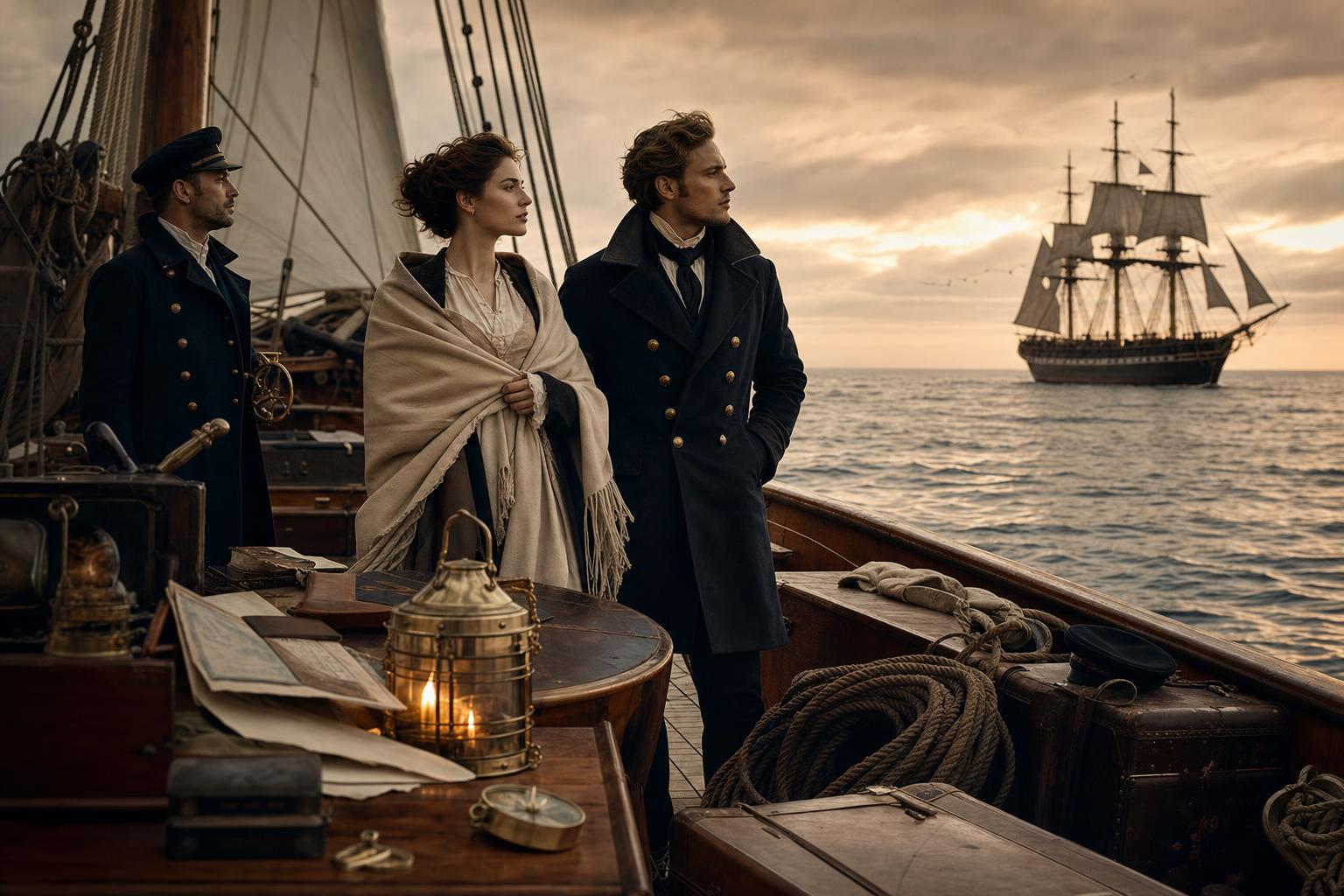
Introduction to the Mary Celeste
The Mary Celeste remains one of maritime history’s most enduring mysteries, a ship found drifting in the Atlantic Ocean with no sign of the people who had been aboard. More than 150 years after its discovery, the vessel still captures public imagination because the facts are strange, the evidence is incomplete, and the disappearance of its crew has never been definitively explained. In discussions of so-called ghost ships, the Mary Celeste is often the first name mentioned, not because it was supernatural, but because the real story is unsettling enough on its own.
A Merchant Brigantine with an Ordinary Purpose
Built in 1861 in Nova Scotia, the ship was originally named Amazon before later being renamed Mary Celeste. It was a brigantine, a two-masted merchant vessel designed for carrying cargo across long distances. At about 103 feet in length and measuring roughly 282 gross tons, it was not an especially large ship, but it was well suited to commercial trade. Over the years, the vessel changed ownership several times, reflecting the practical, business-driven world of 19th-century shipping.
By 1872, the Mary Celeste was engaged in a routine commercial voyage that should have attracted little attention. It departed New York Harbor on November 7, 1872, bound for Genoa, Italy, carrying a cargo of 1,701 barrels of industrial alcohol. On board were Captain Benjamin Spooner Briggs, an experienced and respected mariner, his wife Sarah, their two-year-old daughter Sophia, and a crew of seven. Nothing about the departure suggested that the voyage would become one of the most debated maritime incidents ever recorded.
The Discovery That Sparked a Legend
On December 4, 1872, the British ship Dei Gratia encountered the Mary Celeste adrift near the Azores, approximately 400 nautical miles east of the islands. The ship was under partial sail and moving erratically, which immediately raised suspicion. When a boarding party inspected the vessel, they found it deserted. The crew’s personal belongings were largely still aboard, the cargo remained mostly intact, and there were no obvious signs of violent struggle.
What Made the Scene So Unusual
The mystery deepened because the ship was not in ruins. Although some water was found in the hold, it was not enough to sink the vessel. One lifeboat was missing, and navigational instruments such as the sextant and marine chronometer were gone, suggesting the crew may have left in an organized, if urgent, manner. The last log entry was dated November 25, placing the ship near Santa Maria Island in the Azores. That gap between the final recorded position and the date of discovery created a troubling silence in the historical record.
Why the Story Endures
What makes the Mary Celeste so compelling is the contrast between its ordinary mission and its extraordinary aftermath. It was not a warship, an exploration vessel, or a ship sailing into legendary waters. It was a working merchant craft on a standard Atlantic route. Yet its abandonment generated theories ranging from mutiny and piracy to alcohol fumes, waterspouts, and panic triggered by misunderstood danger. The lack of definitive evidence has allowed the case to remain open in the public mind, inviting each generation to revisit the clues.
The Ship and Her Early History
A Vessel Born in Nova Scotia
Before the Mary Celeste became one of history’s most famous ghost ships, she began life as a hardworking merchant brigantine built for ordinary trade. The vessel was launched in 1861 at Spencer’s Island, Nova Scotia, and was originally named Amazon. She measured about 103 feet in length and displaced roughly 282 tons, making her a modest but capable ship for Atlantic commerce. Constructed from local timber by experienced shipbuilders in a region known for maritime craftsmanship, the Amazon reflected the practical design of mid-19th-century merchant sailing vessels.
Her first master was Robert McLellan, who took command shortly after launch. Yet misfortune seemed to shadow the ship from the beginning. On her maiden voyage, McLellan fell seriously ill and died not long afterward, an event later folded into the vessel’s eerie legend. While such tragedies were not uncommon in the dangerous world of 19th-century seafaring, they contributed to the sense that the ship’s history was marked by instability long before her most famous voyage.
Early Setbacks and Changing Ownership
The Amazon’s early commercial career was troubled by a series of accidents. In 1867, she was damaged in a storm off Cape Breton. Later that same year, she ran aground in the Strait of Belle Isle. Although she was repaired and returned to service more than once, these incidents reduced her value and complicated her reputation among owners and insurers. Merchant ships of the era often changed hands after damage or financial loss, and the Amazon was no exception.
From Amazon to Mary Celeste
After being abandoned as a wreck, the ship was eventually salvaged and sold to American owners. In 1868, she underwent substantial rebuilding in New York, where her structure was enlarged and refitted. Following these repairs, she was renamed Mary Celeste. Her registered tonnage increased to about 282.28 tons, and she was converted into a brigantine suited for carrying cargo efficiently across long distances. The renaming was more than cosmetic; it marked an attempt to give the vessel a fresh commercial identity after years of setbacks.
This phase of her life also reflected broader changes in Atlantic trade. By the late 1860s, American and British merchants relied heavily on ships like the Mary Celeste to transport industrial goods, foodstuffs, and raw materials between North America, Europe, and the Caribbean. Steamships were becoming more common, but sailing vessels remained economically important because they were cheaper to operate on many routes.
A Ship in Capable Hands
In the years before her disappearance, the Mary Celeste passed through several ownership arrangements, eventually becoming partly owned by Captain Benjamin Spooner Briggs, an experienced and respected mariner from Massachusetts. Briggs had a reputation for sobriety, discipline, and sound judgment, qualities highly valued in an age when a captain’s decisions could determine the fate of ship, cargo, and crew.
Her Condition Before the Final Voyage
By 1872, the Mary Celeste was considered seaworthy, though not exceptional. She was a seasoned merchant vessel rather than a glamorous ship, built for function instead of prestige. That practical history is important because it grounds the mystery in reality: this was not a legendary phantom ship from the start, but a real working vessel with a documented past, shaped by commerce, repair, and resilience. When she sailed from New York in November 1872, bound for Genoa with a cargo of industrial alcohol, she carried with her not only people and goods, but also a decade of hard maritime experience.
The Final Voyage Begins
A Routine Departure with Unusual Historical Weight
On November 7, 1872, the brigantine Mary Celeste left New York Harbor bound for Genoa, Italy, carrying a cargo of about 1,701 barrels of denatured alcohol. At first glance, the voyage appeared ordinary. Merchant ships crossed the Atlantic constantly in the nineteenth century, and the route from the American East Coast to the Mediterranean was well established. Yet this departure would become one of maritime history’s most enduring mysteries, because within a month the vessel would be found adrift, seaworthy, and eerily abandoned.
The ship itself already had a complicated past. Built in 1861 in Nova Scotia and originally named Amazon, it had experienced several misfortunes before being refitted and renamed Mary Celeste in 1869. By the time of its final crewed voyage, the vessel was considered sound enough for commercial service, though not especially remarkable among Atlantic traders. That ordinary quality is part of what makes the story so compelling: nothing about the ship’s departure clearly signaled disaster.
Captain Briggs and the People on Board
Commanding the voyage was Captain Benjamin Spooner Briggs, an experienced and respected American mariner. At 37 years old, Briggs had developed a reputation for sobriety, discipline, and sound judgment. He was not the sort of captain associated with recklessness or poor seamanship. His decision to take personal charge of the voyage suggested confidence in both the ship and the route.
Traveling with him were his wife, Sarah Elizabeth Briggs, and their two-year-old daughter, Sophia Matilda. Their presence gave the journey a domestic dimension unusual enough to be noted, but not unheard of in merchant service. The captain’s young son was left behind to attend school, a detail that later deepened the emotional resonance of the case.
The Crew Behind the Crossing
The crew consisted of seven sailors, carefully selected and by most accounts competent. First mate Albert G. Richardson and second mate Andrew Gilling were experienced seamen. The rest of the crew included a steward and able-bodied sailors, many of them of German origin, reflecting the international character of maritime labor in the era. Contemporary reports suggest Briggs chose men he believed to be reliable, reducing the likelihood that obvious internal conflict existed before departure.
Cargo, Conditions, and Early Progress
The cargo of industrial alcohol mattered greatly. Denatured alcohol was valuable but volatile, and later investigators would focus heavily on whether fumes from leaking barrels could have contributed to the abandonment. Records indicate that nine barrels were eventually found empty when the ship was discovered, though whether they had leaked, evaporated, or been compromised in transit remains debated. Even a small vapor buildup in the hold could have alarmed an experienced captain.
Weather conditions at departure were not exceptionally severe, but the Atlantic in late autumn was always unpredictable. Strong winds, rough seas, and sudden squalls were common hazards. The Mary Celeste did not sail entirely alone, either. Another vessel, the Dei Gratia, departed New York on November 15, following a similar route. That timing would later prove crucial, because the Dei Gratia would become the ship that encountered the abandoned brigantine.
The Last Known Record
The final confirmed entry in the Mary Celeste’s log was dated November 25, 1872, placing the ship near the Azores, roughly 400 nautical miles from where it would later be found. This detail remains central to the mystery. It shows that for much of the crossing, the voyage had progressed in a documented and apparently controlled manner. There was no recorded mutiny, no formal distress signal, and no written indication of panic.
A Mystery Taking Shape
Somewhere after that final log entry, something happened compelling enough for Captain Briggs, his family, and every crew member to leave the vessel. The ship’s yawl, a small boat used for transfer or emergency escape, was missing when the Mary Celeste was discovered. That fact strongly suggests an organized departure rather than a sudden catastrophe onboard. Yet the ship itself remained afloat, with provisions, navigational equipment partly intact, and no decisive evidence of violence.
The final voyage therefore began as a standard commercial crossing led by a trusted captain, crewed by capable sailors, and supported by a profitable cargo. Its transformation from routine passage to legend did not arise from obvious danger at the outset, but from the unsettling gap between what should have happened next and what history could never fully explain.
Discovery of the Abandoned Vessel
The Sighting That Sparked a Maritime Legend
On December 5, 1872, the brigantine Dei Gratia was sailing through the Atlantic Ocean, roughly 400 nautical miles east of the Azores, when its crew spotted a vessel moving oddly in the distance. The ship was the Mary Celeste, a merchant brig that had departed New York on November 7 bound for Genoa, Italy. At first glance, nothing about the sighting suggested that the vessel would become one of history’s most enduring maritime mysteries. Yet as the Dei Gratia drew closer, experienced sailors noticed something deeply wrong: the ship’s movements were irregular, and no one appeared on deck.
Captain David Morehouse of the Dei Gratia recognized the Mary Celeste and knew its captain, Benjamin Spooner Briggs. The two ships had left New York within days of each other, making the encounter all the more striking. Morehouse ordered his men to hail the vessel, but there was no response. Signals went unanswered, and the silence from aboard the drifting brigantine quickly raised alarm. In the age of sail, a ship found wandering without visible command was not merely unusual; it was a sign that something serious had occurred.
Boarding the Mary Celeste
To investigate, Morehouse sent a boarding party led by First Mate Oliver Deveau. What they found was unsettling precisely because it did not resemble the aftermath of a storm, pirate attack, or violent mutiny. The Mary Celeste was deserted. Captain Briggs, his wife Sarah, their two-year-old daughter Sophia, and the seven crew members were all gone. No bodies were found, and no immediate evidence explained their disappearance.
A Ship Still Seaworthy
One of the most puzzling details was that the vessel remained largely intact and seaworthy. Although some water had collected in the hold, reports indicate it was not enough to threaten the ship’s survival. The sails were in poor condition, with some damaged or set improperly, and the rigging showed wear, but the brigantine was still capable of staying afloat. This fact would later fuel endless speculation, because abandonment usually occurred only when a ship faced imminent destruction.
The cargo also appeared mostly untouched. The Mary Celeste was carrying 1,701 barrels of industrial alcohol, and while a few barrels were later found empty, there was no sign of widespread theft. Personal belongings, navigational instruments aside, were largely left behind. The crew’s clothing, valuables, and even Captain Briggs’s sword remained on board. Such details suggested that the departure had been sudden, but not necessarily chaotic.
Clues Left Behind
Inside the cabin, the boarding party found an eerie sense of order. The ship’s papers were missing, along with the sextant, chronometer, and the vessel’s only lifeboat. These absences implied that the crew had not simply vanished one by one or been swept overboard unexpectedly. Instead, they may have intentionally left the ship, perhaps believing they would return or reach safety nearby.
The Final Log Entry
Among the most important clues was the ship’s log. Its last entry was dated November 25, 1872, placing the Mary Celeste near Santa Maria Island in the Azores about ten days before it was discovered. This gap in the record became a central mystery. If the ship had been abandoned near the Azores, why had it continued drifting for days without any trace of those who left it? Maritime historians have long noted that a small boat in the Atlantic would have been dangerously vulnerable, especially in uncertain weather.
The condition of the galley and living quarters added to the confusion. Some accounts suggest food was still prepared or available, and there were no obvious signs of struggle. Beds were not dramatically disturbed, and the atmosphere was less like a crime scene than a place abruptly paused in time. That contrast between normalcy and disappearance gave the Mary Celeste its haunting reputation.
Salvage, Suspicion, and Public Fascination
After confirming the vessel was abandoned, Captain Morehouse made the practical decision to salvage it. Under maritime law, abandoned ships could be claimed for salvage compensation if brought safely to port. The Mary Celeste was sailed to Gibraltar, where an official inquiry began. Rather than immediately treating the event as a tragic mystery, authorities initially viewed it with suspicion. The unusual circumstances led some investigators to wonder whether fraud, mutiny, or even murder had taken place.
Early Theories Begin to Form
Those suspicions were not supported by clear evidence, but they helped transform the discovery into an international sensation. Newspapers seized on the story, often embellishing facts to heighten drama. Over time, the discovery of the abandoned vessel became more than a maritime report; it became the foundation of a myth. The image of a sound ship drifting alone across the Atlantic, its passengers and crew vanished without explanation, captured public imagination in a way few nautical incidents ever had.
From that moment forward, the Mary Celeste ceased to be merely a merchant ship and entered the realm of legend, with the circumstances of its discovery remaining the essential first chapter in the mystery.
What Was Found On Board
When the Mary Celeste was discovered adrift in the Atlantic on December 5, 1872, the ship presented one of the most unsettling scenes in maritime history. The Canadian brigantine Dei Gratia, which spotted and boarded her, found a vessel that was not wrecked, burned, or bloodstained, yet was completely abandoned. That contrast between order and absence is what transformed an ordinary salvage case into a lasting mystery.
The General Condition of the Ship
At first inspection, the Mary Celeste was still seaworthy. She had some water in the hold, but not an amount that should have doomed a vessel of her size. Reports generally place the water at around 3.5 feet, which sounded serious but was far from catastrophic for a cargo ship built to handle rough Atlantic crossings. Her sails were in mixed condition, with some damaged or set improperly, and the rigging showed signs of wear, but the ship was still afloat and capable of being brought to port.
The vessel’s orderly appearance was one of the most striking details. There was no clear evidence of piracy, mutiny, or violent struggle. Furniture remained in place, personal belongings were largely undisturbed, and valuable cargo had not been looted. In maritime investigations, such details matter because they suggest the crew did not leave under the kind of chaotic attack often imagined in later retellings.
Cargo, Supplies, and Personal Effects
The Mary Celeste was carrying a cargo of 1,701 barrels of industrial alcohol, bound from New York to Genoa. Most of that cargo was still on board when the ship was found. A small number of barrels were later noted as empty or leaking, which became important in later theories. Some historians have suggested that fumes from the alcohol may have frightened the crew into temporarily abandoning ship, especially if they feared an explosion.
Food and Water
One of the most revealing discoveries was that the ship still held ample provisions. There was enough food and fresh water for months. This fact strongly indicates that the crew had not planned a permanent desertion. If they had intended to abandon the vessel for good, they likely would have taken more supplies. Instead, the remaining stores suggest a sudden departure, possibly with the expectation of returning.
Valuables Left Behind
Equally significant was the presence of valuables. The captain’s cabin still contained personal items, and money and jewelry were reportedly untouched. This is one reason piracy is considered unlikely. Pirates would almost certainly have taken portable valuables, and signs of theft would have been obvious. The absence of looting supports the idea that whatever happened was not a conventional criminal attack.
Missing Equipment and Clues
Although much remained on board, some critical items were missing. The ship’s lifeboat, more accurately a yawl, was gone. So were the sextant and marine chronometer, both essential navigation instruments. These absences suggest that Captain Benjamin Briggs and those with him may have left the ship deliberately rather than being swept away accidentally. If they entered the boat, they would have needed navigational tools to survive.
The ship’s papers were also incomplete. The official logbook was present, but some documents, including the bill of lading, were missing. The last log entry was dated November 25, 1872, placing the vessel near the Azores about ten days before she was found. That gap in the record has fueled speculation ever since, because it leaves historians without a precise account of the crew’s final decisions.
Signs of Order, Not Panic
Another eerie detail was the condition of daily life on board. Accounts describe the galley as usable and the cabins as relatively tidy. Some reports say sewing materials and other domestic items were left out, creating the impression that ordinary routines had been interrupted. While later versions of the story exaggerated these details, the broader truth remains: the ship did not look like a scene of disaster.
What Investigators Inferred
To investigators, the evidence pointed toward an organized but urgent evacuation. The missing boat and instruments implied intention. The untouched valuables and cargo argued against foul play. The ship’s manageable damage suggested that the crew may have misjudged the danger. A faulty pump, alcohol fumes, rough weather, or fear of explosion could have convinced them to leave temporarily, perhaps while towing the boat behind the ship. If that line parted, the Mary Celeste would have drifted on alone, leaving no trace of those who departed.
The Missing Lifeboat and Crew
The clearest sign of an organized departure
When the Mary Celeste was discovered adrift in December 1872, one of the most important clues was not what remained on board, but what was missing. The ship’s only lifeboat, a yawl, was gone. This detail strongly suggested that Captain Benjamin Briggs, his family, and the crew had not simply vanished in an instant. Instead, they likely left the vessel deliberately, believing they faced immediate danger.
The absence of the lifeboat shaped nearly every serious theory about the case. If the crew had abandoned ship in panic, the missing boat provided the means. If they had intended only a temporary evacuation, it explained why valuables, cargo, and many personal belongings were still left behind. The mystery deepened because the Mary Celeste itself remained seaworthy enough to stay afloat, raising the question of why experienced sailors would leave a vessel that still offered better odds of survival than a small open boat on the Atlantic.
Who disappeared with the lifeboat
The missing people included Captain Benjamin Briggs, his wife Sarah, their two-year-old daughter Sophia, and seven crew members. In total, ten people vanished. Contemporary records identify the crew as a relatively experienced group, not a collection of reckless or untrained sailors. That matters because it makes a careless abandonment less likely and suggests that any decision to leave the ship was probably made under intense pressure.
A family at sea
The presence of Sarah and young Sophia made the case even more haunting. It was unusual, though not unheard of, for a captain’s family to travel aboard a merchant brigantine. Their disappearance transformed the event from a maritime puzzle into a deeply human tragedy. Any theory must account not only for professional seamen, but also for a mother and child placed into an already dangerous situation.
Why the lifeboat matters so much
Investigators noted that the lifeboat was likely lowered in a controlled way rather than destroyed by violence. There were no clear signs of a struggle, piracy, or mutiny. The cargo of industrial alcohol, more than 1,700 barrels, was largely intact, and the crew’s possessions were mostly undisturbed. This evidence points away from criminal explanations and toward a fear-driven evacuation.
The problem of survival in the Atlantic
A small boat offered little protection against wind, waves, cold, and navigation errors. In late autumn, Atlantic conditions could become deadly very quickly. Even if the occupants had intended to remain tethered to the ship, a snapped line or sudden weather shift could have separated them forever. In that scenario, the Mary Celeste would continue drifting while the lifeboat, carrying all ten people, disappeared without a trace.
A clue that created more questions
The missing lifeboat is often treated as the case’s most practical clue, yet it also creates the central paradox. Skilled mariners usually stayed with a sound vessel whenever possible. Because they did not, historians continue to ask what danger seemed so urgent that abandoning the ship felt like the safer choice.
Captain Briggs and the People Aboard
A Respected Captain at the Helm
When the Mary Celeste set sail in November 1872, she was under the command of Captain Benjamin Spooner Briggs, an experienced and widely respected American mariner. Born in Massachusetts in 1835, Briggs came from a family deeply rooted in seafaring life. By the time he took charge of the vessel, he had spent much of his life at sea and had built a reputation for being capable, disciplined, and deeply religious. Contemporary accounts described him as a man of good judgment and steady character, qualities that made the later disappearance of everyone aboard even more baffling.
Briggs was not considered reckless or careless. In fact, he was known for running orderly ships and maintaining strong professional standards. He had previously commanded several vessels successfully, and fellow sailors viewed him as dependable. This background is important because it challenges later theories suggesting incompetence or panic. Everything known about Briggs points instead to a captain who would have acted cautiously in a crisis.
The Captain’s Family on Board
One of the most striking details of the voyage is that Briggs did not travel alone. He brought his wife, Sarah Elizabeth Briggs, and their two-year-old daughter, Sophia Matilda, aboard the Mary Celeste. This was not unheard of in the 19th-century merchant marine, but it adds a deeply personal dimension to the mystery. A captain traveling with his family would likely have been even more careful than usual, especially on a transatlantic journey carrying commercial cargo.
Their young son, Arthur, was left behind with relatives so he could continue his schooling. This decision suggests the voyage was expected to be routine rather than dangerous. Letters written by Sarah before departure indicate a calm and hopeful outlook. Nothing in the surviving record suggests fear, conflict, or concern about the ship, the crew, or the route ahead.
The Crew: Skilled but Mysteriously Lost
The Mary Celeste carried a crew of seven sailors, making ten people aboard in total. These men were not random hires gathered at the last minute. Reports indicate that Briggs selected them carefully, favoring experienced seamen with solid reputations. The first mate, Albert G. Richardson, was considered competent and trustworthy. The second mate, Andrew Gilling, was a Danish sailor with years of maritime experience. The steward and the remaining crew members were likewise believed to be capable hands.
A Multinational Ship’s Company
Like many merchant vessels of the era, the crew reflected the international nature of seafaring trade. Sailors often came from different countries, spoke different first languages, and worked together under strict hierarchy. Even so, there is no strong evidence of mutiny, serious dispute, or disorder aboard the Mary Celeste. This matters because sensational explanations often depend on conflict among the crew, yet the known facts do not strongly support that idea.
Why Their Identities Matter
Understanding who was aboard the Mary Celeste helps explain why the case remains so compelling. This was not an infamous captain with an unruly crew or a ship packed with desperate passengers. It was a professional merchant voyage led by a respected commander, accompanied by his family, and staffed by experienced sailors. The disappearance of such a group feels especially unsettling because it seems to defy ordinary maritime logic.
Their backgrounds make the mystery harder, not easier, to explain. Every known detail suggests a voyage that should have been uneventful, which is precisely why the fate of Captain Briggs and the people aboard continues to haunt maritime history.
Leading Theories Behind the Disappearance
Few maritime mysteries have inspired as much debate as the fate of the Mary Celeste crew. When the brigantine was found adrift in December 1872, her cargo of industrial alcohol remained largely intact, the hull was seaworthy, and there was no decisive sign of violence. Yet Captain Benjamin Briggs, his family, and the crew were gone. Because the physical evidence was limited and sometimes contradictory, historians have developed several competing explanations. None has been proven beyond doubt, but some theories align far better with the known facts than others.
The Abandon-Ship Theory
The most widely accepted explanation is that the crew left the vessel voluntarily, believing they faced immediate danger. This theory rests on a combination of clues: the missing lifeboat, the absence of the ship’s papers and navigational instruments, and the fact that valuable personal belongings were left behind. These details suggest an orderly departure rather than a chaotic attack.
One important piece of evidence was the sounding rod and records indicating concern about water in the hold. Some researchers believe Captain Briggs may have feared the ship was taking on dangerous amounts of water. In the nineteenth century, sounding equipment was not always precise, and a faulty reading could have made the situation appear more serious than it really was. If Briggs thought the vessel might founder, launching the lifeboat as a temporary precaution would have seemed rational.
Why the Crew May Have Misjudged the Risk
The Mary Celeste had previously carried a cargo of denatured alcohol, and on this voyage she transported more than 1,700 barrels. Alcohol cargoes were volatile, and even a minor leak could create fumes. If the captain heard a strange noise from the hold, saw evidence of vapor, or worried about a possible explosion, he may have ordered everyone into the boat while the ship was aired out. In that scenario, the crew may have intended to remain tethered to the vessel by a line. If the rope later snapped in rough weather, the lifeboat would have been separated, leaving those aboard with little chance of survival.
This interpretation gained support from later scientific testing. In 2006, an experiment for a documentary recreated an alcohol-vapor ignition and showed that a pressure wave could occur without leaving heavy burn marks. That finding helped explain reports of a hatch being displaced while the ship itself showed no major fire damage.
The Explosion or Fume Panic Hypothesis
Closely related to the abandon-ship theory is the idea that the crew reacted to a sudden event involving the cargo. Of the 1,701 barrels on board, nine were later found to be empty. Historians have noted that these barrels were made of red oak, a more porous wood than white oak, making leakage plausible. Escaping alcohol fumes could have accumulated in the hold and created a frightening, potentially explosive atmosphere.
Evidence Supporting a Cargo Scare
This theory explains several otherwise puzzling details. The ship was not looted, there were no bloodstains, and the galley and cabins suggested an interrupted routine rather than a struggle. If the crew had been alarmed by a loud bang, a rush of fumes, or a fear of combustion, they may have evacuated quickly but calmly. The lack of widespread damage is not fatal to the theory because a vapor flash can be dramatic without destroying the vessel.
Critics note that no definitive explosion marks were recorded by the boarding party. However, nineteenth-century observations were not always systematic, and some subtle evidence may have gone unnoticed or unrecorded. As a result, the fume-panic hypothesis remains one of the strongest explanations.
Severe Weather and Sea Conditions
Another serious theory points to bad weather, rough seas, or a waterspout. Although the Mary Celeste was discovered in relatively manageable condition, that does not mean she had not recently encountered dangerous conditions. Maritime weather can shift rapidly, especially near the Azores, where the ship was found. A sudden squall could have damaged rigging, shipped water onto the decks, and convinced Briggs that the vessel was no longer safe.
The Case for Temporary Evacuation
Supporters of this view argue that the captain may have intended only a short-term evacuation. If a storm had made the ship unstable or if he feared the pumps were failing, he might have ordered the crew into the lifeboat while remaining attached to the ship. The Mary Celeste could then have sailed on under partial control while the boat trailed behind. A single strong wave, however, might have severed the line or swamped the smaller craft.
This theory fits the absence of violence and the missing lifeboat, but it depends on a sequence of unfortunate events that cannot be directly verified. Even so, given the hazards of nineteenth-century Atlantic navigation, weather remains a credible factor.
Piracy, Mutiny, and Criminal Attack
More dramatic explanations have long captured the public imagination. Some early commentators proposed piracy, mutiny, or even murder by the crew of the Dei Gratia, the ship that discovered the Mary Celeste. These theories persist largely because they satisfy the mystery in a dramatic way, but the evidence for them is weak.
There were no clear signs of combat, no major theft, and no bodies. The cargo was valuable, yet it was not stolen. The boarding party from the Dei Gratia had much to gain from a legitimate salvage claim and much to lose from criminal conduct. Official investigations examined suspicions against Captain David Morehouse and his crew, but no persuasive proof emerged. Likewise, mutiny seems unlikely because the crew had solid reputations, and mutineers would normally seize valuables or redirect the vessel rather than vanish completely.
Fringe Explanations and Enduring Uncertainty
Over time, the mystery has attracted increasingly speculative ideas, including giant squid, sea monsters, paranormal intervention, and alien abduction. These notions endure because the case contains the perfect ingredients of legend: an intact ship, missing people, and an oceanic setting. Yet none of these claims is supported by credible historical evidence.
What keeps the Mary Celeste mystery alive is not the strength of exotic theories, but the frustrating incompleteness of the record. The most plausible explanations involve a reasonable captain responding to what he believed was an urgent threat, whether from fumes, faulty soundings, or severe weather. The tragedy may have resulted not from something supernatural, but from a brief decision made under pressure on an unpredictable sea.
Fraud, Piracy, and Mutiny Claims
Why Suspicion Formed So Quickly
When the Mary Celeste was discovered adrift in December 1872, the ship presented a baffling scene. Its cargo of industrial alcohol was largely intact, the vessel remained seaworthy, and there were no obvious signs of a violent struggle. Yet Captain Benjamin Briggs, his family, and the crew had vanished completely. In an era when maritime communication was slow and rumor often traveled faster than fact, speculation filled the silence almost immediately.
The circumstances encouraged dramatic theories. A deserted ship with valuable cargo naturally raised questions about fraud, piracy, or mutiny, especially because such incidents were not unknown in the nineteenth-century Atlantic. Marine insurance scams had occurred before, pirate attacks still haunted popular imagination, and mutiny remained a familiar fear in seafaring culture. The mystery of the Mary Celeste seemed to invite every dark possibility.
Fraud Allegations and Insurance Motives
One of the earliest claims suggested that the ship had been deliberately abandoned as part of an insurance fraud. Suspicion fell partly on the vessel’s owners and on Captain David Morehouse of the Dei Gratia, the ship that found the Mary Celeste. Because salvage law entitled rescuers to compensation, some wondered whether the two captains had conspired to stage the disappearance.
Why the Fraud Theory Weakened
This theory has never held up well under scrutiny. The financial logic was poor. The Mary Celeste and its cargo were valuable, but not valuable enough to justify the enormous risks of a criminal conspiracy involving multiple people. Investigators also found no convincing evidence of coordination between Briggs and Morehouse beyond their ordinary professional acquaintance. Historian analyses have repeatedly noted that the salvage award, while meaningful, was far lower than sensational accounts implied. Morehouse ultimately received only a modest sum, hardly the payoff expected from a carefully engineered fraud.
Piracy Claims and Missing Valuables
Piracy was another popular explanation. A boarded vessel could account for the crew’s disappearance, and the Atlantic still carried a reputation for danger. However, the evidence again proved uncooperative. The ship’s cargo of 1,701 barrels of alcohol remained aboard, and valuable personal belongings were not systematically looted. If pirates had attacked, they had shown remarkably little interest in profit.
What Investigators Observed
There were no clear marks of battle, no widespread bloodshed, and no damage consistent with a violent seizure. Some navigational instruments and the ship’s lifeboat were missing, but that pattern suggested evacuation rather than plunder. In practical terms, piracy usually aimed at theft, and the Mary Celeste offered too little proof that robbers had taken control.
Mutiny as a Human Explanation
Mutiny appealed to those seeking a more realistic answer rooted in shipboard tensions. The crew was multinational, and later writers sometimes portrayed them as unruly or untrustworthy. Yet surviving records do not strongly support that image. Captain Briggs had a reputation for competence and sobriety, and there is no solid evidence of conflict severe enough to trigger rebellion.
The cargo itself may have fueled the mutiny theory, since alcohol can suggest disorder. But the industrial spirit aboard was denatured and not intended for drinking. Modern historians generally regard mutiny as possible in the abstract but weak in evidentiary terms. Like fraud and piracy, it survives largely because the ship’s silence left room for stories where facts were scarce.
Science and Modern Explanations
Moving Beyond Supernatural Theories
For more than a century, the Mary Celeste has inspired stories of sea monsters, mutiny, and paranormal intervention. Modern research, however, favors explanations grounded in maritime science, historical records, and the known risks of nineteenth-century sailing. When the ship was found adrift in December 1872, it was seaworthy but abandoned, with cargo still aboard and no obvious signs of violence. That combination has led investigators to focus less on fantasy and more on how a competent crew might have made a fatal decision under pressure.
The Cargo and Explosion Hypothesis
One of the most widely discussed scientific theories involves the ship’s cargo of industrial alcohol. The Mary Celeste was carrying more than 1,700 barrels, and records suggest that several were later found empty or leaking. Alcohol vapors are highly flammable, and even without a visible fire, a sudden vapor explosion could have produced a loud blast, a pressure wave, or flames that quickly extinguished. Such an event might have convinced Captain Benjamin Briggs that the vessel was about to ignite catastrophically.
Why the Crew May Have Left Temporarily
In this scenario, the crew may have boarded the ship’s yawl, intending only to wait at a safe distance while remaining attached by rope. If the line snapped in rough weather, the Mary Celeste could have drifted away, leaving the people in a small boat exposed to the Atlantic. This theory gained attention in part because controlled experiments have shown that alcohol vapor can create an explosive burst without leaving heavy burn marks, matching the ship’s puzzling condition.
Weather, Equipment, and Human Judgment
Another modern explanation centers on severe weather and navigational uncertainty. Although no hurricane was recorded directly at the ship’s location, the Atlantic in late autumn was unpredictable, and rough seas could have made the vessel feel unstable. Some historians note that the sounding rod and chronometer were missing, suggesting the captain may have been actively checking for water ingress or trying to assess position. If Briggs believed the ship was taking on dangerous amounts of water, abandoning it briefly may have seemed rational.
The Bilge Pump Problem
Evidence also points to possible mechanical trouble. One of the pumps was reportedly disassembled, which may indicate it was malfunctioning. A captain unable to measure flooding accurately would face a terrifying information gap. In maritime emergencies, uncertainty itself can drive drastic action, especially when family members were aboard, as Briggs’s wife and young daughter were on the voyage.
What Modern Historians Agree On
Most scholars reject piracy and mutiny because valuables remained untouched and the vessel showed no battle damage. The strongest modern explanations combine cargo fumes, bad weather, and imperfect instruments, presenting the disappearance not as magic, but as a tragic chain of reasonable decisions made with incomplete information.
How the Mystery Became Legend
From Maritime Incident to Global Fascination
When the Mary Celeste was discovered adrift in December 1872 between the Azores and Portugal, the basic facts were strange enough to command attention. The brigantine was seaworthy, its cargo of industrial alcohol was largely intact, and there were no signs of piracy or violent struggle. Yet Captain Benjamin Briggs, his family, and the crew had vanished. That gap between evidence and explanation is what transformed a maritime case into one of history’s most enduring legends.
Newspapers in the late nineteenth century played a major role in amplifying the mystery. Reports often emphasized the eerie image of an abandoned ship under sail, inviting readers to imagine disaster, mutiny, or supernatural intervention. In an era when transatlantic travel was still hazardous and communication was slow, such stories spread quickly and were difficult to verify. As a result, speculation often traveled farther than fact.
The Power of Embellishment
The legend grew because later retellings added dramatic details that were either exaggerated or entirely false. Some accounts claimed meals were left warm on the table or that the crew had disappeared only moments before the ship was boarded. Historical records do not support these images, but they proved memorable. A mystery becomes more powerful when it feels cinematic, and the Mary Celeste offered exactly that opportunity.
Fiction Shaping Public Memory
One of the most influential embellishments came from Arthur Conan Doyle, who published a fictionalized story in 1884 based on the case. He changed details, renamed the ship, and introduced sensational elements, but many readers absorbed the fiction as if it were history. This helped shift the Mary Celeste from a puzzling shipping incident into popular mythology.
Why the Story Endures
The case remains compelling because it resists closure. Modern theories include an alcohol vapor explosion, panic over perceived danger, navigational error, or temporary abandonment gone wrong. Each explanation is plausible, yet none can be proven with certainty. That uncertainty keeps the story alive across books, documentaries, and online discussions.
A Perfect Ghost Ship Narrative
The Mary Celeste endures because it combines verifiable history with unanswered questions. There was a real ship, a real crew, and a documented discovery, but no final explanation. That balance of fact and mystery is what allowed the incident to evolve into legend, securing its place as perhaps the most famous ghost ship story in maritime history.
Conclusion: Why the Mary Celeste Endures
A Mystery Stronger Than Time
More than 150 years after the Mary Celeste was found drifting in the Atlantic, its story still grips readers, historians, and filmmakers. The facts are deceptively simple: in December 1872, the brigantine was discovered seaworthy, carrying cargo, food, and personal belongings, yet the captain, his family, and crew had vanished. Because no definitive explanation was ever proven, the case remains open in the public imagination.
The Power of Unanswered Questions
What makes the Mary Celeste endure is not only the disappearance itself, but the unusual balance between evidence and uncertainty. Investigators found no clear signs of piracy, mutiny, or violent struggle. The ship’s cargo of industrial alcohol was largely intact, and the vessel was still capable of sailing. Those details make ordinary explanations feel incomplete, while more dramatic theories often collapse under scrutiny. That tension between logic and legend keeps the mystery alive.
History, Myth, and Popular Culture
The case also survived because it moved beyond maritime history into popular culture. Newspaper reports, fictionalized retellings, and later films transformed the Mary Celeste into the archetypal “ghost ship.” Even Arthur Conan Doyle helped popularize embellished versions of the tale in the 1880s. Over time, the real vessel became larger than itself, symbolizing humanity’s fear of the unknown sea and the unsettling idea that people can disappear without leaving answers.
Why It Still Matters
The Mary Celeste endures because it sits at the crossroads of fact and folklore. It reminds us that even in an age of records, navigation, and investigation, some events resist closure. That unresolved space is exactly where enduring mysteries live, inviting each new generation to ask what really happened out there.
FAQ About the Mary Celeste Mystery
What was the Mary Celeste?
The Mary Celeste was an American merchant brigantine discovered adrift in the Atlantic Ocean in December 1872. Built in 1861 and originally named Amazon, the vessel became famous after it was found abandoned between the Azores and Portugal. Although the ship was seaworthy, its crew had vanished without a confirmed trace.
When and where was it found?
On December 4, 1872, the British ship Dei Gratia spotted the Mary Celeste drifting roughly 400 miles east of the Azores. A boarding party found the cargo largely intact, along with food, water, and personal belongings. No signs of violence were reported, which deepened the mystery.
What happened to the crew?
Leading theories
No one knows for certain. The missing people included Captain Benjamin Briggs, his wife, their young daughter, and seven crew members. Popular explanations include a faulty chronometer, fear of an explosion from alcohol fumes, rough weather, or an emergency evacuation in the ship’s lifeboat. Piracy and mutiny have been widely discussed, but evidence for both remains weak.
Why is the case still famous?
The Mary Celeste became legendary because it combined verified maritime facts with unexplained disappearance. Later fictionalized accounts, especially Arthur Conan Doyle’s 1884 story, amplified public fascination and helped transform a real shipping incident into one of history’s most enduring nautical mysteries.


