

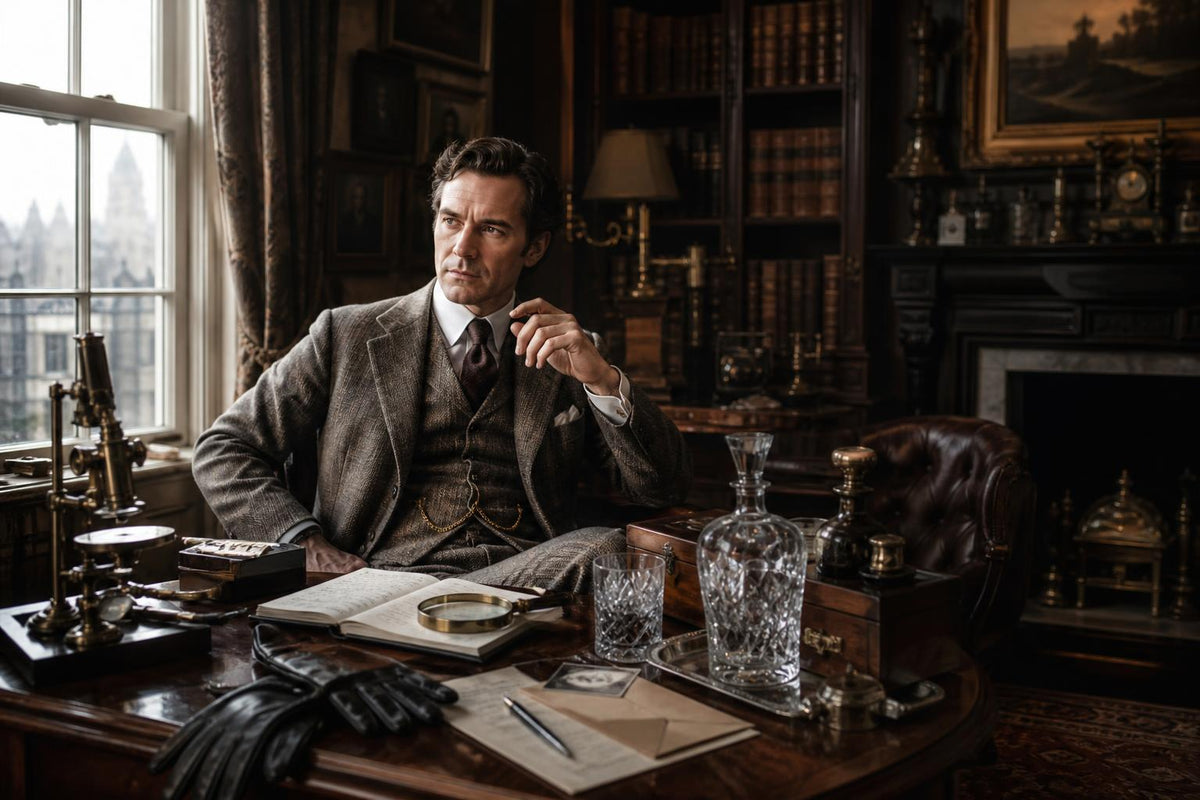
Introduction: Holmes and Forensics
A Fictional Detective with Real-World Influence
When Sherlock Holmes first appeared in A Study in Scarlet in 1887, forensic science was still developing as a formal discipline. Police work often relied on witness statements, confessions, and intuition rather than systematic analysis of physical evidence. Through Holmes, Arthur Conan Doyle introduced readers to a detective who treated crime scenes as sources of measurable facts. He examined footprints, cigar ash, handwriting, blood traces, and even the subtle wear on clothing to reconstruct events with striking precision. This method felt revolutionary to Victorian audiences, and it helped popularize the idea that science could uncover truth more reliably than guesswork.
Holmes as a Model of Scientific Detection
What made Holmes so compelling was not only his brilliance, but his method. He observed carefully, formed hypotheses, and tested them against evidence. That process closely resembles the scientific method used in modern forensic laboratories. While Doyle sometimes exaggerated Holmes’s abilities for dramatic effect, many of the techniques described in the stories reflected real scientific interests of the late nineteenth century. Toxicology, microscopy, fingerprinting, and blood analysis were all emerging fields, and Holmes presented them in a way the public could understand and admire.
From Page to Police Procedure
Holmes’s influence extended beyond entertainment. His stories shaped public expectations of detectives and encouraged respect for evidence-based investigation. In some cases, they also inspired real investigators. Edmond Locard, often called the father of modern forensic science, admired Holmes and echoed his logic in developing Locard’s Exchange Principle, the idea that every contact leaves a trace. That principle remains foundational in forensic work today.
Why This Connection Still Matters
The relationship between Holmes and forensics is important because it shows how fiction can affect professional practice. Holmes did not invent forensic science, but he helped give it cultural authority. Readers came to see the detective as a scientist, and the scientist as a solver of human mysteries. This blending of literature and laboratory thinking helped create the modern image of criminal investigation, one centered on observation, deduction, and physical evidence rather than mere suspicion. Understanding that legacy reveals why a fictional detective continues to appear in discussions of real-world forensic history and why his shadow still falls across crime scene investigation, courtroom expectations, and popular ideas about scientific proof.
Victorian Crime and Early Detection
Crime in a Rapidly Changing Society
Victorian Britain experienced dramatic urban growth, industrial expansion, and rising social inequality, all of which shaped public ideas about crime. London’s population grew from roughly 2.3 million in 1851 to more than 6.5 million by 1901, creating overcrowded districts where theft, assault, fraud, and prostitution became highly visible concerns. Newspapers amplified these fears, often portraying the city as a maze of danger. Crime was not necessarily exploding at the rate people imagined, but anxiety about hidden offenders certainly was. This atmosphere created demand for more systematic ways to identify suspects and interpret evidence.
The Limits of Early Policing
The Metropolitan Police, founded in 1829, represented a major institutional shift, yet early detectives worked with limited scientific support. Officers relied heavily on witness statements, confessions, informants, and personal observation. These methods could be useful, but they were also vulnerable to error, intimidation, and class prejudice. In many cases, investigators judged guilt through behavior, reputation, or neighborhood associations rather than physical proof. Detection was often an art of suspicion rather than a science of verification.
Why Traditional Methods Fell Short
Eyewitness testimony was especially unreliable. Poor lighting, crowded streets, and the stress of violent incidents frequently distorted memory. At the same time, record-keeping remained inconsistent across jurisdictions. A repeat offender might evade recognition simply by moving to another district or changing appearance. Without dependable identification systems, police struggled to connect crimes to known individuals.
Early Forensic Thinking Emerges
Even before modern forensic science fully developed, Victorian investigators began experimenting with more disciplined approaches. Medical testimony became increasingly important in murder cases, especially in determining time and cause of death. Toxicology also advanced during the nineteenth century. Chemists improved tests for poisons such as arsenic, a substance notorious in Victorian criminal cases because it was cheap, accessible, and difficult to detect without laboratory analysis.
Identification Before Fingerprints
Before fingerprinting became standard in Britain in the early twentieth century, authorities tried several methods to identify criminals more accurately. Photography became one of the most significant innovations. Mug shots allowed police to preserve visual records, though changes in hairstyle, facial hair, age, or clothing could still limit usefulness. Later in the century, some departments adopted anthropometry, a system developed by Alphonse Bertillon that measured body parts such as head length and arm span. The method was more systematic than casual description, but it was time-consuming and not always precise.
The Promise of Classification
What made these methods important was not perfection but the growing belief that crime could be studied, categorized, and solved through observable facts. That idea marked a turning point. Detection was beginning to move away from intuition alone and toward repeatable procedures.
Public Fascination with Detection
Victorian readers were deeply interested in criminal investigation. Sensational trials, serialized fiction, and press coverage turned detectives into cultural figures. The Jack the Ripper murders of 1888 intensified this fascination while also exposing investigative weaknesses. Despite extensive press attention and police effort, the killer was never conclusively identified. For the public, this failure highlighted the need for sharper methods and more intelligent analysis of clues.
A World Ready for the Consulting Detective
By the late Victorian period, society had already begun to value trace evidence, medical expertise, and careful observation. This was the historical setting that made a character like Sherlock Holmes feel both extraordinary and believable. He did not emerge from a world untouched by science; he emerged from one actively searching for better ways to turn suspicion into proof.
How Conan Doyle Built Holmes
A Detective Shaped by Medicine and Observation
Arthur Conan Doyle did not create Sherlock Holmes out of thin air. He built the character from medical training, literary influences, and the scientific spirit of late nineteenth-century Britain. While studying medicine at the University of Edinburgh, Doyle encountered Dr. Joseph Bell, a surgeon famous for diagnosing patients through tiny visual clues. Bell could infer a person’s occupation, habits, and recent movements from posture, clothing, and speech. That method became the foundation of Holmes’s signature approach: close observation followed by logical deduction.
Doyle later acknowledged Bell’s influence directly, and the resemblance is unmistakable. Holmes’s ability to notice mud on a trouser cuff, calluses on a hand, or cigar ash on a coat sleeve reflects Bell’s clinical style. This mattered because Victorian readers were living in an age increasingly fascinated by science as a tool for uncovering truth. Holmes felt modern in a way earlier fictional detectives did not.
Blending Earlier Detective Traditions
Doyle also borrowed from existing literary models, especially Edgar Allan Poe’s C. Auguste Dupin and Émile Gaboriau’s Monsieur Lecoq. Dupin had already demonstrated the appeal of the brilliant analytical detective, while Lecoq brought procedural elements into crime fiction. Doyle’s innovation was to combine those traditions with a more disciplined, almost laboratory-like method. Holmes was not merely clever; he was systematic.
The Role of Watson
Just as important was Doyle’s decision to pair Holmes with Dr. John Watson. Watson serves as narrator, audience surrogate, and emotional counterweight. Through Watson’s eyes, Holmes appears extraordinary without becoming unreadable. This structure allowed Doyle to explain complex reasoning step by step while preserving suspense. It also humanized Holmes, whose cold precision might otherwise have distanced readers.
Building a Character for a Scientific Age
Holmes emerged in print in A Study in Scarlet in 1887, during a period when forensic thinking was beginning to influence policing. Scientific crime detection was still limited in practice, but public interest was growing. Doyle gave Holmes expertise in chemistry, anatomy, tobacco ash, footprints, and handwriting, creating the impression of a detective whose mind functioned like a forensic instrument.
Knowledge With Limits
One of Doyle’s smartest choices was to make Holmes selective rather than universally learned. In A Study in Scarlet, Watson is surprised that Holmes knows little of astronomy yet possesses deep knowledge of poisons and soil stains. This selectivity made the character believable. Holmes’s brain, as he explains, is like a “brain-attic,” stocked only with useful tools. That idea reinforced his identity as a specialist, not a generic genius.
Personality, Habit, and Myth
Doyle also understood that method alone would not make Holmes memorable. He gave him eccentric habits, a violin, a Baker Street address, and periods of restless boredom between cases. These details transformed Holmes from a puzzle-solving device into a living figure. Readers could imagine him not only solving crimes but inhabiting a recognizable world.
By combining Dr. Bell’s observational rigor, earlier detective fiction, and the era’s faith in science, Conan Doyle created a character who seemed both plausible and exceptional. Holmes was crafted to embody reason in action, making him the ideal fictional detective for a society beginning to believe that evidence, properly read, could reveal what human eyes alone might miss.
Observation as Investigative Method
From Literary Device to Investigative Discipline
Observation sits at the heart of Sherlock Holmes’s method, but its importance extends far beyond fiction. In detective work, observation is not simply “looking carefully.” It is the disciplined process of noticing, recording, and interpreting details that other people overlook. Holmes popularized the idea that small physical clues can reveal larger truths, and that principle strongly influenced public understanding of criminal investigation. While Arthur Conan Doyle dramatized this skill for storytelling, modern forensic practice also depends on structured observation at every stage of an inquiry.
In real investigations, observation begins before any laboratory testing occurs. Crime scene examiners first assess the environment, identify disturbances, and note relationships between objects, bodies, entry points, and trace materials. A misplaced chair, a broken watch, or mud tracked across a floor may appear insignificant in isolation, yet each detail can help reconstruct events. Observation provides the raw material from which hypotheses are built, making it one of the earliest and most essential steps in forensic reasoning.
What Makes Observation Scientific
Seeing Versus Interpreting
A crucial distinction in investigative work is the difference between observing and inferring. Observation involves documenting what is directly present: a window is open, a glass is cracked, a sleeve is stained. Interpretation comes later, when investigators ask what those facts may mean. Holmes often appeared to leap instantly from detail to conclusion, but real forensic professionals are trained to separate these stages. This distinction reduces error and helps preserve objectivity.
Scientific observation also requires consistency. Investigators use photographs, sketches, measurements, and written notes to ensure that details are captured accurately. In many jurisdictions, crime scene units follow standardized protocols so that evidence is documented in the same order each time. This matters because memory is unreliable. Research in cognitive psychology has repeatedly shown that people can miss obvious details when distracted or influenced by expectations. Systematic observation protects investigations from the limits of human perception.
The Role of Context
Observation becomes more powerful when details are considered in context. A footprint alone may reveal size and tread pattern, but its location, depth, and direction add meaning. A bloodstain means little without noting shape, distribution, and nearby surfaces. Holmes’s fictional brilliance often came from linking isolated signs to broader circumstances, and real investigators do the same through scene reconstruction.
For example, bloodstain pattern analysis depends heavily on observation. Analysts examine droplet size, angle, and distribution to determine whether blood resulted from impact, transfer, or passive dripping. Likewise, forensic anthropology relies on close observation of bone trauma, weathering, and burial conditions. In each case, careful visual assessment guides later testing rather than replacing it.
Observation at the Crime Scene
First Impressions and Scene Preservation
The first officers arriving at a crime scene make observations that can shape the entire case. They may note odors, temperature, lighting, sounds, or the emotional state of witnesses before conditions change. These early details are often critical because scenes are fragile. Rain can wash away trace evidence, bystanders can alter object placement, and emergency medical care can disrupt original patterns.
This is why scene preservation is so important. Once an area is secured, investigators document it before moving anything. The sequence usually begins with overall views, then mid-range photographs, and finally close-ups of specific evidence. Holmes’s stories emphasized the value of entering a scene with an alert mind, and modern practice reinforces that lesson with procedure. Observation loses value if the original scene is not protected.
Limits, Bias, and Professional Training
Observation is powerful, but it is not infallible. Investigators can be influenced by confirmation bias, stress, fatigue, or prior assumptions about suspects and motives. A detective who expects burglary may overlook signs of staging; an examiner focused on one theory may misread ambiguous evidence. Because of these risks, professional training emphasizes note-taking, peer review, and evidence-based interpretation.
Modern forensic education teaches observers to slow down, document thoroughly, and remain aware of cognitive bias. Some agencies use blind verification, where analysts review evidence without knowing the preferred theory of the case. This approach helps ensure that observation remains a tool of discovery rather than a source of distortion. Holmes made observation seem almost magical, but real forensic success depends on discipline, method, and restraint.
Lasting Influence on Forensic Culture
Even though Sherlock Holmes was fictional, he helped establish observation as a cultural symbol of intelligent investigation. His methods encouraged readers to value detail, logic, and material evidence over rumor or intuition alone. That legacy matters because public expectations often shape institutional change. As forensic science developed in the late nineteenth and early twentieth centuries, the Holmesian ideal of the observant investigator aligned closely with emerging professional standards in policing and laboratory work.
Today, whether examining fingerprints, digital traces, fibers, or wound patterns, investigators still begin with the same foundational act: noticing what is there, what is missing, and what does not fit.
Deduction and Scientific Reasoning
Holmes as a Model of Analytical Thought
Sherlock Holmes popularized the idea that crime solving should rest on careful observation, logical inference, and testable evidence rather than intuition alone. Although Arthur Conan Doyle wrote fiction, his detective reflected a growing nineteenth-century respect for scientific method. Holmes studies footprints, cigar ash, handwriting, mud stains, and chemical traces, then connects them through deduction. For readers, this created a compelling image of the investigator as a disciplined thinker who could move from tiny details to broad conclusions without guesswork.
This portrayal mattered because policing in the late Victorian era was still developing professional standards. In many real investigations, confessions, witness statements, and personal suspicion carried more weight than physical evidence. Holmes offered a different model. He treated every scene as a source of data. That mindset closely resembles modern forensic reasoning, where investigators gather measurable facts, compare them against known patterns, and build explanations that can be challenged or confirmed.
What Holmes Meant by Deduction
Strictly speaking, Holmes often used a mix of deduction, induction, and abductive reasoning. Deduction moves from a general rule to a specific conclusion. Induction builds general patterns from repeated observations. Abduction identifies the most likely explanation from incomplete facts. When Holmes sees a worn sleeve, ink stains, and a certain posture and infers that a client writes extensively at a desk, he is not using pure deduction in the formal philosophical sense. He is combining observed clues with experience-based pattern recognition.
Reasoning from Trace Evidence
This blend of methods mirrors real forensic practice. A fingerprint examiner, for example, does not simply “guess” identity. The examiner compares ridge details, evaluates consistency, and rules out alternatives. A bloodstain analyst studies shape, direction, and distribution to reconstruct movement. Holmes dramatized this process long before forensic science became fully institutionalized. His stories taught audiences that small traces can reveal large truths when interpreted systematically.
Observation Before Theory
One of Holmes’s most quoted principles is that it is a mistake to theorize before one has data. That idea aligns strongly with scientific reasoning. In science, premature conclusions can distort how evidence is collected and interpreted. Investigators today are trained to avoid confirmation bias, a well-documented cognitive error in which people favor information that supports their initial beliefs. Holmes repeatedly warns Watson against this trap, insisting that facts must come first.
Why This Principle Still Matters
Modern forensic failures often involve exactly the problem Holmes cautioned against. If investigators decide too early who the suspect is, they may unconsciously interpret ambiguous evidence in that person’s direction. Research in cognitive psychology has shown that context can influence expert judgment, including fingerprint comparison and forensic pathology. Holmes’s fictional method therefore anticipated a real professional lesson: reasoning is strongest when observation is disciplined by skepticism.
The Scientific Imagination in Detection
Holmes also helped readers imagine the detective as a kind of laboratory thinker. He conducts chemical experiments, classifies tobacco ash, and compares case details against stored knowledge. While some of these feats were exaggerated, they reflected genuine scientific ambitions of the era. By the early twentieth century, forensic fields such as fingerprinting, toxicology, and document examination were becoming more standardized. Holmes did not invent those disciplines, but he made them culturally vivid and intellectually exciting.
Limits, Myths, and Real-World Influence
Holmes’s brilliance can create the misleading impression that one exceptional mind can solve any case alone. Real forensic work is far more collaborative and procedural. It depends on chain of custody, validated methods, peer review, and courtroom scrutiny. Even so, Holmes had enormous influence on public expectations. He encouraged generations of readers, police officers, lawyers, and scientists to value evidence over assumption.
From Fiction to Professional Practice
The broader legacy of Holmes lies in how he linked reasoning with responsibility. His method suggested that justice should be built on verifiable facts, not social status or dramatic accusation. That ideal helped shape the cultural authority of forensic science, making the detective not just a pursuer of criminals, but an interpreter of evidence in a world increasingly defined by scientific thinking.
Forensic Science in Holmes Stories
Fiction as a Laboratory for Detection
Arthur Conan Doyle gave Sherlock Holmes an unusual power for a Victorian detective: he treated crime as a scientific problem. In story after story, Holmes resists intuition unsupported by evidence and instead studies ash, footprints, handwriting, bruises, dust, and chemical traces. That approach mattered because the late nineteenth century was a period when policing was only beginning to professionalize. London’s Metropolitan Police had been founded in 1829, but many investigative methods remained inconsistent, and courtroom standards for physical evidence were still developing. Holmes therefore appeared not merely as a clever sleuth, but as a model of what disciplined forensic reasoning could look like.
Doyle’s medical training shaped this portrayal. Having studied under Dr. Joseph Bell in Edinburgh, Doyle learned the value of close observation in diagnosis. Bell famously inferred occupations, habits, and recent movements from tiny visual clues, and Holmes extends that clinical logic into criminal investigation. The stories repeatedly suggest that evidence speaks most clearly when the observer knows how to read it. That idea helped popularize a forensic mindset long before many readers encountered real laboratory science in police work.
Trace Evidence and the Power of Small Clues
One of the most striking features of the Holmes canon is its emphasis on trace evidence. Holmes notices what others dismiss: cigar ash on a windowsill, mud on a trouser hem, scratches on a watch, or the shape of a bicycle tire. In “The Boscombe Valley Mystery” and “Silver Blaze,” for example, physical surroundings become records of human action. Holmes reconstructs events from marks in the ground and disturbances in the landscape, anticipating later crime scene reconstruction techniques.
Ash, Dust, and Material Identification
Holmes even claims expertise in identifying tobacco ash, a detail that sounds theatrical but reflects a real forensic principle: different materials leave distinctive residues. In “A Study in Scarlet,” he refers to a monograph on 140 varieties of cigar, cigarette, and pipe tobacco ash. While fictionalized, the concept mirrors modern trace analysis, where examiners compare fibers, glass fragments, paint, soil, and gunshot residue. Holmes’s method teaches that small materials can carry large evidentiary value when properly classified.
This attention to microscopic or nearly invisible clues was especially influential because it encouraged readers to imagine the crime scene as a source of recoverable data. Long before television crime dramas made lab work familiar, Holmes stories framed physical remnants as objective witnesses.
Chemistry, Experimentation, and the Detective’s Workspace
Holmes is not only an observer; he is also an experimenter. Baker Street often resembles a private laboratory, with reagents, test tubes, and improvised analyses scattered among papers and correspondence. In “A Study in Scarlet,” Holmes demonstrates a chemical test for hemoglobin, dramatizing the challenge of distinguishing blood from rust or other stains. Historically, blood testing was indeed a major forensic problem in the nineteenth century. The guaiacum test existed earlier, and later methods improved reliability, but no single test was perfect in Holmes’s era.
Early Blood Analysis in Context
Doyle uses such scenes to present science as practical and case-solving rather than abstract. The blood test in the story symbolizes a broader forensic transition: investigators increasingly sought repeatable methods that could survive scrutiny. Although Holmes’s exact procedures are sometimes exaggerated for narrative effect, they reflect contemporary fascination with chemistry as a tool of truth. Readers saw that crime detection might depend not only on interrogation or confession, but on laboratory verification.
Identification, Handwriting, and Personal Characteristics
Holmes also works with forms of forensic identification that were emerging in real life. He studies handwriting, typewritten documents, disguises, and bodily features with remarkable precision. In “A Case of Identity” and “The Reigate Squires,” written communication becomes evidence of personality, education, and intent. This aligns with forensic document examination, a field that later developed systematic methods for comparing signatures, ink, paper, and machine impressions.
Footprints, Gait, and Behavioral Inference
Footprints are another recurring tool. Holmes compares stride length, depth of impressions, and direction of travel to infer speed, weight, and state of mind. Modern forensic gait analysis remains more limited and cautious than Holmes sometimes appears, yet the underlying principle is valid: movement leaves patterns. Doyle’s stories repeatedly connect physical pattern recognition with logical inference, showing how behavior can be reconstructed from material signs.
The Limits of Holmesian Forensics
Despite their scientific reputation, the Holmes stories do not present forensics as infallible. Holmes occasionally lacks data, misjudges timing, or depends on witness statements to complete the picture. His science works best when paired with reasoning, local knowledge, and an understanding of motive. That balance is important. Real forensic science has always required interpretation, and evidence can be contaminated, incomplete, or misleading when taken out of context.
Holmes also reflects the limitations of his time. Fingerprinting, for instance, does not dominate the early stories, even though it gained official use in policing around the turn of the twentieth century. DNA analysis, toxicology standards, and chain-of-custody protocols were far in the future. Yet this gap makes the stories more revealing, not less. They capture a moment when scientific detection was becoming imaginable, before it became routine.
Why Holmes’s Methods Resonated
The enduring appeal of Holmesian forensics lies in its combination of rigor and drama. Doyle transformed technical observation into narrative suspense. A stain, a footprint, or a scrap of ash becomes the hinge on which justice turns. For readers, this was deeply persuasive because it suggested that truth could be discovered through method rather than guesswork. In that sense, Holmes helped shape public expectations of what detectives should do: preserve clues, test hypotheses, compare physical evidence, and let facts challenge assumptions.
That fictional standard would later influence not just literature, but the cultural legitimacy of forensic investigation itself, preparing audiences to trust the laboratory, the expert examiner, and the disciplined reading of crime scenes
Influence on Real Police Work
From Fictional Method to Investigative Mindset
Arthur Conan Doyle created Sherlock Holmes as a fictional detective, yet his methods helped shape how generations of police officers, detectives, and forensic specialists thought about crime. Holmes popularized the idea that careful observation, logical inference, and physical evidence could reveal truths that witnesses, suspects, and even investigators might miss. In the late nineteenth century, when many real police forces still relied heavily on confessions, informants, and intuition, this emphasis felt revolutionary to readers and professionals alike.
Holmes did not invent scientific investigation, but he gave it a compelling public face. His stories reached a mass audience across Britain, Europe, and the United States, helping normalize the belief that crime solving should be systematic rather than purely instinctive. That cultural shift mattered. When the public began expecting detectives to notice tiny clues and explain cases through evidence, police institutions faced growing pressure to modernize their practices.
Raising Expectations for Detectives
The Holmes stories elevated the image of the detective from a routine investigator to a trained analytical specialist. Before this shift, many officers were seen primarily as enforcers of order. Holmes suggested that the best investigator was part scientist, part psychologist, and part logician. This changed public expectations of police work, encouraging respect for expertise and specialized knowledge.
Real detectives and police reformers drew inspiration from that model. In the early twentieth century, criminal investigation departments in several countries expanded training in observation, interviewing, record keeping, and scene analysis. Holmes’s influence appeared not in direct copying of every fictional trick, but in the broader professional ideal he represented. Detectives were increasingly expected to explain how they knew something, not merely assert it.
Observation as a Professional Skill
One of Holmes’s strongest lessons was that observation is not the same as simply seeing. He repeatedly noticed mud on boots, ash on clothing, handwriting details, or wear patterns on objects, then connected them to behavior. That narrative pattern reinforced a practical truth used in modern policing: small physical details can carry major evidentiary value.
Police academies and detective manuals eventually placed greater emphasis on disciplined scene observation. Investigators learned to document positions of objects, signs of forced entry, blood patterns, and trace materials before disturbing a scene. While this development came from scientific progress and institutional reform, Holmes helped make such habits culturally admired and professionally desirable.
Encouraging Scientific Policing
Holmes also helped legitimize the relationship between policing and laboratory science. In the stories, he conducted chemical tests, compared traces, and treated evidence as something that could be examined objectively. This mirrored emerging real-world advances such as fingerprint classification, toxicology, ballistics, and forensic pathology. By the early 1900s, police agencies were beginning to adopt these tools more formally.
A useful example is fingerprinting. Although fingerprint identification was developed through the work of figures such as Sir Francis Galton and Sir Edward Henry, popular fiction helped audiences understand why such methods mattered. Holmes conditioned readers to accept that identity and guilt could be established through physical traces, not just eyewitness testimony. That mindset supported wider acceptance of forensic systems in court and in public opinion.
Influence on Training, Records, and Case Review
Holmes’s analytical style also highlighted the importance of comparing current crimes with past cases. He often referred to files, newspaper clippings, and prior patterns. Real police work increasingly moved in the same direction. Departments developed centralized records, mugshot collections, and later fingerprint databases to identify repeat offenders and link crimes across jurisdictions.
The Value of Documentation
Good documentation became a hallmark of serious investigation. Holmes’s habit of preserving details and revisiting them resembles modern case review practices, where notes, photographs, chain-of-custody records, and lab reports can determine whether a prosecution succeeds. Today, major case units rely on documentation not only to solve crimes but also to withstand courtroom scrutiny and later appeals.
Inspiring Individuals in the Field
The influence of Holmes was not merely abstract. Numerous real investigators, forensic pathologists, and legal scholars have cited the character as an early inspiration. Edmond Locard, often called a pioneer of forensic science, shared Holmes’s belief that every contact leaves a trace, a principle central to modern trace evidence analysis. While Locard built his ideas scientifically, the Holmes stories helped create a world ready to appreciate them.
Across the twentieth century, police memoirs and criminology discussions repeatedly referenced Holmes as a symbol of intellectual detective work. His name became shorthand for deductive brilliance, and that symbolism encouraged recruits and professionals to value patience, reasoning, and evidence over haste. Even when real investigations proved slower and messier than fiction, the aspiration remained powerful.
Limits of the Holmes Model
Real police work also had to correct some misleading impressions. Holmes often solved cases quickly, sometimes with minimal procedural barriers. In reality, investigations require warrants, team coordination, evidence preservation, and legal standards. Modern detectives cannot rely on intuition alone, even brilliant intuition. Still, the enduring contribution of Holmes lies in promoting the principle that facts must lead the investigation.
Lasting Cultural Impact on Policing
Today’s crime scene units, behavioral analysts, and forensic laboratories operate in a world where evidence-based investigation is expected. Sherlock Holmes did not create that world by himself, but he helped popularize its values. By turning scientific detection into a cultural ideal, he influenced how police work was imagined, taught, and defended in the public sphere, especially as forensic science became more central to justice systems worldwide.
Holmes and the Public Imagination
A Detective Who Escaped the Page
Few fictional characters have entered public consciousness as completely as Sherlock Holmes. First appearing in A Study in Scarlet in 1887, Holmes quickly became more than a literary creation. He evolved into a cultural symbol of logic, observation, and scientific thinking. Readers did not simply enjoy his adventures; many came to regard him as a model for how truth itself could be uncovered. That response was extraordinary even by Victorian standards, when serialized fiction already commanded loyal audiences.
Holmes’s popularity was measurable as well as anecdotal. By the early 1890s, The Strand Magazine, where many Holmes stories appeared, had circulation figures reaching hundreds of thousands, helped significantly by Conan Doyle’s detective. When Doyle attempted to kill Holmes off in “The Final Problem” in 1893, public reaction was intense. Newspapers reported mourning, readers wore black armbands, and subscription cancellations followed. This level of emotional investment showed that Holmes had become a shared social figure, not merely a protagonist in print.
Why Holmes Felt Real
The Power of Method
One reason Holmes captured the public imagination was that his methods seemed convincingly practical. He did not solve mysteries through luck or supernatural insight. Instead, he relied on close observation, chemical testing, comparison of evidence, and disciplined reasoning. For readers living in an age of rapid scientific progress, this approach felt modern and credible. Holmes represented the idea that chaos could be mastered through method.
Dr. Watson also played a crucial role in this effect. As narrator, he translated Holmes’s brilliance into language ordinary readers could follow, while still preserving an aura of mystery around the detective’s mind. This balance made Holmes appear both exceptional and accessible. Readers could admire him without feeling entirely excluded from his process.
A London of Fog and Facts
The setting deepened the illusion. Conan Doyle placed Holmes in a vividly rendered London of cabs, newspapers, train timetables, and recognizable streets. Specific addresses such as 221B Baker Street gave the stories a documentary texture. Over time, people began writing letters to Holmes as though he were real, a phenomenon that continued well into the twentieth century. The character’s fictional residence eventually became one of the most famous addresses in literature.
From Literary Hero to Cultural Archetype
Holmes also reshaped what audiences expected from detectives in fiction and beyond. Before him, investigators often relied on confession or coincidence. After Holmes, the public increasingly associated detection with trace evidence, deduction, and expert analysis. His influence can be seen in everything from Hercule Poirot to modern television procedurals.
More broadly, Holmes gave the public a heroic image of the analytical mind. Intelligence itself became dramatic. In an era often anxious about urban crime and social change, Holmes offered reassurance that careful reasoning could expose hidden patterns, identify guilt, and restore order. That imaginative legacy helped prepare audiences to trust real forensic science when it began to develop more fully in police work.
Limits, Myths, and Criticism
Where Holmes Outran Real Science
Sherlock Holmes helped popularize the idea that careful observation and scientific reasoning can solve crimes, but many of his methods were far ahead of what police could actually do in the late nineteenth century. In Arthur Conan Doyle’s stories, Holmes often identifies a suspect from tiny traces with near-perfect certainty. Real investigators, however, worked with far less reliable tools. Fingerprinting was only beginning to gain acceptance in the 1890s, and forensic laboratories as we know them did not yet exist in most police systems.
This gap between fiction and practice created a powerful myth: that evidence always speaks clearly if the detective is clever enough. In reality, forensic evidence is often incomplete, contaminated, or open to multiple interpretations. Science narrows possibilities; it rarely delivers absolute certainty on its own.
Popular Myths Holmes Helped Create
The “Instant Genius” Detective
One lasting misconception is that brilliant individuals solve cases almost single-handedly. Holmes appears to move from clue to answer in dramatic leaps, but real forensic work depends on teams, documentation, chain of custody, and repeatable testing. Modern crime labs involve specialists in DNA, toxicology, digital analysis, and pathology, each contributing only part of the final picture.
The Infallibility of Forensic Evidence
Holmes also reinforced the belief that scientific evidence is objective in every circumstance. Yet history shows otherwise. Bite mark analysis, once accepted in court, has been heavily criticized for lacking scientific validity. Even fingerprint analysis, though valuable, relies on human judgment. DNA testing is highly powerful, but errors can still arise through mishandling, laboratory contamination, or misleading statistical presentation.
Criticism from Modern Perspectives
Bias, Class, and Narrative Certainty
Some critics argue that Holmes reflects Victorian assumptions about class, empire, and criminality. His confidence can make intuition seem superior to due process, and suspects in fiction are often judged within moral narratives that real justice systems must avoid. Today, forensic science is expected to meet stricter standards of transparency and accountability.
A major modern criticism is the so-called “CSI effect,” the public expectation that every case should contain decisive forensic proof. Studies have debated how strong this effect truly is, but legal professionals widely acknowledge that television and fiction shape jury expectations. Holmes did not create this problem alone, yet he helped establish the enduring fantasy that science can turn every mystery into certainty.
The Productive Tension Between Legend and Reality
That criticism does not erase Holmes’s influence. Instead, it highlights an important truth: fiction can inspire progress while also distorting public understanding. Holmes made forensic thinking culturally exciting, even when the real work remained slower, messier, and far more limited.
Modern Forensics and Holmes’s Legacy
Fiction Inspiring Scientific Detection
Sherlock Holmes was fictional, yet his methods anticipated many practices that now define modern forensic science. Arthur Conan Doyle gave Holmes a disciplined approach built on close observation, logical inference, trace evidence, and laboratory testing. In the late nineteenth century, these ideas felt revolutionary to general readers, even though some were already emerging in medicine and policing. Holmes helped popularize the belief that crime could be solved not only through confessions or eyewitnesses, but through physical facts that could be measured, compared, and explained.
That cultural shift mattered. Public fascination with Holmes encouraged respect for the expert investigator, the crime laboratory, and the careful interpretation of evidence. By the early twentieth century, police forces in Europe and North America were expanding fingerprint files, photography units, and chemical analysis. Edmond Locard, often called the father of forensic science, established the first police crime lab in Lyon in 1910 and promoted the principle that every contact leaves a trace, an idea Holmes readers instantly recognized in spirit.
Techniques That Echo Holmes Today
Trace Evidence and Scene Awareness
Modern investigators are trained to protect crime scenes because tiny materials can reveal movement, contact, and identity. Fibers, hairs, soil, glass fragments, paint, and gunshot residue often become crucial evidence. Holmes frequently noticed overlooked details of this kind, treating mud on a boot or ash on a sleeve as meaningful clues rather than background noise. Today, trace evidence is examined with microscopes, spectroscopy, and comparison methods that provide far more precision than Holmes ever had, but the underlying mindset is strikingly similar.
Fingerprints, Chemistry, and Identification
Holmes also helped normalize the idea that identity could be established scientifically. Fingerprint use in policing expanded rapidly after the 1890s, and by the early 1900s many departments had adopted classification systems. Chemical analysis likewise became central to toxicology, blood detection, and document examination. While Holmes sometimes relied on fictional shortcuts, his stories reflected a growing confidence in laboratory reasoning. That confidence now extends to highly standardized methods, peer review, and evidence handling protocols designed to reduce contamination and bias.
The DNA Era and Beyond
The biggest leap beyond Holmes came with DNA profiling. First developed in 1984 by Sir Alec Jeffreys, DNA analysis transformed criminal investigation by allowing biological material to link suspects, victims, and scenes with extraordinary power. In the United States, the National DNA Index System became operational in the 1990s, and similar databases spread internationally. DNA has helped solve cold cases, identify unknown remains, and exonerate wrongfully convicted people. Holmes never imagined genetics, yet he absolutely would have admired a method that turns minute biological traces into persuasive evidence.
Holmes’s Enduring Professional Influence
A Model for Investigative Thinking
Holmes’s greatest legacy may be intellectual rather than technical. He embodied the principle that investigators should observe carefully, test assumptions, and separate inference from speculation. Modern forensic science depends on exactly that discipline, especially as experts confront challenges involving digital evidence, probabilistic interpretation, and cognitive bias.
Today’s best investigators know that science is strongest when paired with humility, documentation, and verification. Holmes made detection seem rigorous, curious, and evidence-driven. Even in an age of DNA sequencers, forensic databases, and artificial intelligence, that vision continues to shape how society imagines the search for truth.
Conclusion: Fiction Shaping Fact
From Baker Street to the Crime Lab
Sherlock Holmes began as a literary invention, yet his methods helped reshape public and professional expectations of criminal investigation. Arthur Conan Doyle gave readers a detective who valued trace evidence, logical inference, chemical testing, and careful observation at a time when many real investigations still relied heavily on confessions, witness statements, and intuition. That vision mattered. By the early twentieth century, forensic science was becoming more systematic, and Holmes had already made scientific detection feel not only plausible, but necessary.
A Cultural Force Behind Scientific Thinking
Holmes did not invent fingerprinting, toxicology, or blood analysis, but he helped popularize the mindset that made such tools compelling. Readers came to associate good detective work with precision, patience, and evidence-based reasoning. In that sense, fiction influenced fact by shaping cultural demand. Detectives, lawyers, journalists, and ordinary citizens increasingly expected investigations to produce demonstrable proof. Modern forensic disciplines, from DNA profiling to digital forensics, rest on that same principle: conclusions should follow verifiable evidence.
Legacy Beyond Literature
The character’s influence can still be seen in police training, courtroom narratives, and countless crime dramas. Even today, investigators are often praised for “Holmesian” observation, a sign that the fictional detective remains shorthand for analytical excellence. His legacy also offers a useful caution. Popular stories can inspire scientific progress, but they can also create unrealistic expectations, as seen in the so-called CSI effect. Even so, Holmes endures because he represents an ideal that real forensics continues to pursue: the disciplined search for truth through evidence, method, and reason.
FAQ: Sherlock Holmes and Real Forensics
Did Sherlock Holmes really influence forensic science?
Yes, Sherlock Holmes had a measurable cultural influence on real forensic science, even though he was fictional. When Arthur Conan Doyle introduced Holmes in A Study in Scarlet in 1887, many investigative methods were still inconsistent, and police work often relied heavily on confessions, witness statements, and intuition. Holmes popularized the idea that crimes could be solved through trace evidence, chemical analysis, and disciplined observation.
This mattered because fiction can shape professional ambition. Generations of scientists, detectives, and legal investigators have cited Holmes as an early inspiration. The character helped normalize the belief that tiny clues such as ash, footprints, handwriting, fibers, and blood traces could reveal objective truth. By the early twentieth century, forensic disciplines such as fingerprinting, toxicology, and ballistics were becoming more formalized, and Holmes had already made the public receptive to those methods.
Were Holmes’s techniques realistic for his time?
Some were surprisingly realistic, while others were exaggerated for dramatic effect. Conan Doyle was trained as a physician, and that medical background gave his stories a scientific flavor uncommon in earlier detective fiction. Holmes’s attention to cigar ash, mud, bruising, and document examination reflected genuine scientific curiosity. His use of chemical tests also echoed the growing laboratory culture of the late nineteenth century.
What was accurate?
Holmes’s insistence on careful observation before forming a theory aligns strongly with modern investigative practice. His famous warning against theorizing before one has data mirrors the logic of evidence-based inquiry. In real casework, investigators are trained to avoid confirmation bias and preserve scenes before drawing conclusions.
His interest in blood evidence was also timely. In the nineteenth century, distinguishing blood from rust or paint was a major challenge. While Holmes’s fictional tests were not always technically exact, the underlying idea that blood could be scientifically identified anticipated real forensic advances.
What was exaggerated?
Holmes often reached conclusions with astonishing speed and certainty from minimal clues. Real forensic work is slower, more collaborative, and subject to error rates, chain-of-custody rules, and courtroom scrutiny. A modern laboratory may need days or weeks to process DNA, toxicology, or trace evidence. Holmes also worked as a near-solitary genius, whereas actual investigations depend on teams of analysts, pathologists, scene technicians, and prosecutors.
Did Sherlock Holmes invent any forensic methods?
No, Holmes did not literally invent forensic methods, but he popularized and dramatized them. Fingerprinting, for example, was developed through the work of figures such as Henry Faulds, Francis Galton, and Edward Henry. By the early 1900s, fingerprint systems were being adopted by police forces in Britain and beyond.
Holmes’s role was different. He served as a narrative bridge between science and the public imagination. Readers saw laboratory reasoning turned into suspense, which helped make forensic thinking seem modern, reliable, and intellectually exciting.
How does Holmes compare with modern forensic science?
Modern forensic science is far more advanced, standardized, and technology-driven. DNA profiling, first used in criminal investigations in the 1980s, transformed identification by allowing analysts to compare biological samples with extraordinary precision. Digital forensics now examines phones, computers, metadata, and surveillance systems, areas Holmes could never have imagined.
Still, the core philosophy remains familiar. Holmes emphasized that small physical details matter, that evidence should be interpreted systematically, and that observation must be paired with reasoning. Those principles still sit at the heart of forensic work, even when the tools involve mass spectrometry or genomic sequencing rather than magnifying glasses and chemical vials.
Why does Holmes still matter in discussions of forensics?
Holmes endures because he symbolizes the ideal of rational investigation. He represents a turning point in popular culture, when detective work became associated not just with bravery or instinct but with science. That image influenced crime fiction, television, legal drama, and public expectations of police work.
The lasting legacy
Even today, many people imagine forensic investigation through a Holmes-like lens: the hidden clue, the analytical mind, the revealing experiment. Although real science is more cautious and less theatrical, Holmes helped establish a powerful idea that still shapes modern criminal investigation: truth can be uncovered through evidence, method, and disciplined thought.


