

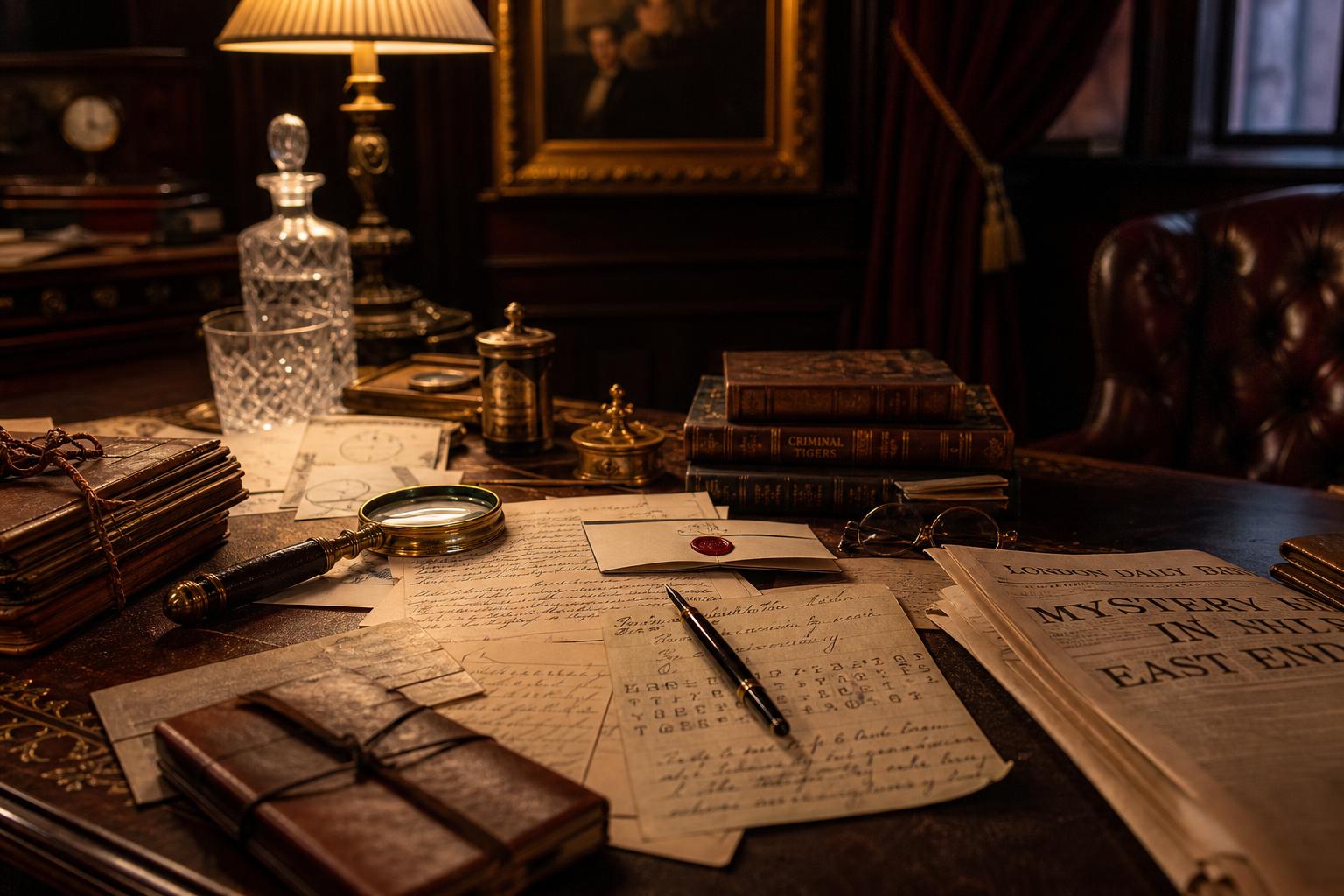
Introduction: Why Criminal Letters Fascinate Us
Criminal letters occupy a strange space between evidence, performance, and confession, which is why they continue to grip public imagination. Unlike courtroom records or police reports, letters written by criminals often feel immediate and personal. They carry a voice, a mood, and sometimes a deliberate attempt to manipulate the reader. In the history of crime, these documents have served many purposes: taunting investigators, misleading authorities, threatening victims, or preserving secret communication within criminal networks. Their power lies not only in what they say, but in what they reveal unintentionally.
The Human Voice Behind the Crime
A letter can make an abstract crime feel unsettlingly real. Handwriting, phrasing, spelling patterns, and emotional tone all create a sense of proximity to the writer. This is one reason infamous cases involving correspondence, from the Jack the Ripper letters of 1888 to the Zodiac Killer’s coded messages in the late 1960s, remain culturally powerful. Even when authenticity is disputed, the letters shape how the public remembers the case.
More Than Written Words
These documents are rarely just messages. They are artifacts. Investigators examine paper type, ink, fingerprints, postal marks, and linguistic habits. In modern forensic linguistics, experts may compare grammar, vocabulary, and syntax to identify likely authors. Such analysis has become increasingly important because language can expose education level, regional background, or psychological intent.
Codes, Secrecy, and the Appeal of Mystery
Secret codes add another layer of fascination. Humans are naturally drawn to puzzles, and criminal history is full of encoded notes, hidden meanings, and symbolic signatures. Some were practical, designed to conceal plans from police or rivals. Others were theatrical, created to project intelligence or power. The Zodiac Killer, for example, sent several ciphers to newspapers, one of which remained unsolved for more than 50 years before being cracked in 2020 by a team of private codebreakers.
Why These Letters Still Matter
Criminal letters are not merely sensational relics. They help historians, criminologists, and forensic experts understand motive, method, and mindset. They also reveal how media attention can amplify a criminal’s message, sometimes turning private communication into public spectacle. In many cases, the letter becomes part of the crime itself, shaping the investigation and influencing how society interprets guilt, fear, and control.
A Window Into Criminal Psychology
What makes these letters enduring is their dual nature: they are both communication and strategy. Each one offers a rare glimpse into how offenders wanted to be seen, and what they hoped to hide.
What Makes a Criminal Letter Strange
Unusual Language, Tone, and Intent
A criminal letter becomes strange when it breaks the expectations of ordinary communication. Most letters are written to inform, persuade, apologize, or maintain relationships. By contrast, letters tied to crimes often aim to intimidate, mislead, boast, confess indirectly, or manipulate investigators and the public. That unusual purpose shapes every part of the message, from word choice to structure.
In many historical cases, the strangest letters combine everyday language with disturbing subject matter. A writer may discuss violence in a calm, almost casual tone, creating a sharp contrast that unsettles readers. This mismatch between tone and content is one reason such documents attract lasting attention. The Zodiac Killer’s letters, for example, became infamous not only because of their threats and claims, but because they mixed taunting humor, cryptic statements, and apparent self-satisfaction.
The Power of Contradiction
A letter often feels especially strange when it contains contradictory signals. The writer may sound educated in one sentence and irrational in the next. They may demand recognition while trying to hide their identity. They may claim moral superiority while describing criminal acts. These inconsistencies can suggest psychological instability, deliberate performance, or an attempt to confuse authorities.
Secret Codes and Hidden Meanings
Another feature that makes a criminal letter strange is the use of codes, ciphers, symbols, or layered messages. Secret writing transforms a letter from a simple document into a puzzle. In criminal history, coded messages have been used to conceal identity, protect accomplices, or create fear through mystery. Even a short substitution cipher can dramatically increase public fascination because it implies that the visible message is only part of the story.
Physical Clues and Visual Oddities
Strangeness is not limited to words alone. The physical appearance of a criminal letter can also make it memorable. Investigators often study handwriting, punctuation habits, spelling patterns, paper type, and ink. A message written in block capitals, assembled from cut-out newspaper letters, or marked with unusual symbols can seem theatrical and threatening at the same time.
Why Presentation Matters
Visual presentation can serve a strategic purpose. A disguised handwriting style may hinder identification, while chaotic formatting may be intended to project unpredictability. In forensic linguistics, even repeated misspellings can matter. Some are genuine errors; others are planted to create a false impression about the writer’s education, nationality, or mental state.
Public Reaction and Cultural Impact
A criminal letter becomes truly strange when it moves beyond evidence and enters public imagination. Media coverage often amplifies bizarre phrasing, coded passages, and symbolic details. Once that happens, the letter is no longer just a communication between offender and recipient; it becomes part of a larger narrative about fear, mystery, and control.
More Than a Message
What makes these letters endure is that they operate on multiple levels at once. They are personal messages, psychological weapons, forensic artifacts, and cultural objects. Their strangeness comes from that combination, where language, secrecy, and performance merge into something far more unsettling than ordinary correspondence.
Codes, Ciphers, and Hidden Meanings
Why Criminals Turned to Secret Writing
Across criminal history, codes and ciphers have served one central purpose: to hide intent from police, rivals, and sometimes even accomplices. Long before encrypted messaging apps, offenders relied on handwritten substitutions, symbolic drawings, acrostics, and numerical patterns to disguise plans or taunt investigators. In many famous cases, these hidden systems were not especially sophisticated by military standards, yet they proved powerful because they created delay, confusion, and public fascination.
A code usually replaces words or ideas with other terms or symbols, while a cipher transforms the letters or structure of a message according to a rule. That distinction matters because many notorious criminal messages blended both methods. A killer might use a substitution alphabet, then insert misleading phrases, spelling errors, or visual tricks to frustrate decoding. The result was often less about perfect secrecy and more about psychological control.
Famous Cases That Captivated Investigators
One of the best-known examples remains the Zodiac Killer, who mailed cryptograms to newspapers in the late 1960s and early 1970s. His first 408-character cipher was solved within days by a California schoolteacher and his wife. It revealed disturbing boasts but not his identity. Decades later, the 340-character cipher, sent in 1969, was finally cracked in 2020 by an international team using software-assisted analysis. The message again offered menace rather than a name, showing that some criminal ciphers were designed as performance as much as concealment.
Another enduring mystery is the Beale ciphers, allegedly linked to a buried treasure in Virginia. Of the three encrypted texts, only one has been decoded, reportedly using the United States Declaration of Independence as a key. Whether the story is genuine or a hoax remains debated, but its influence on popular culture is undeniable. It demonstrates how hidden writing can generate legends even when hard evidence is thin.
When Simplicity Worked
Not every secret message required advanced mathematics. During Prohibition and organized crime investigations, criminals often used nicknames, ledger abbreviations, and coded references to shipments, payments, or meeting places. These systems were effective because meaning depended on context. A harmless phrase about “shirts” or “tickets” could actually refer to weapons or cash.
How Investigators Decode Hidden Meanings
Modern codebreaking combines linguistics, statistics, historical context, and digital tools. Investigators look for repeated symbols, probable word patterns, and the habits of the writer. Frequency analysis remains foundational because, in English, letters such as E, T, and A appear more often than others. Even short notes can reveal clues through punctuation, spacing, and recurring errors.
Behavioral Clues Inside the Message
A cipher can expose personality as much as it hides content. Repetition, grandiose language, religious references, or theatrical threats may help profilers understand motive and ego. In some cases, the hidden meaning lies not only in what is encoded, but in why the sender wanted the message discovered at all.
Why These Messages Still Matter
Secret criminal writings continue to fascinate because they sit at the intersection of language, fear, and power. They remind us that communication itself can become a weapon, shaping investigations and public memory long after the crimes occurred. Some messages are solved quickly, others after decades, and some may never yield their full meaning, leaving historians and cryptanalysts with puzzles that remain stubbornly alive.
The Zodiac Killer's Unsolved Messages
A Campaign of Fear Through the Mail
Few criminal cases illustrate the terrifying power of written communication as vividly as the Zodiac Killer investigation. Between 1969 and 1974, a self-proclaimed murderer operating in Northern California sent a series of letters, greeting cards, and ciphers to newspapers and police. These messages did more than taunt investigators. They transformed a regional homicide case into a national obsession, using the media as a stage and cryptography as psychological warfare. The Zodiac’s writings became as infamous as the murders themselves, largely because they blended threats, symbolism, and apparent clues into a puzzle that still resists full explanation.
The first confirmed Zodiac letters arrived in July 1969, shortly after attacks in Vallejo and Benicia. Three nearly identical letters were mailed to the San Francisco Chronicle, the San Francisco Examiner, and the Vallejo Times-Herald. Each contained one-third of a 408-symbol cipher and a demand for publication on the front page. The writer threatened to kill again if the newspapers failed to comply. This was an early sign of the killer’s method: he sought not only victims, but also control over public attention.
The 408-Symbol Cipher
The Zodiac’s first major coded message, now known as the 408 cipher, was solved within a week by Donald and Bettye Harden, a schoolteacher and his wife from Salinas, California. Their solution revealed a rambling statement in which the killer claimed he enjoyed murdering people because it was “so much fun” and described humans as dangerous game. He also asserted that his victims would become his servants in the afterlife. Although the cipher offered insight into the killer’s mindset, it did not reveal his identity.
What the Solution Revealed
The decrypted text was disturbing less for its sophistication than for its theatricality. It contained spelling irregularities, repeated phrases, and a tone that mixed boastfulness with fantasy. This mattered because it suggested the Zodiac was crafting a persona, not simply communicating facts. Investigators and profilers have long debated whether the errors were genuine, deliberate misdirection, or part of an attempt to appear more chaotic than he really was.
Notably, the 408 cipher ended with an incomplete line. The final 18 characters remained unsolved because they did not fit the rest of the message cleanly. Some researchers believe they may be meaningless filler, while others suspect they conceal a signature or name. More than five decades later, no consensus exists.
The Infamous 340 Cipher
If the 408 cipher introduced the Zodiac as a code-maker, the 340 cipher cemented his legend. Mailed in November 1969, this 340-character cryptogram resisted solution for 51 years. Amateur and professional codebreakers studied it for decades, making it one of the most famous unsolved ciphers in criminal history. In December 2020, a team consisting of David Oranchak, Sam Blake, and Jarl Van Eycke finally cracked it using a combination of software analysis and human pattern recognition.
The solution did not reveal the killer’s name, despite decades of speculation. Instead, it contained another taunting message. The Zodiac denied being afraid of the gas chamber and repeated his belief that he would collect slaves for the afterlife. The text also appeared to reference a television appearance in which someone claiming to be the Zodiac had called into a talk show. Its significance lay in confirming that the killer’s codes were often performative rather than confessional.
Why It Took So Long to Solve
The 340 cipher proved difficult because it was not arranged in a straightforward substitution pattern like the earlier 408. The solver team discovered that the text had been written diagonally and included transposition elements, meaning the symbols had to be reordered before substitution could work. This complexity made brute-force attempts ineffective for years. The eventual breakthrough demonstrated how modern computing could assist in historical investigations, even when the result offered more psychological texture than hard evidence.
Letters Beyond the Ciphers
The Zodiac’s unsolved messages were not limited to cryptograms. Many of his plain-text letters remain mysterious because of their references, threats, and possible hidden meanings. In August 1969, he opened one letter with the phrase, “This is the Zodiac speaking,” creating one of the most recognizable signatures in criminal history. He often included his crosshair symbol, which became a visual trademark.
Some messages hinted at future violence, while others appeared designed to confuse. The “Bus Bomb” letter of November 1969 described a supposed explosive device and threatened schoolchildren, causing widespread panic. No such bomb was found, but the letter showed how effectively the Zodiac could weaponize uncertainty. Even when he may have been bluffing, authorities had to treat every claim as credible.
Disputed and Unverified Communications
A major challenge in Zodiac research is determining which messages were authentic. More than 20 letters are generally associated with the case, but not all are universally accepted. Handwriting differences, tone shifts, and inconsistent details have led experts to question several communications. This uncertainty complicates interpretation because a fake letter can distort the perceived motives or style of the real killer.
The 1974 “Exorcist letter,” for example, is often considered authentic because of handwriting and phrasing similarities, yet it is markedly different in tone from earlier messages. It praised the film The Exorcist as “the best satirical comedy” and included a brief symbol-based sign-off. Whether this reflected an evolving mindset, declining interest, or imitation remains debated.
Why the Messages Still Matter
The Zodiac’s letters continue to fascinate because they sit at the intersection of crime, media, and codebreaking. They are historical documents, but also unresolved artifacts. Some contain solved text without solved meaning. Others remain partly or wholly undeciphered, including the so-called Z13 and Z32 ciphers, both too short to yield reliable solutions. Short ciphers are notoriously difficult because there is not enough text for statistical certainty, allowing countless plausible interpretations.
For investigators, these messages remain potentially evidentiary. For historians, they reveal how a killer manipulated public fear in an era before the internet. For readers today, the enduring mystery lies not only in who wrote the letters, but in how language itself became a weapon.
Jack the Ripper and the Infamous Taunts
A Killer Who Wrote to the World
Few criminal cases are as entangled with letters, rumor, and media spectacle as Jack the Ripper. During the autumn of 1888, as a series of brutal murders terrorized London’s Whitechapel district, newspapers and police began receiving messages allegedly written by the killer. These communications helped transform a local murder investigation into an international obsession. Whether authentic or fabricated, the letters became central to the mythology of the case and remain among the most famous examples of criminal taunting in history.
The Whitechapel murders occurred in a densely populated, impoverished area of London’s East End. Between August and November 1888, at least five women are widely considered the “canonical” victims: Mary Ann Nichols, Annie Chapman, Elizabeth Stride, Catherine Eddowes, and Mary Jane Kelly. The violence of the crimes, combined with limited forensic methods of the era, created ideal conditions for panic. Into that atmosphere came a flood of correspondence, much of it claiming insider knowledge or direct responsibility.
The “Dear Boss” Letter
The most famous of these messages is the “Dear Boss” letter, dated 25 September 1888 and received by the Central News Agency. Written in red ink, it mocked police efforts and promised further violence. Most significantly, it ended with the signature “Jack the Ripper”, a name that would eclipse all other labels previously used in the press, such as “Leather Apron.” The letter’s theatrical tone suggested someone keenly aware of public fear and media attention.
Why the Name Mattered
The phrase “Jack the Ripper” was unforgettable because it was simple, vivid, and sensational. In an age of rapidly expanding mass journalism, a memorable nickname could shape public imagination almost instantly. Once newspapers printed it, the case gained a brand-like identity. That identity still dominates popular culture more than a century later, demonstrating the extraordinary power of a single written taunt.
The “Saucy Jacky” Postcard
A second notorious communication, the “Saucy Jacky” postcard, was postmarked 1 October 1888. It referred to the “double event,” a phrase seemingly alluding to the murders of Elizabeth Stride and Catherine Eddowes on the same night, 30 September. Because the postcard appeared to reference details not yet widely known, some investigators considered it potentially genuine. Others argued that journalists or opportunists could have inferred enough from early reports to create a convincing fake.
The postcard reinforced the image of a killer who was not merely evasive but performative. Instead of hiding in silence, the writer appeared to relish suspense, timing, and public reaction. That feature made the communications especially disturbing. They implied not only violence, but a desire to control the narrative surrounding it.
The “From Hell” Letter
Another chilling message, known as the “From Hell” letter, was sent to George Lusk, head of the Whitechapel Vigilance Committee, in October 1888. Unlike the polished mockery of “Dear Boss,” this note was rougher in style and accompanied by half of a human kidney. The writer claimed to have fried and eaten the missing half. Because Catherine Eddowes had suffered kidney damage during her murder, the package drew immediate attention.
Authenticity and Doubt
Historians remain divided over whether any of these letters came from the actual killer. More than 600 letters connected to the case were reportedly received by police, newspapers, and local figures. Many were almost certainly hoaxes. Some may have been written by reporters seeking circulation boosts in a fiercely competitive press market. Modern scholarship often treats the “Dear Boss” letter as likely fraudulent, yet uncertainty persists because definitive proof is impossible.
Media, Fear, and the Birth of a Criminal Legend
The Ripper letters mattered not only because of what they said, but because of how they circulated. Victorian newspapers thrived on sensational crime coverage, and the letters gave editors dramatic material that blurred the line between evidence and entertainment. Public officials had to respond to messages that might be worthless, while citizens absorbed each new publication as if it were a direct window into the killer’s mind.
A Template for Future Taunts
These communications established a pattern later seen in other notorious cases: the criminal or supposed criminal using letters to manipulate investigators, frighten the public, and secure immortality through print. In that sense, the Ripper correspondence marks an early and influential example of crime as media performance. The taunts were not just side notes to the murders; they were instruments that amplified terror, distorted investigation, and helped create one of history’s most enduring unsolved mysteries.
The Black Dahlia and Anonymous Notes
A Murder That Invited Public Obsession
The 1947 murder of Elizabeth Short, remembered as the Black Dahlia, became one of the most infamous unsolved crimes in American history. Short, a 22-year-old aspiring actress, was found in Los Angeles on January 15, 1947, her body deliberately posed in a vacant lot. The brutality of the crime, combined with the theatrical staging, drew intense media attention almost immediately. Newspapers amplified the mystery, and the case quickly evolved from a homicide investigation into a national spectacle.
What made the Black Dahlia case especially haunting was not only the violence itself, but the way it seemed to invite communication from the shadows. In the days after the discovery, journalists and police began receiving anonymous notes, letters, and packages connected to the murder. These messages transformed the case into something larger than a police file. They suggested a killer, or perhaps a hoaxer, who understood the power of fear and publicity.
The Anonymous Mailings
One of the most famous developments came when the Los Angeles Examiner received a package on January 24, 1947. It contained Short’s birth certificate, business cards, photographs, and an address book with names embossed on the cover. The sender had apparently cleaned the items with gasoline, likely to remove fingerprints. This detail alone indicated either careful planning or a sophisticated attempt to appear credible.
The “Here Is Dahlia’s Belongings” Message
The package included a note assembled from clipped newspaper and magazine letters, reading: “Here is Dahlia’s belongings” and promising more to come. The crude style resembled the ransom-note tradition already familiar to the public, but in this case the purpose seemed different. Rather than demand money, the writer appeared to be controlling the narrative, feeding the press while taunting investigators.
Additional letters followed, some signed with names like “Black Dahlia Avenger.” Authorities had to determine whether these communications came from the murderer or from opportunists exploiting the headlines. That challenge remains central to many famous criminal correspondence cases: publicity attracts imitators.
Why the Notes Mattered
The anonymous notes mattered because they blurred the line between evidence and performance. Investigators could not ignore them, especially when authentic personal items were included. Yet every false lead consumed time and resources. In major cases, this problem is common. The FBI and local police have long noted that high-profile crimes often generate floods of confessions, tips, and fabricated messages.
Media, Myth, and Manipulation
The Black Dahlia case unfolded during a period when newspapers were powerful cultural gatekeepers. Anonymous notes became tools of manipulation, allowing an unknown writer to shape headlines and public emotion. Whether the sender was the killer or not, the letters helped build the enduring mythology of the case. They turned the murder into a dialogue between the press, the police, and an unseen author.
Even today, historians study these messages not just for forensic clues, but for what they reveal about criminal theater, media influence, and the unsettling human urge to insert oneself into notorious violence.
The Lindbergh Kidnapping Ransom Letters
A Crime Defined by Its Correspondence
The 1932 kidnapping of Charles Lindbergh Jr., the infant son of aviator Charles Lindbergh and Anne Morrow Lindbergh, became one of the most infamous crimes in American history. While the tragedy itself shocked the public, the case was also shaped by a series of ransom letters that turned a private nightmare into a national obsession. These notes were not merely demands for money. They became forensic evidence, linguistic puzzles, and crucial clues in one of the earliest media-saturated criminal investigations.
From the first note left on the windowsill of the Lindbergh home in Hopewell, New Jersey, investigators recognized that the letters were unusual. The opening ransom demand asked for $50,000, a massive sum during the Great Depression, and warned the family against contacting police. Over time, the kidnappers sent multiple letters, eventually increasing the demand to $70,000. Each message reinforced the same threatening tone and strange written style, helping authorities build a profile of the writer.
Distinctive Features of the Letters
What made the Lindbergh ransom letters so memorable was their highly distinctive language. The writer used broken English, irregular grammar, and unusual spelling, including constructions that suggested a non-native speaker. Phrases such as “gut care” instead of “good care” and awkward sentence patterns led investigators to suspect a German-speaking author. This detail later became significant when attention focused on Bruno Richard Hauptmann, a German immigrant arrested in 1934.
The Symbol That Stood Out
Perhaps the most striking feature was the signature symbol appearing on the ransom notes. Instead of a conventional name, the kidnapper used a strange mark composed of interlocking circles and colored holes, often described as a custom emblem. This symbol functioned like a criminal trademark, intended to prove authenticity and distinguish real communications from possible hoaxes. In an era before digital verification, such a mark served as a primitive but effective security device.
The symbol also added to the aura of mystery surrounding the case. Newspapers reproduced it widely, and the public came to associate it with the kidnapping itself. In effect, the emblem transformed the letters into something more than written threats; they became branded artifacts of fear.
Forensic Importance in the Investigation
The ransom letters played a central role in the prosecution’s case. Handwriting experts compared the notes to samples linked to Hauptmann and argued that the similarities were substantial. At the time, handwriting analysis was considered a powerful forensic tool, though modern scholars debate how reliable some of those methods were. Still, in the 1935 trial, the letters helped persuade the jury that Hauptmann had authored the demands.
Language, Handwriting, and Evidence
Investigators examined not only penmanship but also spelling habits, word choice, and syntax. The repeated grammatical errors were treated as identifying markers rather than random mistakes. Authorities believed the letters revealed both education level and national background. Combined with testimony, ransom money traced to Hauptmann, and other circumstantial evidence, the correspondence became a cornerstone of the case.
Public Fascination and Lasting Debate
The Lindbergh ransom letters remain controversial because the case itself has never fully escaped doubt. Some historians argue that the evidence against Hauptmann was compelling, while others believe the investigation and trial were influenced by intense public pressure. The letters sit at the center of that debate. Were they the authentic voice of a lone kidnapper, or part of a more complicated criminal network?
What is certain is that these notes changed criminal investigation in the United States. They demonstrated how document analysis, linguistic clues, and symbolic markings could shape a major case. They also showed the power of written communication in criminal history: a few sheets of paper, marked by strange grammar and a cryptic emblem, were enough to terrify a nation and leave questions that still endure.
The Monster of Florence and Cryptic Clues
A Killer Who Left More Than Fear
The case of the Monster of Florence remains one of Italy’s most disturbing criminal mysteries, not only because of the murders themselves but also because of the strange clues that seemed to orbit the investigation. Between 1968 and 1985, 16 people were killed in a series of attacks around Florence, most of them young couples parked in secluded areas. The murders were marked by a consistent method, leading investigators to believe a single killer, or tightly connected group, was responsible.
What pushed the case beyond a conventional serial murder investigation was the appearance of cryptic communications and symbolic details. These elements fueled public panic and encouraged theories involving ritual motives, coded messages, and hidden networks. In a country already sensitive to political conspiracies and secret societies during the late twentieth century, such clues carried enormous cultural weight.
The Anonymous Letter and Escalating Mystery
One of the most infamous developments came in 1985, when an anonymous letter was sent to prosecutor Silvano Franzoni. Inside was a fragment of a victim’s body, a horrifying act that transformed the killer from a shadowy murderer into someone apparently eager to communicate through terror. The message was not elaborate in length, yet its symbolism was unmistakable. It suggested control, mockery, and a desire to manipulate investigators.
Why the Letter Mattered
The letter demonstrated that the perpetrator, or someone closely connected to the crimes, understood the power of psychological theater. Rather than simply evading capture, the sender appeared to be shaping the narrative. This tactic resembles other notorious criminal cases in which coded or taunting messages became part of the offender’s identity. In Florence, however, the communication was less about puzzles on paper and more about a grotesque, symbolic statement.
Codes, Ritual Theories, and Investigative Confusion
As the investigation expanded, authorities explored theories that the murders were linked to esoteric practices, underground groups, or ceremonial symbolism. Some suspected that the mutilations carried coded meaning. Others believed the clues were red herrings, either planted deliberately or overinterpreted by investigators under intense pressure.
A Case Buried in Interpretation
The difficulty was that ambiguous evidence can generate endless readings. A symbol, a missing object, or a staged scene may look like a code even when it is not. In the Monster of Florence case, this problem became severe. Multiple suspects were pursued, including Pietro Pacciani, yet convictions were overturned and competing explanations persisted. The result was an investigation clouded by uncertainty, where cryptic clues deepened the mystery instead of solving it.
Even today, the case stands as a chilling example of how secrecy, symbolism, and fear can turn a murder investigation into a labyrinth of interpretation.
How Investigators Decode Criminal Messages
Reading Beyond the Surface
When investigators encounter a suspicious letter, ransom note, or encrypted message, they rarely treat it as just text. Every criminal communication is a source of behavioral, linguistic, and forensic evidence. Detectives, cryptanalysts, and forensic linguists work together to determine not only what a message says, but also who likely wrote it, how it was produced, and what hidden meanings may be embedded within it.
In many cases, the first step is preserving the original document. Handwriting, paper type, ink composition, printer marks, and even fold patterns can reveal valuable clues. A typed note may carry microscopic defects from a specific printer, while a handwritten message can expose habits such as letter formation, spacing, and pressure. These details have helped link suspects to threatening letters in numerous criminal investigations.
The Role of Cryptanalysis
When a message appears coded, investigators turn to cryptanalysis, the practice of breaking ciphers without the original key. Some criminal codes are simple substitution systems, where one letter stands for another. Others use transposition, symbols, or layered encryption designed to confuse readers. Analysts begin by looking for patterns, repeated characters, and common word lengths. In English, letters such as E, T, and A appear frequently, making frequency analysis a powerful starting tool.
Pattern Recognition in Practice
A short coded message can still reveal structure. If a three-symbol sequence appears repeatedly, analysts may test whether it represents common words like “the” or “and.” In longer texts, recurring clusters can suggest names, places, or instructions. This method was famously used in attempts to solve messages attributed to the Zodiac Killer, whose ciphers continue to fascinate both professionals and amateur codebreakers.
Linguistics and Author Profiling
Not all decoding involves mathematics. Forensic linguistics examines grammar, spelling, vocabulary, and phrasing to identify likely authorship or regional background. A criminal may try to disguise their style, yet subtle patterns often remain. Repeated misspellings, unusual punctuation, or preferred expressions can point to education level, age group, or native language.
Hidden Signals in Word Choice
Investigators also study whether a message contains deliberate misdirection. A writer may imitate another person’s accent or use exaggerated errors to appear less educated. In some cases, messages include acrostics, embedded initials, or references only a small circle would understand. These hidden signals can narrow the suspect pool significantly.
Technology in Modern Investigations
Today, digital tools accelerate the decoding process. Software can compare writing samples, test cipher possibilities, and scan massive databases for matching phrases. Machine learning systems can detect stylistic similarities across emails, manifestos, and online posts. According to cybersecurity research, automated text analysis now helps process thousands of communications far faster than manual review alone.
When Decoding Changes a Case
A decoded message can reveal motive, timeline, accomplices, or intended victims. Sometimes the breakthrough is not the full solution of a code, but a single identified pattern that connects the message to a suspect. In criminal history, that small crack in secrecy has often been enough to turn a baffling mystery into a solvable case.
Why Offenders Send Letters at All
Communication as Control
Criminal letters are rarely random. In many cases, offenders write because communication extends their power beyond the crime itself. A letter can intimidate victims, taunt investigators, manipulate public opinion, or reshape how the offender is perceived. Long before digital media, mailed messages offered a direct route into homes, police stations, and newspaper offices, giving offenders a way to command attention at relatively low risk.
For some, the act of writing becomes part of the offense. The message is not separate from the crime but an extension of it. Historical cases show that anonymous letters often appeared after highly publicized offenses, especially when newspapers amplified every detail. In the late nineteenth and twentieth centuries, sensational press coverage created an environment in which a single letter could generate national fascination.
The Need for Recognition
Many offenders send letters because they want recognition, notoriety, or validation. This does not always mean fame in the ordinary sense. Sometimes it reflects a desire to prove superiority over police, to demonstrate cleverness, or to force society to acknowledge them. In notorious serial crime cases, letters often include coded phrases, insider references, or threats designed to convince authorities that the writer is genuine.
Publicity and Ego
When media outlets publish excerpts, the offender may feel rewarded. Criminologists have long noted that some offenders display narcissistic traits, and public attention can reinforce that behavior. A letter signed with a symbol, nickname, or cryptic slogan can help build a dark persona that outlives the original act.
Manipulation, Misdirection, and Strategy
Not every criminal letter is driven by ego alone. Some are strategic tools. Offenders may send false confessions, misleading clues, or coded messages to divert investigations. Others use letters to negotiate ransom, threaten witnesses, or maintain contact with accomplices. In organized crime and prison settings, written communication has historically served practical purposes, including passing instructions while avoiding direct meetings.
Why Codes Appear
Codes and ciphers add another layer. They can conceal information, but they also create mystique. Even simple substitutions may be enough to delay understanding or attract media attention. In many famous cases, the code matters not only for secrecy but for theater, turning the letter into a performance aimed at police, journalists, and the public.
A Window Into Criminal Psychology
These letters matter because they reveal motive, fear, vanity, and planning. They are artifacts of psychology as much as evidence, offering investigators rare insight into how offenders want to be seen, remembered, or misunderstood.
Media, Public Panic, and Mythmaking
How Coverage Turns Mystery into Legend
When strange letters or coded messages appear in a criminal case, media attention often becomes part of the story itself. Newspapers, radio, television, and now social platforms do more than report facts; they shape public interpretation. In several famous investigations, repeated headlines transformed uncertain details into enduring myths. The more cryptic the message, the easier it became for speculation to fill gaps left by limited evidence.
During the late nineteenth and twentieth centuries, sensational crime reporting was a proven circulation driver. Editors understood that coded threats, taunting letters, and anonymous notes offered a perfect mix of fear and intrigue. Cases linked to figures such as Jack the Ripper and the Zodiac Killer show how public fascination can outgrow verified facts. In the Zodiac case, for example, some letters were authenticated while others remain disputed, yet popular culture often treats the entire body of correspondence as equally reliable.
The Mechanics of Public Panic
Public panic grows when uncertainty meets repetition. A single alarming letter may disturb a community, but constant coverage can make danger feel omnipresent. This effect is amplified when reports emphasize symbols, hidden meanings, or claims of secret knowledge. Readers begin to imagine a criminal mastermind operating beyond the reach of ordinary policing, even when investigators possess little proof of such sophistication.
Why Codes Intensify Fear
Codes suggest planning, intelligence, and concealment. Even simple substitution ciphers can appear terrifying to the public because they imply that something important is being hidden. Historically, many so-called secret codes in criminal correspondence were not especially advanced, yet their presentation in headlines gave them an aura of near-supernatural complexity. The mystery of the unread message often frightened people more than the message itself.
Mythmaking and Cultural Memory
Once a dramatic narrative takes hold, it can persist for decades. Films, books, documentaries, and online forums frequently repeat unverified claims because they are memorable and emotionally powerful. Over time, rumor can harden into accepted history. A forged letter, an exaggerated translation, or a misunderstood symbol may become central to a case’s legend despite weak evidentiary support.
The Gap Between Record and Reputation
This gap matters because it affects how criminal history is remembered. Mythmaking can overshadow victims, distort investigative realities, and reward theatrical offenders with lasting notoriety. It also reminds readers to distinguish between documented evidence and the stories built around it, especially in cases where secrecy, fear, and media competition collided.
Conclusion: What These Letters Reveal
More Than Messages
The strangest letters and secret codes in criminal history reveal far more than hidden words on a page. They expose how criminals think, manipulate, and perform for audiences that often extend beyond their immediate victims. From the Zodiac Killer’s ciphers to ransom notes designed to confuse investigators, these documents show that written communication can become a weapon in itself. In many cases, the letter was not simply a tool for delivering information. It was part of the crime’s psychological architecture, meant to create fear, control public attention, or shape the offender’s image.
The Power of Secrecy and Symbolism
Why Codes Matter
Codes and cryptic language carry a special power because they suggest forbidden knowledge. Even when a cipher is eventually solved, its greatest impact often occurs before the solution arrives. Investigators must spend valuable time decoding it, while the public becomes captivated by mystery. That delay creates tension, and offenders who use coded messages often understand this effect. Historical cases show that secrecy can magnify notoriety, especially when newspapers, police departments, and amateur codebreakers all become involved.
What Investigators Learn
These letters also reveal the importance of forensic linguistics, handwriting analysis, and contextual reading. A message may contain clues about education, regional language, emotional state, or intent. In some investigations, such details have helped narrow suspect pools or expose hoaxes. In others, they have demonstrated how easily written evidence can mislead. The most revealing feature is often not the code itself, but the human need behind it: the desire for power, recognition, revenge, or immortality.
A Lasting Historical Record
Taken together, these letters remain unsettling historical artifacts. They preserve the voices criminals wanted remembered, while also documenting the evolving methods investigators use to interpret silence, deception, and fear.
FAQ: Common Questions About Criminal Codes
What is a criminal code in historical cases?
In the context of criminal history, a criminal code usually refers to a secret system of letters, symbols, numbers, or substitutions used by offenders to hide meaning from police, rivals, or the public. These codes have appeared in extortion letters, prison messages, gang communications, and infamous unsolved cases. One of the best-known examples is the Zodiac Killer, who sent encrypted messages to newspapers in the late 1960s. Several of those ciphers were solved, while others remain disputed or unread.
Why did criminals use coded messages?
Criminals often relied on codes for secrecy, intimidation, and control. A coded note could delay investigators, protect accomplices, or create a myth around the sender. In some cases, the code itself became part of the crime. Historians and criminologists note that public fascination grows when a message appears deliberately mysterious, especially if it includes unusual symbols or taunting language. That attention sometimes gave offenders exactly what they wanted: fear and notoriety.
Were these codes usually sophisticated?
Simple substitutions versus complex ciphers
Many historical criminal codes were less advanced than popular culture suggests. A large number used simple substitution methods, where one letter stands for another. Others mixed symbols, misspellings, and misleading patterns to appear more complex. Truly advanced encryption was rarer because most offenders lacked formal cryptographic training. Even so, a basic cipher could be effective if investigators had limited time, weak pattern analysis tools, or incomplete text samples.
How are old criminal codes solved today?
Modern researchers combine traditional codebreaking with digital analysis. Frequency testing, pattern recognition, and contextual reading remain essential, but computers now help process thousands of possible solutions quickly. Collaboration also matters. Linguists, historians, mathematicians, and amateur cryptanalysts have all contributed to famous breakthroughs. In 2020, for example, an international team solved the Zodiac’s 340-character cipher, showing how modern computing and human insight can work together.
Do all criminal codes get solved?
No. Some messages are too short, damaged, or intentionally chaotic to decode with confidence. Without enough text, analysts cannot reliably identify patterns. In other cases, the “code” may be meaningless by design, created only to confuse investigators. That uncertainty is part of why criminal codes still fascinate readers, researchers, and true-crime audiences today.


