

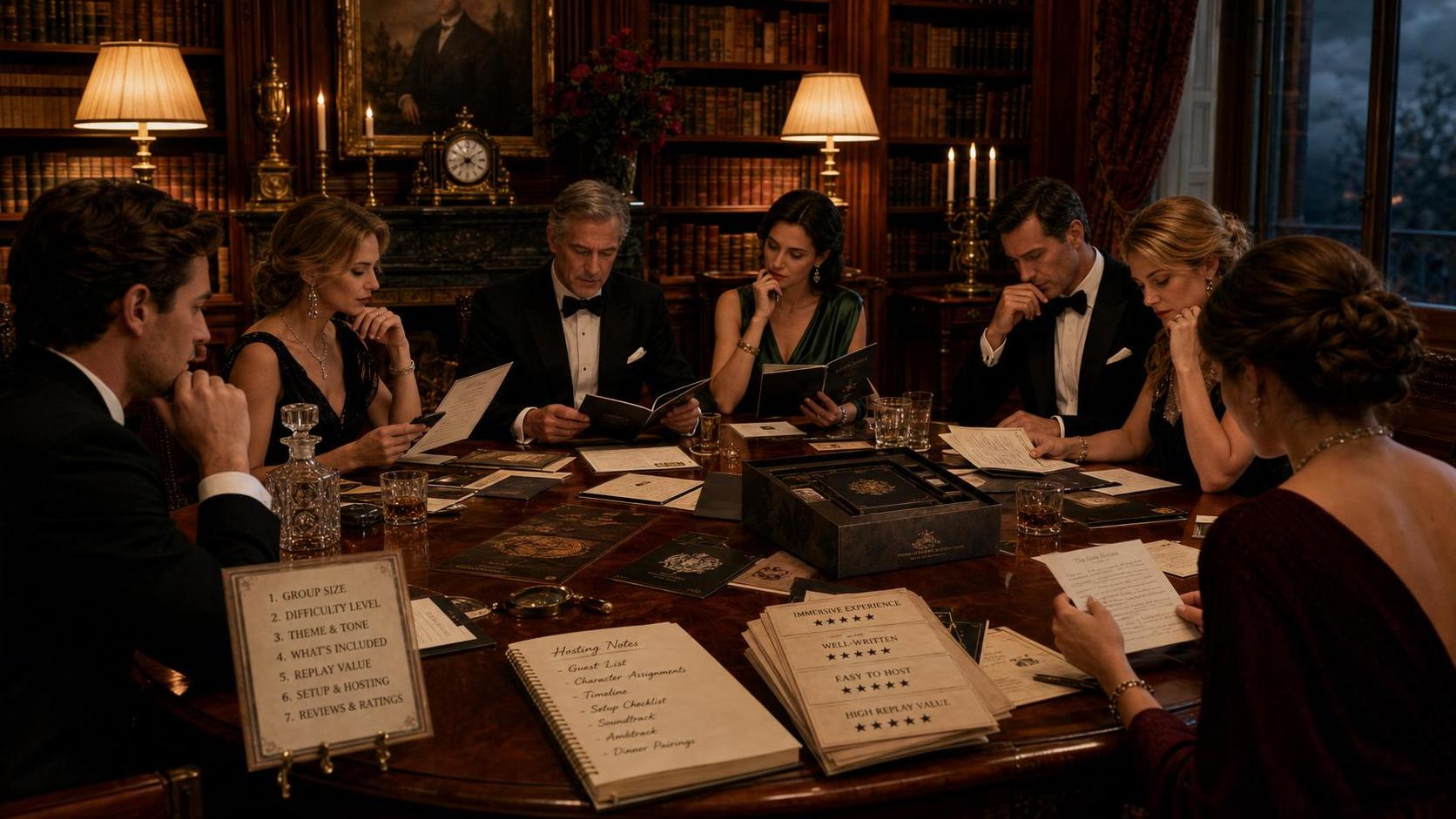
Introduction: Why Murder Mystery Games Need a Closer Look
Murder mystery games often look simple on the surface: a box, a theme, a guest list, and the promise of an unforgettable night. Yet buying the right game is rarely as straightforward as the packaging suggests. These games vary widely in structure, writing quality, player involvement, and overall difficulty, which means a poor choice can quickly turn an exciting gathering into a confusing or awkward experience.
More Than Just a Party Activity
At their best, murder mystery games combine storytelling, improvisation, deduction, and social interaction in a way few other party formats can match. The global board game market surpassed $13 billion in recent years, and social deduction and narrative-driven experiences continue to grow in popularity. Murder mystery titles benefit from that trend, appealing to families, friend groups, corporate teams, and event hosts looking for something more immersive than standard party games.
However, not every game delivers the same kind of experience. Some are designed for lighthearted fun with minimal preparation, while others demand detailed character study, scripted clues, and several hours of focused participation. Understanding those differences before buying matters because the success of the event often depends less on the theme and more on how well the game fits the group.
Why the Wrong Choice Can Ruin the Experience
A mismatch between the game and the players is one of the most common reasons these events fall flat. A highly theatrical game may overwhelm shy guests, while a loosely structured mystery may disappoint players who want stronger logic and clearer objectives. Group size also matters. A game built for eight players can feel broken with six, and a flexible game may still lose momentum if too many participants are passive.
Expectations Shape Enjoyment
Buyers also need to consider practical factors such as age suitability, hosting effort, replay value, and whether the game requires costumes, apps, or printed materials. What looks entertaining in a product description may involve far more work than expected. Reviews often reveal issues like uneven character importance, predictable endings, or vague instructions that are easy to miss at first glance.
A Smarter Purchase Starts With Better Questions
Looking more closely at murder mystery games helps buyers avoid wasted money and disappointing events. It also makes it easier to choose a game that matches the tone, complexity, and energy of the occasion. Before comparing specific products, it is worth understanding the key factors that separate a memorable mystery night from one guests would rather forget.
1. Know Your Group Size and Player Type
Choosing the right murder mystery game starts with a clear understanding of who will actually be playing. A beautifully designed game can still fall flat if it does not match your group’s size, energy level, or social style. Before comparing themes, price points, or production quality, it helps to evaluate the practical reality of your guest list. The best experience usually comes from a game that feels tailored to the people in the room rather than one that simply looks exciting on the box.
Why group size matters more than most buyers expect
Group size affects nearly every part of gameplay, including pacing, character distribution, clue sharing, and overall immersion. Many murder mystery games are built around a fixed number of roles, often somewhere between 6 and 12 players, while others offer expandable formats for larger parties. If you buy a game designed for eight and invite twelve, four guests may end up underinvolved or forced into awkward last-minute adjustments. On the other hand, using a large-cast game with only six players can leave major plot gaps and reduce the dramatic tension that makes the format enjoyable.
A well-matched player count helps ensure that everyone has a meaningful role. In strong designs, each participant receives motives, secrets, and opportunities to interact. When the numbers are off, some players may become passive observers instead of active suspects. That imbalance can quickly weaken the experience, especially in groups where people expect equal participation.
Fixed-role games versus flexible formats
Not all murder mystery games handle attendance the same way. Some are tightly scripted, with each character tied to specific evidence and dialogue prompts. These games often deliver a more cinematic experience, but they are less forgiving if someone cancels. Flexible games, by contrast, may use modular clues, host-led narration, or scalable suspect pools that can accommodate changing numbers more easily.
When fixed-role games work best
Fixed-role games are ideal for groups that can confirm attendance in advance and enjoy structured roleplay. They often create stronger character arcs because every player has a defined place in the story. For milestone birthdays, dinner parties, or themed events, this format can feel polished and memorable.
When flexible games are the safer choice
Flexible formats are better for casual gatherings, mixed social circles, or events where RSVPs are uncertain. If your group tends to change plans at the last minute, a scalable game can prevent unnecessary stress. This is especially useful because event planners often see no-show rates of 10% to 20% for informal social gatherings, making adaptability a practical advantage.
Understanding your player type
Beyond numbers, you need to think about how your group likes to interact. Some players love theatrical accents, improvisation, and staying in character for hours. Others prefer solving puzzles, reviewing evidence, and asking strategic questions. A mismatch between game style and player personality is one of the most common reasons a murder mystery night feels awkward instead of entertaining.
Social players, analytical players, and mixed groups
Social players usually enjoy games with dramatic reveals, humorous dialogue, and plenty of conversation. They may care less about perfect deduction and more about the fun of suspicion and performance. Analytical players, by contrast, often want coherent clues, logical timelines, and a solvable mystery. They are more likely to notice plot holes or become frustrated if the ending feels random.
Matching the game to the room
If your group is highly social, look for games that emphasize interaction and character secrets. If your players are detail-oriented, choose a mystery with stronger investigative mechanics. For mixed groups, the best option is usually a balanced game that combines accessible roleplay with enough evidence to reward careful thinking. That balance matters because most real-world gatherings include a range of comfort levels, from outgoing extroverts to quieter guests who need clearer prompts to participate.
Consider age, experience, and comfort level
Player type also includes age range and familiarity with the format. A group of first-time players may need simpler rules, shorter play sessions, and more guided hosting. Experienced players can usually handle layered plots, hidden objectives, and longer character briefs. If teens and adults are playing together, content tone matters too. Some games lean comedic, while others involve darker themes such as betrayal, blackmail, or staged violence.
A good buyer asks whether the group will enjoy performing, deducing, or simply socializing around the mystery. The right fit creates momentum, while the wrong fit creates hesitation. Once you know your group size and player type, it becomes much easier to choose a game that feels engaging from the first clue onward.
2. Choose the Right Difficulty Level
Selecting the right difficulty level is one of the most important factors when buying a murder mystery game. A game that is too easy can feel predictable and underwhelming, while one that is too complex may frustrate players and slow the energy of the event. The ideal choice depends on the experience level of your group, the amount of time available, and the style of challenge your guests actually enjoy.
Why difficulty matters
Murder mystery games are designed to balance storytelling, clue discovery, and deduction. If that balance is off, the entire experience can suffer. A beginner-friendly game usually offers clearer motives, more direct clues, and a simpler suspect pool. A more advanced game may include misleading evidence, layered character secrets, and multiple plausible theories that require closer attention.
This matters because players engage differently depending on the challenge. In a casual social setting, guests often want to laugh, role-play, and solve the case without feeling like they need detective training. In contrast, a group that enjoys escape rooms, strategy games, or puzzle-heavy board games may appreciate a tougher mystery with more intricate logic.
Match the game to your group
Before buying, think honestly about who will be playing. A game for first-time participants should not demand intense note-taking or long periods of analysis. If your guests are new to murder mystery parties, choose a game labeled easy or moderate. These versions typically keep the pace moving and help everyone feel involved.
Consider group experience
A mixed-experience group often benefits from a moderate difficulty level. That gives confident players enough to investigate while still allowing newer guests to follow the plot. If every participant is highly experienced, a difficult game can be rewarding because it creates more debate, deeper suspicion, and a stronger sense of accomplishment when the mystery is solved.
Consider group size
Difficulty also changes with player count. In smaller groups, each player tends to absorb more information, so a slightly harder mystery may still feel manageable. In larger groups, information can become fragmented, and side conversations may cause important clues to be missed. For groups of 10 or more, a moderate game often works better than an expert-level one unless the host is prepared to guide the flow carefully.
Understand common difficulty levels
Many publishers classify their games by challenge level, but those labels are not always standardized. One company’s “medium” may feel like another company’s “hard.” That is why reading product descriptions and customer reviews is essential.
| Difficulty | Typical Features | Best For |
|---|---|---|
| Easy | Clear clues, fewer twists, straightforward ending | Beginners, family groups, casual parties |
| Moderate | Some red herrings, stronger deduction, more character depth | Mixed groups, repeat players |
| Hard | Complex motives, misleading evidence, multiple layers | Experienced players, puzzle lovers |
A useful benchmark is playtime. Easy games often run between 60 and 90 minutes, while harder games may stretch beyond two hours, especially if players enjoy discussing every possibility. If your event includes dinner, drinks, or other activities, that extra time can affect the evening more than expected.
Watch for hidden complexity
Some games appear simple but become difficult because of poor writing or unclear instructions. That is not the same as a well-designed challenge. Good difficulty feels intentional, with clues that are subtle but fair. Bad difficulty feels confusing, with players unsure what information matters.
Read reviews carefully
Customer reviews often reveal whether a game is genuinely clever or simply disorganized. Look for comments about clue clarity, pacing, and whether the final solution made sense. If several buyers mention that players felt lost, that is a warning sign. If reviews say the mystery was challenging but satisfying, that usually indicates stronger design.
Think about the hosting style
The host plays a major role in how difficult a game feels. A structured host who explains rules clearly and keeps the event moving can make a moderate or hard game much more accessible. On the other hand, if the host wants a relaxed, low-prep evening, an easier game is usually the better purchase.
Some boxed games provide host guides, scripted reveals, and timed clue drops. These features reduce friction and help maintain momentum. For online or downloadable games, check whether the materials are organized well enough for smooth hosting, especially if this is your first time running a mystery event.
Choose challenge over confusion
The best murder mystery game creates tension, curiosity, and conversation without overwhelming the room. Difficulty should enhance fun, not replace it. When in doubt, it is usually smarter to choose a slightly easier game and let guests enjoy the experience than to risk a complicated mystery that drains enthusiasm. A well-matched challenge keeps players engaged, encourages interaction, and sets the stage for a memorable night of suspicion, discovery, and dramatic accusation.
3. Understand the Theme, Tone, and Setting
Before buying a murder mystery game, it is essential to look beyond the box title and understand its theme, tone, and setting. These three elements shape the entire player experience. A game may have clever clues and strong mechanics, but if the atmosphere does not match your group’s preferences, the evening can feel awkward or flat. Choosing the right style matters just as much as choosing the right difficulty level or player count.
Why theme matters
The theme is the central concept that gives the game its identity. Some murder mystery games are set in glamorous 1920s mansions, while others unfold on a train, at a masquerade ball, in a haunted hotel, or even aboard a spaceship. The theme influences costumes, dialogue, character roles, and the kind of story players will be stepping into.
A well-matched theme can dramatically increase engagement. For example, a group that enjoys period dramas may love a classic aristocratic whodunit, while fans of campy entertainment might prefer a retro prom-night mystery. According to consumer trend reports in the tabletop entertainment market, immersive experiences continue to grow in popularity because players want events that feel memorable rather than generic. A strong theme helps create exactly that kind of memorable event.
Tone sets expectations
The tone of a murder mystery game is equally important. Not every mystery is dark and serious. Some are written as lighthearted comedies filled with absurd twists, while others lean into suspense, noir, or psychological drama. If the tone is mismatched with the occasion, the game may not land as intended.
For instance, a humorous mystery works well for casual parties, mixed-age gatherings, or groups new to roleplay. A darker, more intense story may be better suited to adults who enjoy dramatic storytelling and are comfortable staying in character. If you are hosting a birthday party or holiday gathering, a playful tone often keeps the mood relaxed. If you are planning a dedicated game night with experienced players, a more serious tone may feel richer and more rewarding.
Matching tone to your group
Think carefully about your guests’ personalities. Some people love theatrical confrontation and dramatic reveals, while others prefer witty banter and low-pressure participation. A game described as “gritty,” “sinister,” or “mature” may include betrayal, scandal, or sensitive themes. By contrast, a game labeled “family-friendly” or “comedic” is usually designed to be accessible and easy to enjoy.
This is especially important if your group includes coworkers, teens, or relatives from different generations. Tone affects comfort level, and comfort level affects participation.
Setting shapes immersion
The setting is the world in which the mystery takes place. While theme and setting are closely related, the setting adds practical context. It tells players whether they are in Victorian London, a modern resort, the Wild West, or a futuristic colony. This matters because setting influences language, costumes, and how believable the clues feel.
A strong setting can make hosting easier. If the game takes place at a dinner party in a manor house, it is simple to decorate with candles, formal tableware, and classical music. If it is set in a sci-fi universe, your guests may need more imagination and preparation to fully engage. Neither is better, but one may fit your event more naturally.
Questions to ask before you buy
Before purchasing, read the product description carefully and look for clues about the game’s atmosphere. Ask whether the story feels elegant, silly, spooky, or intense. Consider whether your venue supports the setting and whether your guests will enjoy dressing for it. Reviews are especially useful here, because buyers often mention whether a game felt immersive, funny, confusing, or too serious for their group.
A practical example
Imagine you are hosting eight friends for a casual weekend gathering. A murder mystery set at a glamorous 1930s cocktail party with a witty tone will likely encourage easy conversation and playful roleplay. In contrast, a bleak detective thriller involving corruption and revenge may feel too heavy for the same crowd. The best choice is not the most dramatic game, but the one your players will genuinely enjoy stepping into.
When theme, tone, and setting align with your audience, the game becomes more than a puzzle. It becomes an experience your guests are far more likely to remember, talk about, and want to repeat.
4. Check What Is Included in the Box or Download
Before buying a murder mystery game, it is essential to look closely at what you are actually getting. Two games may appear similar in theme, price, or player count, yet offer very different levels of content. Some provide a complete, ready-to-run experience, while others require extra printing, preparation, or even additional purchases. Knowing exactly what is included helps you judge value, avoid surprises, and choose a game that matches your event style.
Physical Games Versus Digital Downloads
A boxed murder mystery game usually includes printed materials such as character booklets, invitations, clue cards, host instructions, and solution sheets. In some premium sets, you may also receive props, themed decorations, costume suggestions, or playlists. These extras can make hosting easier, especially for first-time organizers who want a more immersive experience without creating everything from scratch.
A downloadable game, by contrast, often delivers files in PDF format. These may include the same core materials as a boxed version, but the host is responsible for printing and organizing them. This can be convenient because digital products are available instantly and often cost less. However, the lower price does not always mean better value if you need to print 20 to 40 pages in color, buy envelopes, or spend hours assembling packets.
Core Materials to Look For
At minimum, a good murder mystery game should include clear host guidance, character descriptions, the main script or event structure, clues, and the final solution. If any of these elements are missing or vague, the game may be harder to run than expected. Reviews often reveal whether instructions are beginner-friendly or whether the host has to improvise major parts of the evening.
Character Packets and Role Detail
One of the most important inclusions is the character packet. Strong character materials usually contain background information, motives, secrets, and conversation prompts. These details help players stay engaged and make the mystery feel dynamic rather than scripted. If a game only gives each guest a name and a short paragraph, roleplaying may feel thin, particularly for groups that enjoy immersive storytelling.
Host Materials and Setup Instructions
The host packet should explain timing, room setup, clue distribution, and how to manage unexpected situations. For example, if a player cancels at the last minute, some games include flexible role adjustments, while others do not. That difference matters. A well-designed host guide can reduce preparation time significantly and make the event smoother from start to finish.
Extras That Add Real Value
Not every extra is necessary, but some additions can greatly improve the experience. Printable invitations, name tags, themed recipes, music suggestions, and decor guides help create atmosphere. In a 2023 consumer trend report from the Toy Association, experience-driven social entertainment continued to grow as buyers looked for products that supported at-home gatherings. Murder mystery games fit that trend well, and included extras often determine whether the event feels basic or memorable.
Some digital games also include editable files, allowing hosts to customize guest names or adapt the setting. That flexibility is especially useful for birthdays, team-building events, or holiday parties. If personalization matters to you, check whether the files are locked PDFs or editable templates.
Watch for Hidden Requirements
Some games seem complete at first glance but depend on outside materials. You may need internet access, a separate soundtrack, a smartphone for each player, or common household props. Others require the host to print everything, including confidential clues and certificates. These are not necessarily drawbacks, but they should be clear before purchase.
A helpful way to compare products is with a simple checklist:
| Feature | Why It Matters |
|---|---|
| Host guide | Reduces confusion and setup time |
| Character sheets | Supports roleplay and engagement |
| Clue cards or evidence | Drives the mystery forward |
| Invitations and extras | Enhances presentation |
| Printable or editable files | Adds flexibility |
| Solution reveal | Ensures a satisfying ending |
Match the Contents to Your Event
The right package depends on your goals. If you want a low-effort evening, a comprehensive boxed set may be worth the higher price. If you are comfortable printing materials and adding your own flair, a download can be a smart, budget-friendly option. The key is not just how much the game costs, but how complete the experience is. A quick check of the included contents can tell you whether the game is truly ready for your group, your schedule, and your hosting style.
5. Compare Replay Value and Game Format
One of the smartest ways to choose a murder mystery game is to look beyond the theme and examine how often it can be played and what format it uses. Two games may both promise suspense, character drama, and a memorable reveal, yet deliver very different long-term value. If you are buying for a one-time birthday party, a single-use experience may be perfect. If you want something your group can revisit with different players, replay value becomes far more important.
Why Replay Value Matters
Replay value affects both cost efficiency and group satisfaction. A boxed mystery that can only be played once may still be worth the price if it offers a polished, immersive evening. However, if the game costs $30 to $50 and serves only one session, the value calculation changes compared with a reusable title that supports multiple rounds. For example, a replayable game used six times by eight players can reduce the effective cost per player to well under $1 per session.
Replay value also depends on your social circle. If you regularly host game nights with different guests, even a story with a fixed solution can feel fresh because new participants bring different energy, suspicions, and roleplay styles. On the other hand, a small household that plays with the same people may quickly exhaust a game’s surprises.
One-Time Play vs. Replayable Designs
Many murder mystery games are designed as single-solution experiences. Once the killer, motive, and clues are known, the central puzzle loses much of its tension. This format is common in escape-room-style mystery boxes, detective case files, and heavily scripted party kits. These products often deliver stronger narrative pacing because the designers can tightly control the reveal.
Replayable designs take a different approach. Some use variable roles, randomized evidence, or rotating suspects so that each session unfolds differently. Others focus less on solving a fixed puzzle and more on social deduction, bluffing, or improvisation, which naturally creates variety. In these games, the fun comes not only from discovering the culprit but from watching players accuse, defend, and mislead one another in new ways each time.
Questions to Ask Before Buying
Before purchasing, check whether the publisher clearly states if the game is replayable. Look for phrases such as “resettable,” “variable endings,” “randomized setup,” or “play once”. Reviews are especially useful here, because some games marketed as replayable only offer minor variations, while others genuinely change the experience from session to session.
Understanding Common Game Formats
The format of a murder mystery game shapes the entire evening. A hosted party kit usually assigns characters in advance and encourages costumes, scripted reveals, and in-character conversation. This works well for larger gatherings and celebrations, especially when entertainment is as important as deduction.
A boxed tabletop game is often more structured. Players may gather clues through cards, boards, hidden information, or timed rounds. These games tend to be easier to set up than full party experiences and are often better for smaller groups of four to eight.
Digital, Hybrid, and Case-File Formats
Digital and hybrid formats have grown rapidly in recent years. Some games use apps, video evidence, or online portals to deliver clues. These can feel cinematic and convenient, especially for remote or tech-friendly groups. However, they may depend on devices, internet access, or subscription support, which can affect long-term usability.
Case-file mysteries, by contrast, usually emphasize investigation over performance. Players examine documents, maps, interviews, and forensic-style evidence at their own pace. This format appeals to people who enjoy analytical problem-solving more than roleplay, though it often has the lowest replay value because the solution is fixed.
Matching Format to Your Group
A lively, extroverted group may get the most from a theatrical party kit, while a quieter or strategy-focused group may prefer a tabletop or case-solving format. If your guests are new to murder mystery games, choose a format with simple rules and clear guidance. If they are experienced, they may appreciate more open-ended systems with hidden agendas and branching interactions.
The best purchase is not always the most elaborate game. It is the one whose format fits your players and whose replay value matches how often you realistically expect to bring it back to the table.
6. Consider Hosting Time, Setup, and Space
Match the Game to Your Real-World Constraints
A murder mystery game can look perfect on paper, yet still become stressful if it does not fit your schedule, home, or hosting style. Time, setup requirements, and available space often determine whether the experience feels smooth and immersive or rushed and awkward. Before buying, it helps to think beyond the story and guest count and focus on the practical side of hosting.
Many boxed or downloadable murder mystery games advertise a playtime of two to four hours, but that estimate often covers only the core gameplay. In reality, hosts usually need extra time for reading instructions, assigning characters, printing materials, decorating, preparing food, and explaining rules. A game listed as three hours may easily require five or six hours of total commitment on the event day, especially for first-time hosts.
Understand the Full Time Investment
When evaluating a game, look at the entire hosting timeline rather than just the stated runtime. Preparation time varies widely depending on the format. A simple digital party kit with printable character sheets may take under an hour to organize, while a highly themed game with props, invitations, costumes, and scripted rounds can require several evenings of prep.
Pre-Party Planning
Hosts should account for the time needed to invite players, match roles to personalities, and answer guest questions in advance. If the game requires specific costumes or character accents, guests may also need more notice. This matters because a game that demands heavy preparation can lose momentum if your group prefers spontaneous, low-effort gatherings.
Event-Day Timing
On the day of the party, setup can include arranging seating, placing clues, organizing envelopes, cueing music, and preparing food or drinks. If you are hosting dinner alongside the mystery, timing becomes even more important. A meal service can add 60 to 90 minutes, and breaks between rounds may extend the event beyond what some guests expect. For weeknight gatherings, that can be a dealbreaker.
Setup Complexity Can Change the Experience
Not all murder mystery games are equally easy to run. Some are designed for minimal host involvement, with clear instructions and self-guided rounds. Others rely heavily on the host to manage pacing, distribute clues, and keep players on track. The more complex the setup, the more important host confidence becomes.
A well-designed game should clearly explain what must be prepared beforehand and what can be handled during the party. If product descriptions are vague, reviews often reveal whether setup is straightforward or frustrating. For example, buyers frequently mention issues such as unclear printing instructions, confusing character packets, or missing guidance for larger groups. Those details matter more than flashy packaging.
Make Sure Your Space Supports the Format
Space affects gameplay more than many buyers expect. A seated dinner mystery works well in a dining room, but a roaming investigation game may need multiple areas for clue discovery and private conversations. If players are constantly squeezed around one table, the social deduction element can feel limited.
Seating, Movement, and Noise
Consider whether guests will stay seated, rotate between stations, or move freely throughout the room. A group of eight may fit comfortably in a small apartment, but 12 to 15 players often need more breathing room to talk, mingle, and stay in character. Noise is another factor. In compact spaces, several side conversations happening at once can make it hard for players to hear instructions or follow the plot.
Props and Theming
Some games need only printed materials, while others benefit from candles, evidence displays, costume accessories, or labeled clue areas. You do not need a huge house to host successfully, but you do need enough room to support the game’s structure. A simpler game often performs better in a smaller space than an elaborate one that feels cramped.
Choose Convenience or Immersion Intentionally
There is no universally correct level of effort. Some hosts want a quick, low-prep party activity; others enjoy building a theatrical evening around the mystery. The key is choosing a game that aligns with your available time and environment. A realistic assessment of setup demands and space limitations helps you avoid buying a game that is technically excellent but impractical for your event, budget, or guest experience.
7. Read Reviews and Watch for Hidden Costs
Reviews Reveal What the Product Page Leaves Out
A polished product description can make almost any murder mystery game sound immersive, easy to run, and worth the price. Reviews are where the practical truth usually appears. Before buying, spend time reading customer feedback on the publisher’s site, Amazon, Etsy, or board game retailers, and look for patterns rather than one-off complaints. If multiple buyers mention confusing instructions, weak character motives, or a disappointing ending, that is more useful than a single five-star review that only says the game was “fun.”
Reviews are especially valuable because murder mystery games are highly experience-based products. A host may care about setup time, while players may care more about whether the roles feel balanced and engaging. One reviewer might mention that the game worked beautifully for a group of eight adults but felt flat with six players. Another may note that the humor was family-friendly, while someone else points out that the script included innuendo or drinking references. These details help you judge fit, not just quality.
What to Look for in Reviews
Clarity, pacing, and host workload
The best reviews often explain how the game actually played in real life. Pay close attention to comments about whether the instructions were easy to follow, whether the host had to do extra preparation, and whether guests stayed engaged throughout the event. If several reviewers say they had to rewrite clues, explain rules repeatedly, or troubleshoot missing files, that is a warning sign.
Pacing matters too. A two-hour game that drags can feel much longer than a three-hour game with strong momentum. Reviews may reveal whether the mystery unfolds naturally or whether players get stuck waiting for scripted moments. A well-reviewed game usually balances structure with flexibility, allowing guests to interact without feeling lost.
Quality of materials and replay value
If you are buying a boxed set, reviews can tell you whether the props, invitations, costume suggestions, and printed materials feel premium or flimsy. For downloadable games, buyers often mention whether the files were professionally designed, easy to print, and compatible with standard home printers. This matters because poor formatting can create unnecessary friction before the party even starts.
Replay value is another point worth checking. Most murder mystery games are designed for one-time use because the solution becomes known after play. However, some products include alternate endings, multiple suspect paths, or reusable host materials. Reviews can clarify whether the game offers enough value for the price, especially if you plan to host regularly.
Hidden Costs Can Change the Real Price
A game listed at a reasonable price may still become expensive once all related costs are included. The advertised price is not always the total cost of hosting the event. This is particularly true for downloadable kits and themed party packages, where the base purchase may only cover the core script.
Here is a simple breakdown of common extra costs buyers often overlook:
| Cost Area | What to Check |
|---|---|
| Printing | Number of pages, color ink needs, cardstock recommendations |
| Shipping | Domestic versus international fees, rush delivery charges |
| Add-ons | Expansion packs, bonus clues, soundtrack, host guides |
| Costumes | Whether guests are expected to dress to theme |
| Food and decor | Suggested menu, props, table styling, prizes |
Digital Purchases and Licensing Details
Access limits and upgrade fees
Digital murder mystery games can be convenient, but they sometimes come with restrictions that are easy to miss. Some purchases allow only one download window, while others charge extra for editable files, larger group sizes, or additional character packs. If your guest count changes, you may need to pay again to expand the game. Reviews often expose these limitations more clearly than the product listing does.
Also check whether the game is intended for personal use only. If you are hosting at a school, workplace, or community event, licensing terms may matter. A low-cost download can become less attractive if commercial or group-use rights require a separate fee.
Use Reviews to Measure Overall Value
The smartest buyers do not ask only, “Is this game cheap?” They ask, “**Is this game worth the full cost in time, money, and effort?**” A $20 game that requires hours of editing, expensive printing, and extra purchases may be worse value than a $45 game that is polished and ready to run. Reviews help you estimate that total experience before you commit, making it easier to choose a murder mystery game that fits your budget, your group, and your expectations.
Conclusion: How to Pick the Best Murder Mystery Game
Match the Game to Your Group
Choosing the best murder mystery game starts with knowing your players. A game designed for eight highly social adults will feel very different from one built for a mixed-age family or a remote team event. Group size, reading level, comfort with roleplay, and preferred game length all shape the experience. Many boxed games are written for 6 to 12 players, while downloadable kits often offer more flexibility through expandable character lists.
Balance Theme, Difficulty, and Format
The strongest choice is usually the one that balances theme, complexity, and setup requirements. A 1920s speakeasy mystery may be perfect for a costume-loving party, while a lighter, comedy-driven storyline works better for casual gatherings. Difficulty matters too. If clues are too vague, players may lose interest; if the solution is too obvious, suspense disappears. Reviews, sample materials, and publisher descriptions can help you judge whether the mystery offers the right level of challenge.
Pay Attention to Replay Value
Some games are designed for a single unforgettable evening, while others include alternate endings, host guides, or reusable digital files. If budget matters, replay value can make a noticeable difference. Printable games often cost less than boxed sets, but premium physical editions may include props, invitations, and evidence packs that elevate immersion.
Look for Quality and Practicality
A great murder mystery game is not just clever; it is also easy to run. Clear instructions, organized character sheets, and a well-paced structure reduce stress for the host and keep guests engaged. Before buying, check what is included, how much preparation is required, and whether the tone fits your event. The best purchase is the one that turns planning into excitement and gives your group a mystery worth talking about long after the final reveal.
FAQ: Common Questions Before You Buy
How many players does a murder mystery game support?
One of the first questions buyers ask is whether the game fits their group size. Most boxed murder mystery games are designed for 6 to 12 players, although some flexible kits can accommodate as few as 4 or as many as 20. Always check whether every guest receives an active role or if some players participate as observers. A game that matches your guest count creates a smoother, more engaging experience.
How long does a typical game last?
Playtime varies widely, but most murder mystery games run between 1.5 and 3 hours. Simpler party-style versions may take under 90 minutes, while more detailed story-driven games can last an entire evening. If you are hosting a dinner party, make sure the timing aligns with food service, breaks, and guest attention spans.
Is it difficult to host?
In most cases, hosting is easier than people expect. Many modern games include host guides, character sheets, invitations, and step-by-step instructions. Some are even designed so the host can play along. However, more elaborate games may require advance preparation, such as assigning roles early or printing materials before guests arrive.
Do guests need acting experience?
Not at all. Most games are written for casual players, not performers. Guests are usually given prompts, objectives, and background details that help them stay in character without pressure. The best games encourage participation while keeping the tone light and accessible.
Are replay value and theme important?
Yes, especially if you host often. Because the solution is revealed by the end, many murder mystery games have limited replay value with the same group. Theme matters too, since settings like 1920s speakeasies, haunted mansions, or modern crime scenes shape the mood and guest enthusiasm.


