

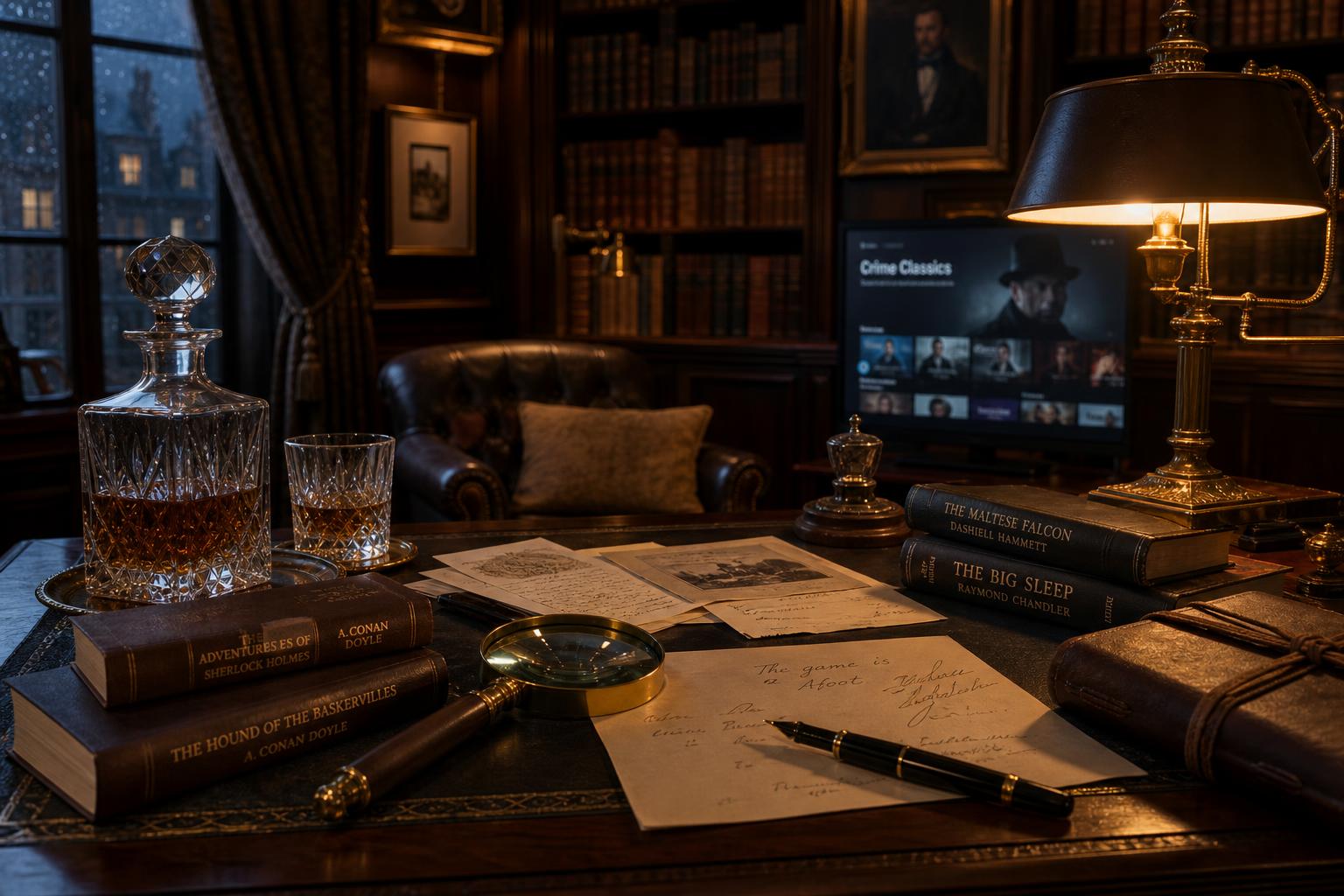
Introduction: Why Crime Fiction Endures
Crime fiction has remained one of literature’s most resilient forms because it speaks to a deep human need for order, explanation, and emotional release. From Edgar Allan Poe’s pioneering detective tales in the nineteenth century to today’s binge-worthy Netflix thrillers, stories about crime invite audiences to confront fear from a safe distance. They transform chaos into narrative, offering readers and viewers the satisfaction of seeing clues assembled, motives exposed, and hidden truths brought to light.
A Genre Built on Curiosity
At its core, crime fiction endures because it is powered by curiosity. A crime creates an immediate question: who did it, how, and why? That structure is almost universally compelling. Scholars of narrative often note that mystery plots mirror the way people solve problems in real life, moving from uncertainty toward understanding. This makes the genre intellectually engaging as well as emotionally gripping.
The Pleasure of Pattern and Resolution
Readers are drawn to the genre’s promise that even the darkest events can be examined and understood. Whether in Arthur Conan Doyle’s logical investigations or modern police procedurals, crime fiction rewards attention to detail. It turns observation into suspense, and suspense into resolution. That pattern helps explain why detective and crime novels consistently rank among the world’s best-selling categories, with mystery and thriller sales representing a major share of commercial fiction markets in the United States and United Kingdom.
Reflecting Social Fears and Moral Questions
Crime fiction also survives because it adapts to the anxieties of each era. Victorian mysteries explored urbanization and class tension. Hard-boiled fiction reflected corruption and disillusionment in the early twentieth century. Contemporary crime dramas often address surveillance, forensic science, gender violence, and institutional failure. In this way, the genre is never only about solving a case; it is also about examining the society in which that crime occurs.
More Than Entertainment
The best crime fiction asks difficult questions about justice, guilt, and power. It can challenge official narratives, expose prejudice, or reveal how fragile social order really is. That moral complexity gives the genre unusual depth. Audiences may arrive for the puzzle, but they stay for the psychological insight and social relevance.
From Page to Screen
Its enduring popularity has also been strengthened by its flexibility across media. Crime fiction thrives in short stories, novels, radio dramas, films, television series, podcasts, and streaming platforms. Each new format reshapes the genre while preserving its central appeal: the irresistible pursuit of truth.
Before Poe: Early Roots of Crime Stories
Ancient and Classical Foundations
Long before Edgar Allan Poe formalized detective fiction, societies were telling stories about crime, guilt, justice, and investigation. Some of the earliest roots appear in ancient literature, where disputes, murders, and acts of deception drove dramatic tension. In Greek tragedy, for example, Sophocles’ Oedipus Rex centers on uncovering a killer through testimony, deduction, and revelation. Although it is not a detective story in the modern sense, its structure anticipates later crime fiction by making the search for truth the engine of the plot.
Biblical narratives also contributed important patterns. The story of Susanna and the Elders, later expanded in the Book of Daniel, presents an early example of cross-examination exposing false witnesses. This emphasis on evidence and reasoning would become essential to later crime narratives.
Crime, Punishment, and Moral Order in the Middle Ages
During the medieval period, stories involving crime were often tied to religious or moral instruction rather than suspense alone. Murder, theft, betrayal, and fraud appeared in chronicles, ballads, and saints’ lives, usually to demonstrate the consequences of sin. Justice was less about solving a puzzle and more about restoring divine or social order.
Yet even in this period, proto-investigative elements emerged. In some Arabic and Persian tales from the One Thousand and One Nights, characters use observation, inference, and disguise to uncover wrongdoing. One frequently cited example is “The Three Apples,” a murder tale involving a hidden corpse, multiple suspects, and a ruler demanding the culprit be found. Its layered plot resembles later mystery fiction surprisingly closely.
Early Modern Influences
By the seventeenth and eighteenth centuries, crime stories became more secular and psychologically complex. Printed pamphlets about notorious murders and public executions were widely read in England and Europe. These “true crime” accounts mixed fact, sensationalism, and moral commentary, showing that audiences were already fascinated by criminal minds and judicial processes.
The Rise of Criminal Biography
A major development came with collections such as The Newgate Calendar, first published in the eighteenth century. These biographies of criminals presented detailed accounts of offenses, trials, and punishments. While often moralizing, they also gave readers recurring character types, urban settings, and procedural detail. This helped establish crime as a literary subject rather than merely a legal matter.
Gothic Shadows and Rational Inquiry
At the same time, Gothic fiction introduced dark atmospheres, hidden secrets, and violent acts. Writers like Horace Walpole and Ann Radcliffe emphasized fear and suspense, while Enlightenment thinking encouraged faith in reason. The eventual fusion of Gothic mystery with rational problem-solving created the conditions from which Poe’s groundbreaking detective tales would emerge in the nineteenth century.
Poe and the Birth of the Detective
The Invention of a New Literary Mind
When readers discuss the origins of modern crime fiction, Edgar Allan Poe stands at the beginning of the trail. Long before Sherlock Holmes, Hercule Poirot, or the psychologically complex investigators of streaming dramas, Poe created a character who transformed mystery into a structured intellectual game. In the 1840s, his stories introduced the idea that crime could be solved not by chance, confession, or brute force, but through disciplined observation and analytical reasoning.
Poe’s most important contribution came through C. Auguste Dupin, the Parisian sleuth who appeared in “The Murders in the Rue Morgue” in 1841, followed by “The Mystery of Marie Rogêt” in 1842 and “The Purloined Letter” in 1844. These three stories are widely recognized as the foundation of detective fiction. Dupin was not a police officer, which was itself significant. He was an independent thinker, a brilliant outsider whose intelligence exposed the limitations of official institutions.
Dupin and the Logic of Detection
What made Dupin revolutionary was not simply that he solved crimes. It was how he solved them. Poe emphasized ratiocination, a term he used to describe a method of logical analysis that moved beyond ordinary deduction. Dupin studies details others dismiss, reconstructs motives, and enters the mind of both criminal and witness. This mental process became the template for generations of fictional detectives.
In “The Murders in the Rue Morgue,” often called the first true detective story, Dupin investigates a brutal double murder in a locked room. The tale established several conventions that still define the genre today. It featured an apparently impossible crime, a baffled police force, misleading evidence, and a final explanation that reorders chaos into clarity. The locked-room mystery, later embraced by writers such as John Dickson Carr, begins here.
The Detective, the Narrator, and the Reader
Poe also introduced a narrative structure that became enormously influential. Dupin’s brilliance is filtered through an admiring unnamed companion, a model later echoed in Dr. Watson’s relationship with Holmes. This device serves two purposes. It highlights the detective’s exceptional mind while also guiding the reader through the puzzle at a measured pace. The narrator sees much, but understands less, allowing the final revelation to feel both surprising and earned.
Crime Fiction Meets Modern Urban Anxiety
Poe’s detective stories emerged during a period of rapid urban growth, rising newspaper circulation, and increasing public fascination with sensational crime. Cities in the nineteenth century felt crowded, anonymous, and unstable. Poe captured that atmosphere by placing mystery within modern streets, apartments, and bureaucracies rather than castles or mythic landscapes. Crime became a social phenomenon, not just a moral failing.
“The Mystery of Marie Rogêt” demonstrates this especially well. Inspired by the real-life death of Mary Rogers in New York, Poe used fiction to analyze a crime that had captivated newspaper readers. He effectively merged journalism and storytelling, showing that detective fiction could engage with real public fears and media culture. That blend remains central to crime narratives today, from paperback procedurals to prestige television.
A Lasting Blueprint
Nearly every major detective archetype owes something to Poe. The eccentric genius, the less capable police force, the loyal narrator, the hidden clue, and the climactic explanation all trace back to Dupin. Arthur Conan Doyle openly acknowledged the debt, and later writers expanded Poe’s formula into hard-boiled fiction, police procedurals, and psychological thrillers. Without Poe, crime fiction would likely exist in a very different form, lacking the analytical core that still drives the genre from Victorian magazines to Netflix series.
Victorian Expansion and Sherlock Holmes
Empire, Industry, and the New Urban Mystery
The rise of Sherlock Holmes cannot be separated from the vast transformations of Victorian expansion. Between 1837 and 1901, Britain became the world’s largest imperial power, governing nearly one quarter of the global population by the century’s end. At the same time, industrial growth reshaped daily life at home. Railways connected cities, telegraph lines accelerated communication, and London grew into a sprawling metropolis of more than 6 million people by 1900. These changes created the perfect setting for modern crime fiction: a world that was richer, faster, more crowded, and far more difficult to fully understand.
Arthur Conan Doyle introduced Holmes in A Study in Scarlet in 1887, at a moment when readers were fascinated by both scientific progress and social instability. Victorian Britain celebrated reason, classification, and order, yet it also produced poverty, anonymity, and fear. Holmes emerged as a figure who could navigate this contradiction. He was not simply a detective solving puzzles; he was a symbolic answer to the anxieties of a rapidly expanding society.
London as a Character
In Holmes stories, London is more than a backdrop. It functions as a living system of streets, classes, professions, and secrets. The city reflected the consequences of Victorian expansion in concentrated form. Wealth from empire and industry sat beside slums, opium dens, and criminal networks. A gentleman’s club in the West End and a dockside warehouse along the Thames could belong to the same narrative world.
Mapping Disorder Through Detection
Holmes’s investigations often depend on reading the city with extraordinary precision. He notices mud on boots, train schedules, cigar ash, handwriting, and accents. These details matter because Victorian life produced an overwhelming amount of information. Holmes turns that chaos into meaning. His method reflects the era’s faith in observation and emerging forensic logic, even before many police procedures were fully standardized.
This is one reason Holmes felt modern. He used chemistry, disguise, and deduction in ways that mirrored the period’s growing respect for expertise. While Edgar Allan Poe’s Dupin had already established the brilliant detective, Holmes placed that figure inside a distinctly Victorian machinery of cabs, newspapers, legal institutions, and imperial trade.
Imperial Reach and Hidden Influence
Victorian expansion also widened the geographical scope of crime fiction. Holmes stories repeatedly point beyond Britain’s borders, showing how empire brought distant conflicts back to London drawing rooms. In The Sign of Four, the plot depends on treasure from India and the aftermath of colonial violence. In “The Adventure of the Speckled Band,” imperial experience shapes the villain’s character and household. These stories suggest that crime in Britain was not purely local; it was entangled with imperial movement, military service, and global commerce.
The Foreign and the Familiar
Conan Doyle often used imperial references to create suspense, though modern readers may also notice the prejudices embedded in those portrayals. The Victorian imagination frequently treated colonized places as exotic, dangerous, or morally unstable. Holmes stories reflect that mindset while also revealing a deeper truth: empire made the boundaries between domestic safety and foreign threat increasingly fragile. What happened abroad could return home in unexpected forms.
Holmes and the Professional Detective Ideal
Holmes also captured a changing idea of authority. The nineteenth century saw the growth of organized policing, yet public confidence in official institutions was uneven. Scotland Yard detectives appear throughout the canon, but they are often slower or less imaginative than Holmes. This contrast appealed to readers who admired expertise but distrusted bureaucracy.
Science, Class, and Individual Genius
Holmes’s success rests on individual intelligence, but it is supported by Victorian structures of knowledge. He belongs to a culture that prized cataloguing, measurement, and rational inquiry. At the same time, Watson makes Holmes accessible by translating brilliance into narrative. Their partnership joins scientific detachment with human experience, allowing readers to enjoy both the puzzle and its emotional stakes.
In this way, Sherlock Holmes became the defining detective of the Victorian age: a character shaped by urban growth, imperial reach, and the promise that reason could still impose order on an expanding, uncertain world.
The Golden Age Puzzle Mystery
A New Kind of Crime Story
Between the two world wars, crime fiction entered what many critics call its Golden Age, a period when the detective story became a refined intellectual game. While Edgar Allan Poe and Arthur Conan Doyle had already established the foundations of modern detection, writers of the 1920s and 1930s transformed the genre into something more structured, social, and playful. The focus shifted from raw sensation and urban menace toward carefully designed mysteries in which readers were invited to compete with the detective.
This era flourished particularly in Britain, though its influence spread internationally. The puzzle mystery became a cultural phenomenon, appearing in bestselling novels, magazine serials, and even stage adaptations. Readers were not simply consuming stories about crime; they were participating in a mental exercise. Fair play became a defining principle, meaning the author should provide enough clues for an attentive reader to solve the case before the final reveal.
The Rules of the Game
The Golden Age mystery often followed a recognizable formula, but that predictability was part of its appeal. A murder, usually committed in a contained setting such as a country house, village, train, or isolated island, disrupted an apparently orderly world. A limited circle of suspects, each with motives and secrets, gave the story its structure. The detective then sifted through alibis, physical evidence, and psychological inconsistencies until the hidden pattern emerged.
Fair Play and Formal Design
Writers and critics of the period sometimes treated detective fiction almost like a sport. In 1929, Ronald Knox published his famous “Ten Commandments” for detective fiction, discouraging supernatural solutions and insisting on logical explanation. Around the same time, S. S. Van Dine proposed similar rules in the United States. These guidelines reflected a broader belief that the mystery should be solvable through reason, not arbitrary surprise.
That formal design encouraged elegant plotting. Red herrings, concealed identities, forged documents, and misleading testimony became standard tools. Yet the best authors used these devices with precision rather than excess. The pleasure came from seeing how every clue, however trivial it first appeared, fit into a coherent whole.
The Queens of the Form
No discussion of the Golden Age is complete without Agatha Christie, whose commercial and artistic impact remains extraordinary. Christie published 66 detective novels and 14 short-story collections, and works such as The Murder of Roger Ackroyd and Murder on the Orient Express redefined what a mystery could do with narration and structure. Her detectives, Hercule Poirot and Miss Marple, represented two different but equally effective modes of inquiry: one methodical and theatrical, the other quietly observant.
Dorothy L. Sayers brought a more literary sensibility to the form through Lord Peter Wimsey, combining intricate plotting with class observation and emotional depth. Ngaio Marsh and Margery Allingham, often grouped with Christie and Sayers as the “Queens of Crime,” expanded the genre’s range further. Together, these writers proved that puzzle mysteries could be both popular entertainment and sophisticated fiction.
Why Readers Loved It
The appeal of Golden Age mysteries was not limited to clever endings. These novels offered reassurance during a period marked by war trauma, economic instability, and social change. In many stories, crime threatened the community, but detection restored order. The detective functioned almost as a moral mathematician, turning confusion into clarity.
Escapism with Structure
Readers also enjoyed the enclosed worlds these books created. A manor house, a snowbound train, or a quiet parish became a stage on which human greed, jealousy, and ambition could be examined safely. Violence was present, but often filtered through wit, decorum, and distance. That balance made the stories gripping without becoming unbearable.
The genre’s popularity can also be measured institutionally. The Detection Club, founded in 1930, brought together leading mystery writers including Christie, Sayers, and G. K. Chesterton. Their collaboration signaled that detective fiction had become a serious and self-aware literary community.
Lasting Influence on Modern Crime Fiction
Although later hard-boiled writers criticized Golden Age mysteries as artificial, the puzzle tradition never disappeared. Contemporary novels, films, and series continue to borrow its architecture. From Knives Out to modern locked-room thrillers on streaming platforms, creators still rely on the Golden Age promise that careful observation can uncover hidden truth.
Its legacy lies in that enduring contract between writer and reader: the mystery is difficult, but not impossible; deceptive, but not dishonest. That balance remains one of crime fiction’s most satisfying achievements.
Hard-Boiled Crime and Noir
From Drawing Rooms to Dark Streets
If classic detective fiction often unfolds in orderly parlors and country estates, hard-boiled crime and noir drag the genre into the city’s alleys, bars, and cheap hotel rooms. Emerging prominently in the United States during the 1920s and 1930s, hard-boiled fiction replaced the cerebral puzzle with a harsher vision of crime shaped by corruption, violence, and social decay. These stories reflected a changing modern world marked by Prohibition, organized crime, economic instability, and growing distrust of institutions.
Writers such as Dashiell Hammett and Raymond Chandler transformed crime fiction by shifting attention from the mystery alone to the damaged environments surrounding it. Hammett, who had worked as a Pinkerton detective, brought procedural texture and street-level realism to novels like The Maltese Falcon in 1930 and Red Harvest in 1929. Chandler followed with The Big Sleep in 1939, introducing Philip Marlowe, a private investigator whose moral code survives in a deeply compromised Los Angeles. In these works, solving the crime matters, but understanding the rot beneath respectable society matters just as much.
Defining the Hard-Boiled Hero
The hard-boiled protagonist differs sharply from earlier sleuths such as Sherlock Holmes or Hercule Poirot. Rather than relying on detached brilliance, this investigator survives through toughness, instinct, and endurance. He is often cynical, underpaid, and physically vulnerable, yet still guided by a personal sense of justice. This moral ambiguity is central to the form. The detective may bend rules, trade insults, or navigate criminal circles, but he remains one of the few figures trying to resist total corruption.
Language, Style, and Atmosphere
A defining feature of hard-boiled fiction is its prose. The language is lean, sharp, and unsentimental, often driven by clipped dialogue and vivid metaphor. Chandler in particular became famous for similes that were both poetic and abrasive, giving noir its distinctive verbal texture. This style helped create an atmosphere where every room seemed smoky, every smile suspicious, and every deal potentially fatal.
The settings are equally important. Instead of insulated country houses, readers encounter urban landscapes shaped by class tension, political graft, and vice economies. Cities in noir are not merely backdrops; they function almost as characters, pressing in on everyone who inhabits them. Place becomes destiny, and the environment itself often seems complicit in crime.
Noir as Mood and Worldview
Although the terms are often used together, hard-boiled and noir are not identical. Hard-boiled usually refers to a literary style and type of detective story, while noir describes a broader mood of fatalism, alienation, and moral darkness. In noir, characters are frequently trapped by desire, greed, or past mistakes. Even when the truth is uncovered, justice may remain incomplete or meaningless.
The Rise of Film Noir
Noir expanded dramatically through cinema in the 1940s and 1950s. Films such as Double Indemnity in 1944, The Big Sleep in 1946, and Out of the Past in 1947 translated literary darkness into visual form through shadow-heavy lighting, oblique camera angles, and urban nightscapes. Many film noirs were influenced not only by American crime writing but also by German Expressionist cinematography, which intensified their psychological unease.
Women in noir were also written differently from earlier crime fiction. The femme fatale became one of the genre’s most recognizable figures: intelligent, alluring, and dangerous, often exposing male weakness rather than simply serving as victim or reward. While sometimes shaped by gender stereotypes, these characters also disrupted conventional moral order and added complexity to the genre’s power dynamics.
Lasting Influence on Modern Crime Storytelling
The influence of hard-boiled crime and noir remains enormous. Contemporary novels, prestige television, graphic novels, and streaming dramas continue to borrow their tone, antiheroes, and urban pessimism. Series such as True Detective, Mindhunter, and many Nordic noir productions echo the tradition’s belief that crime reveals deeper fractures in society. Even when updated for new settings, the core noir insight endures: crime is rarely an isolated act; it is a symptom of a broken world.
This shift permanently widened the possibilities of crime fiction. The genre no longer had to offer neat solutions or reassuring order. It could instead confront readers with compromised institutions, flawed investigators, and endings that sting rather than comfort. In that sense, hard-boiled crime and noir did not just darken the detective story; they made it more psychologically and socially expansive.
Postwar Shifts: Police, Psychology, and Society
The years after 1945 transformed crime fiction as profoundly as they reshaped everyday life. In the aftermath of World War II, readers confronted a world marked by urban expansion, bureaucratic growth, and deep psychological unease. Crime stories could no longer rely only on elegant puzzles or isolated country-house murders. Instead, they increasingly reflected modern institutions, damaged inner lives, and societies struggling with new forms of disorder. This postwar turn helped move the genre from classic detection toward the darker, more complex narratives that still dominate books, film, and streaming television.
The Rise of the Police Procedural
One of the most important developments was the growing prominence of the police procedural. Earlier detective fiction often centered on a brilliant amateur or eccentric private investigator who solved crimes through individual genius. Postwar fiction, by contrast, paid greater attention to the actual mechanics of law enforcement. Writers began depicting investigations as collective efforts involving patrol officers, detectives, forensic specialists, and administrative systems.
This shift reflected real social change. Police forces in the United States and Britain became more professionalized during the mid-twentieth century, with greater emphasis on training, recordkeeping, and scientific methods. Crime fiction responded by showing how cases were built through interviews, lab reports, surveillance, and interdepartmental cooperation. Ed McBain’s 87th Precinct novels, beginning in 1956, became especially influential because they presented the city as a living system and the police station as a workplace shaped by routine, pressure, and institutional limits.
Procedure as Drama
The procedural format created a new kind of suspense. Rather than asking only who committed the crime, these stories asked how truth could be assembled from fragments. Delays, paperwork, jurisdictional conflicts, and human error became part of the narrative tension. This made crime fiction feel more realistic and also more democratic, since success no longer depended on one extraordinary mind alone.
Psychology Moves to the Center
At the same time, postwar crime fiction became far more interested in psychology. The war had exposed millions to trauma, displacement, and moral ambiguity, while the growing cultural influence of psychoanalysis encouraged writers to explore motive in greater depth. Criminals were no longer merely villains to be unmasked; they were often portrayed as fractured, obsessive, or socially alienated individuals.
Patricia Highsmith exemplified this development. In novels such as Strangers on a Train and The Talented Mr. Ripley, suspense emerges not from a tidy investigation but from the unstable minds of characters who blur the line between victim and perpetrator. Readers are drawn into anxiety, desire, and self-deception, making crime fiction less about restoring order and more about exposing the instability beneath ordinary life.
Society as a Source of Crime
Postwar writers also increasingly treated crime as a social phenomenon rather than a purely personal failing. Rapid suburbanization, class tension, racial inequality, and Cold War paranoia all entered the genre. In many stories, the setting itself generates pressure: crowded cities, anonymous apartment blocks, and expanding consumer culture create environments where loneliness and violence can flourish.
Noir and Social Disillusionment
Film noir and noir fiction captured this mood with particular force. Their shadowed streets and compromised protagonists suggested that corruption was not exceptional but systemic. Institutions meant to provide safety could also produce fear, whether through prejudice, surveillance, or abuse of power. This broadened crime fiction’s scope, allowing it to critique the very societies from which crime emerged.
A Bridge to Contemporary Crime Storytelling
These postwar changes laid the groundwork for modern crime fiction across media. Ensemble investigations, psychologically layered offenders, and socially embedded crimes now define many of the genre’s most successful forms. From literary novels to prestige television, the legacy of the postwar era remains visible in stories that treat crime not as an isolated puzzle, but as a window into the structures, anxieties, and contradictions of modern life.
Global Crime Fiction and New Voices
Crime Fiction Crosses Borders
Crime fiction is no longer dominated by a handful of British and American traditions. In the twenty-first century, the genre has become unmistakably global, shaped by writers who use murder, corruption, and investigation to explore the pressures of modern life in very different societies. Translation, streaming platforms, and international publishing have helped readers discover stories from Scandinavia, Latin America, Africa, South Asia, and East Asia, expanding what crime fiction can sound like and what it can examine.
The rise of “Nordic noir” offers one of the clearest examples of this shift. Authors such as Stieg Larsson, Henning Mankell, and Jo Nesbø brought bleak landscapes, social critique, and emotionally burdened detectives to a worldwide audience. Their success proved that readers were eager for crime novels rooted in local realities yet connected to universal anxieties, including inequality, misogyny, state failure, and alienation. What made these books travel was not just suspense, but their ability to show crime as a symptom of deeper fractures.
Regional Voices, New Perspectives
As global readership widened, publishers began paying closer attention to writers outside the traditional centers of the genre. In Latin America, crime fiction often intersects with political violence, dictatorship, and urban instability. Writers such as Claudia Piñeiro of Argentina and Leonardo Padura of Cuba use investigation to reveal class tension and institutional decay. Their novels frequently blur the line between detective story and social novel, making the search for truth feel both personal and historical.
In Africa, a growing number of crime writers have redefined the field with stories grounded in postcolonial realities, economic change, and local justice systems. South African authors like Deon Meyer and Margie Orford, for instance, write within a society still marked by apartheid’s legacy, where crime narratives naturally engage with race, power, and trauma. The mystery becomes a way of reading the nation itself, not merely solving a puzzle.
Urban Change and Social Reality
In South Asia, crime fiction has also gained new energy. Writers such as Abir Mukherjee, Vaseem Khan, and Kalpana Swaminathan have shown how the genre can move between colonial history, contemporary megacities, and intimate moral conflict. Their work often captures the density of places like Mumbai or Calcutta, where law, class, and survival intersect in vivid ways. Crime fiction here becomes a map of social complexity.
The Influence of Screen Adaptation
Television and streaming have accelerated the global circulation of crime stories. Series adapted from international novels, alongside original productions like Money Heist, Sacred Games, and Babylon Berlin, have trained audiences to embrace subtitles, unfamiliar settings, and culturally specific storytelling. This has changed publishing as well. A successful adaptation can transform a regional writer into an international name almost overnight, while also encouraging publishers to seek fresh voices with cinematic potential.
Why New Voices Matter
New writers are reshaping crime fiction by challenging who gets to investigate, who gets believed, and whose communities are represented. Increasingly, protagonists include women, migrants, queer characters, journalists, and ordinary citizens rather than only hardened detectives. This diversification broadens the moral and emotional range of the genre. It also reflects a world in which crime is inseparable from surveillance, displacement, digital life, and contested identity.
The result is a richer, less predictable genre. Global crime fiction still delivers suspense and revelation, but it now does so through a wider chorus of languages, histories, and social experiences, opening the door to forms that earlier traditions rarely imagined.
True Crime, Prestige TV, and Streaming
The Rise of Crime as Premium Entertainment
The relationship between crime storytelling and screen culture changed dramatically in the streaming era. What was once dominated by procedural network dramas and made-for-television documentaries has evolved into a sophisticated ecosystem where true crime, prestige television, and on-demand platforms shape one another. This shift reflects both industrial change and audience appetite. Viewers no longer consume crime stories only as weekly entertainment; they now approach them as cultural events, binge-worthy investigations, and social conversations.
Prestige television helped elevate crime narratives by treating them as vehicles for psychological depth, moral ambiguity, and cinematic craft. Series such as The Sopranos, The Wire, and True Detective demonstrated that crime fiction could deliver the thematic complexity once associated mainly with literary novels or art-house cinema. These shows did not simply ask who committed the crime. They examined institutions, class, corruption, masculinity, and the fragility of justice. In doing so, they expanded the genre’s cultural legitimacy.
How Streaming Changed the Genre
Streaming platforms accelerated this transformation by changing how crime stories are distributed and consumed. Netflix, which surpassed 260 million global subscribers in 2024, helped normalize binge viewing, allowing serialized mysteries to unfold over hours rather than fit into rigid broadcast schedules. This format suits crime especially well because suspense thrives on accumulation. Each episode can deepen uncertainty, introduce conflicting testimony, and encourage viewers to become investigators themselves.
The Binge Effect
The binge model altered narrative pacing. Traditional television often required partial resolution within each episode, but streaming crime dramas can sustain tension across an entire season. This structure mirrors the experience of reading a long detective novel, where clues gain meaning gradually. It also encourages online theorizing, recap culture, and algorithm-driven recommendation loops that keep audiences inside the genre.
Streaming also globalized crime fiction. A viewer in Chicago can move from an American docuseries to a Scandinavian noir, a Spanish thriller, or a Korean police drama in one evening. This circulation has broadened tastes and introduced audiences to different legal systems, visual styles, and cultural anxieties, while preserving the genre’s core fascination with guilt, motive, and punishment.
The True Crime Boom
If prestige TV gave crime artistic status, true crime gave it documentary urgency. Productions such as Making a Murderer, The Jinx, and Serial turned real cases into serialized investigations with enormous public impact. Making a Murderer became one of Netflix’s earliest nonfiction sensations, while Serial reportedly reached more than 300 million downloads over time, proving that crime storytelling could dominate both video and audio platforms.
Ethics and Audience Complicity
True crime’s popularity raises difficult ethical questions. Unlike fictional detectives, real victims and families live with the consequences of renewed attention. Critics argue that some productions aestheticize suffering or privilege suspense over accuracy. Yet supporters contend that the genre can expose wrongful convictions, institutional failure, and neglected cases. The best examples balance narrative tension with accountability, reminding audiences that crime is not merely content but lived trauma.
Why Crime Thrives Now
Crime remains central to streaming culture because it combines emotional intensity, narrative propulsion, and social relevance. It satisfies curiosity while offering a framework for discussing race, gender, power, and media itself. In the age of prestige TV and digital platforms, crime fiction has become more than a genre. It is a flexible storytelling mode that connects nineteenth-century literary fascination with modern habits of watching, listening, and endlessly searching for the truth.
From Page to Screen: Netflix and Modern Adaptation
Streaming as the New Crime Scene
Netflix has become one of the most influential forces in the modern life of crime fiction, reshaping how literary stories are adapted, distributed, and consumed. Where earlier screen versions of crime novels were often constrained by broadcast schedules or studio formulas, streaming platforms allow for longer arcs, darker tones, and more psychologically layered storytelling. This has been especially important for crime fiction, a genre that depends on suspense, ambiguity, and character depth as much as plot.
The platform’s global reach also changes the stakes of adaptation. A detective story that once belonged primarily to one national tradition can now reach viewers in more than 190 countries within days. This has helped revive interest in source material while introducing audiences to new styles of crime storytelling, from Nordic noir to British procedural drama and literary gothic mystery.
Why Crime Fiction Thrives on Netflix
Crime fiction adapts particularly well to the streaming model because its structure naturally encourages binge-watching. Cliffhangers, hidden motives, and gradual revelations fit neatly into serialized viewing habits. Netflix has leaned into this by favoring limited series and multi-episode narratives that preserve more of a novel’s complexity than a two-hour film usually can.
A useful example is The Fall of the House of Usher, which transforms Edgar Allan Poe’s themes into a contemporary serialized drama. Rather than offering a strict page-to-screen retelling, the adaptation uses Poe’s imagery, mood, and moral decay as building blocks for a modern corporate horror-crime narrative. This reflects a broader Netflix strategy: adaptation as reinterpretation rather than simple reproduction.
Fidelity Versus Reinvention
Modern audiences rarely expect total loyalty to a text. Instead, successful adaptations often balance recognition with surprise. Netflix productions frequently update settings, diversify casts, and expand minor characters to reflect current cultural conversations. In crime fiction, this can sharpen themes of class, surveillance, corruption, and gendered violence that were less explicit in older works.
That approach can be risky. Readers may resist major changes, especially when beloved detectives or iconic plots are altered. Yet reinvention often keeps classic material alive. Sherlock Holmes-inspired series, for instance, continue to thrive because each version emphasizes different anxieties, whether they involve technology, urban isolation, or institutional mistrust.
Data, Audience, and Algorithmic Storytelling
Netflix does not adapt books in a cultural vacuum. Its decisions are informed by viewing data, completion rates, and regional demand. This creates a more targeted adaptation environment than traditional television ever allowed.
| Factor | Effect on Adaptation |
|---|---|
| Global analytics | Encourages stories with cross-market appeal |
| Binge viewing habits | Favors serialized mysteries over standalone films |
| Audience retention data | Rewards strong openings and frequent twists |
The Visual Language of Contemporary Adaptation
Netflix-era crime adaptations also rely heavily on atmosphere. Muted palettes, fragmented timelines, and intimate close-ups translate literary interiority into visual form. In this way, the platform has helped redefine adaptation itself, turning crime fiction from something merely transferred to screen into something recomposed for a digital, global audience.
Why Crime Fiction Keeps Evolving
Changing fears, changing crimes
Crime fiction endures because it mirrors the anxieties of each era. In the nineteenth century, Edgar Allan Poe’s detective stories reflected urban growth, anonymity, and the unsettling idea that evil could hide in ordinary streets. By the early twentieth century, writers such as Agatha Christie turned crime into an intellectual puzzle, offering readers order restored through logic during periods of social uncertainty. As societies changed, so did the genre’s central questions.
Today, crime fiction responds to a world shaped by surveillance, cybercrime, misinformation, and global networks. A modern investigator may analyze phone metadata as readily as footprints or fingerprints. This evolution keeps the genre relevant because readers want stories that feel connected to the crimes, institutions, and moral tensions they recognize from real life.
New formats reshape storytelling
Another reason crime fiction keeps evolving is the influence of new media. Serialized Victorian fiction created suspense through cliffhangers, while paperback novels expanded access in the twentieth century. In the streaming era, television and digital platforms have transformed pacing, structure, and audience expectations. Netflix-style crime dramas often unfold across multiple timelines, using visual clues and unreliable perspectives to deepen mystery.
The impact of audience participation
Modern audiences are also more active interpreters. Online forums, fan theories, and social media discussions encourage viewers and readers to investigate alongside the detective. This participatory culture rewards layered plotting and ambiguous motives. Crime fiction is no longer just consumed; it is examined, debated, and decoded in public.
Broader voices, deeper complexity
The genre has also expanded because more writers are reshaping it from different cultural and social perspectives. Contemporary crime fiction increasingly explores race, gender, class, and institutional corruption, moving beyond the simple question of who committed the crime. Many stories now ask why justice fails and who benefits from that failure.
From puzzle to social lens
This shift has made crime fiction richer and more flexible. A murder mystery can still entertain, but it can also expose systemic inequality or challenge official narratives. That ability to combine suspense with social insight is precisely why the genre continues to adapt across generations and platforms.
Conclusion: From Poe to Netflix
A Genre Shaped by Every Era
From Edgar Allan Poe’s analytical detective Dupin to Netflix’s psychologically layered investigators, crime fiction has continually reinvented itself to reflect changing fears, technologies, and social values. What began in the nineteenth century as a puzzle of logic and deduction evolved through the hard-boiled grit of the 1920s, the procedural realism of the postwar decades, and the morally complex storytelling that defines contemporary streaming drama. Each stage added new dimensions, expanding the genre beyond simple mystery into a broader examination of justice, power, and human behavior.
Why Crime Fiction Still Captivates
The genre’s endurance is tied to its unusual flexibility. Crime stories offer both structure and surprise: audiences expect a transgression, an investigation, and some form of revelation, yet the emotional and thematic possibilities remain vast. A Victorian reader encountering “The Murders in the Rue Morgue” sought intellectual intrigue, while a modern viewer watching series like Mindhunter or Broadchurch often looks for psychological depth, social critique, and serialized suspense. According to Netflix’s own public rankings, crime and thriller titles consistently perform among the platform’s most-watched categories, showing how strongly these narratives continue to resonate across global audiences.
From Page to Screen, and Beyond
What remains constant is the genre’s central question: how do people respond when order is broken? That question keeps crime fiction relevant, whether expressed through Poe’s precise reasoning, Agatha Christie’s elegant misdirection, Raymond Chandler’s cynicism, or today’s prestige television. As formats continue to shift across novels, film, podcasts, and streaming platforms, crime fiction proves not only durable but endlessly adaptable, carrying its dark fascination from the printed page into the digital age.
FAQ: Common Questions About Crime Fiction
What exactly counts as crime fiction?
Crime fiction is a broad literary and screen category centered on crime, investigation, justice, and moral consequence. While many readers equate it with detective stories, the genre includes police procedurals, legal thrillers, psychological suspense, noir, capers, prison narratives, and courtroom dramas. The unifying feature is not simply the presence of a crime, but the way the story organizes tension around wrongdoing and its aftermath.
Historically, crime fiction took recognizable shape in the nineteenth century. Edgar Allan Poe’s “The Murders in the Rue Morgue,” published in 1841, is often cited as the first modern detective story because it introduced analytical investigation as narrative structure. Since then, the genre has expanded across novels, pulp magazines, radio, film, television, and streaming platforms, proving remarkably adaptable to changing audiences and technologies.
How is crime fiction different from mystery and thriller?
These labels overlap, but they are not identical. A mystery usually emphasizes a puzzle: who committed the crime, how it happened, or why. A thriller tends to focus on danger, urgency, and high stakes, often revealing the criminal early so suspense comes from whether the protagonist can stop them. Crime fiction is the umbrella term that can contain both forms.
For example, an Agatha Christie novel often asks readers to solve a carefully structured mystery alongside the detective. By contrast, many modern thrillers create momentum through pursuit, conspiracy, or imminent violence. A single work can blend all three modes, which is why bookstores, publishers, and streaming services often market them together despite meaningful differences in structure and tone.
Why are detectives such enduring characters?
Detectives endure because they provide order in stories shaped by disorder. A crime disrupts everyday life, and the investigator becomes the figure who interprets chaos, uncovers hidden motives, and guides readers through uncertainty. Whether amateur or professional, the detective often functions as both character and narrative tool.
The appeal of the investigator’s perspective
Readers are drawn to detectives because they combine intelligence, observation, and emotional distance with human vulnerability. Sherlock Holmes, Hercule Poirot, Miss Marple, Philip Marlowe, and contemporary television investigators all offer distinct methods of seeing the world. Some rely on logic, others on intuition, and still others on institutional procedure. That variety helps explain the genre’s longevity across cultures and eras.
Why is crime fiction so popular across different media?
Crime fiction consistently performs well because it satisfies several audience desires at once. It offers suspense, intellectual engagement, emotional release, and social commentary. According to publishing trend reports and streaming rankings, crime-related content remains one of the most consumed categories globally, especially in television drama and audiobooks.
The genre also adapts easily to episodic formats. A novel series can sustain a recurring detective for decades, while television can build audience loyalty through case-of-the-week structures or season-long investigations. Netflix and other platforms have amplified this appeal by making international crime dramas more accessible, allowing viewers to move from British detective series to Nordic noir or Korean thrillers with minimal friction.
Does crime fiction reflect real society, or is it mainly escapism?
It does both. On one level, crime fiction is undeniably entertaining, offering the pleasure of suspense and resolution. On another, it often reflects social anxieties about class, gender, race, corruption, urban life, and institutional power. Victorian detective fiction emerged alongside modern policing and urban expansion, while twentieth-century noir reflected disillusionment, economic instability, and postwar unease.
Social themes beneath the plot
Many contemporary works use crime narratives to examine systemic issues rather than isolated wrongdoing. Police procedurals may explore bureaucracy and public trust, while psychological crime novels often focus on trauma, memory, or domestic abuse. Even highly commercial stories can reveal what a culture fears most at a given moment, which is one reason scholars continue to study the genre seriously.
What are the major subgenres readers should know?
Crime fiction includes several major branches, each with its own conventions. Classic detective fiction emphasizes clues and deduction. Hard-boiled fiction features cynical investigators, urban settings, and moral ambiguity. Noir is darker still, often highlighting doomed characters and corrupt systems. Police procedurals focus on official investigation methods, forensic work, and teamwork. Legal thrillers center on courts and attorneys, while psychological crime fiction explores motive, obsession, and unreliable perception.
Is crime fiction only about solving murders?
Not at all. Although homicide dominates many famous examples, crime fiction can revolve around fraud, kidnapping, espionage, organized crime, theft, cybercrime, or historical injustice. The central question is often less about the specific offense and more about power, motive, secrecy, and consequence. That flexibility has helped the genre evolve from Poe’s analytical tales to prestige television and streaming-era global franchises.


