

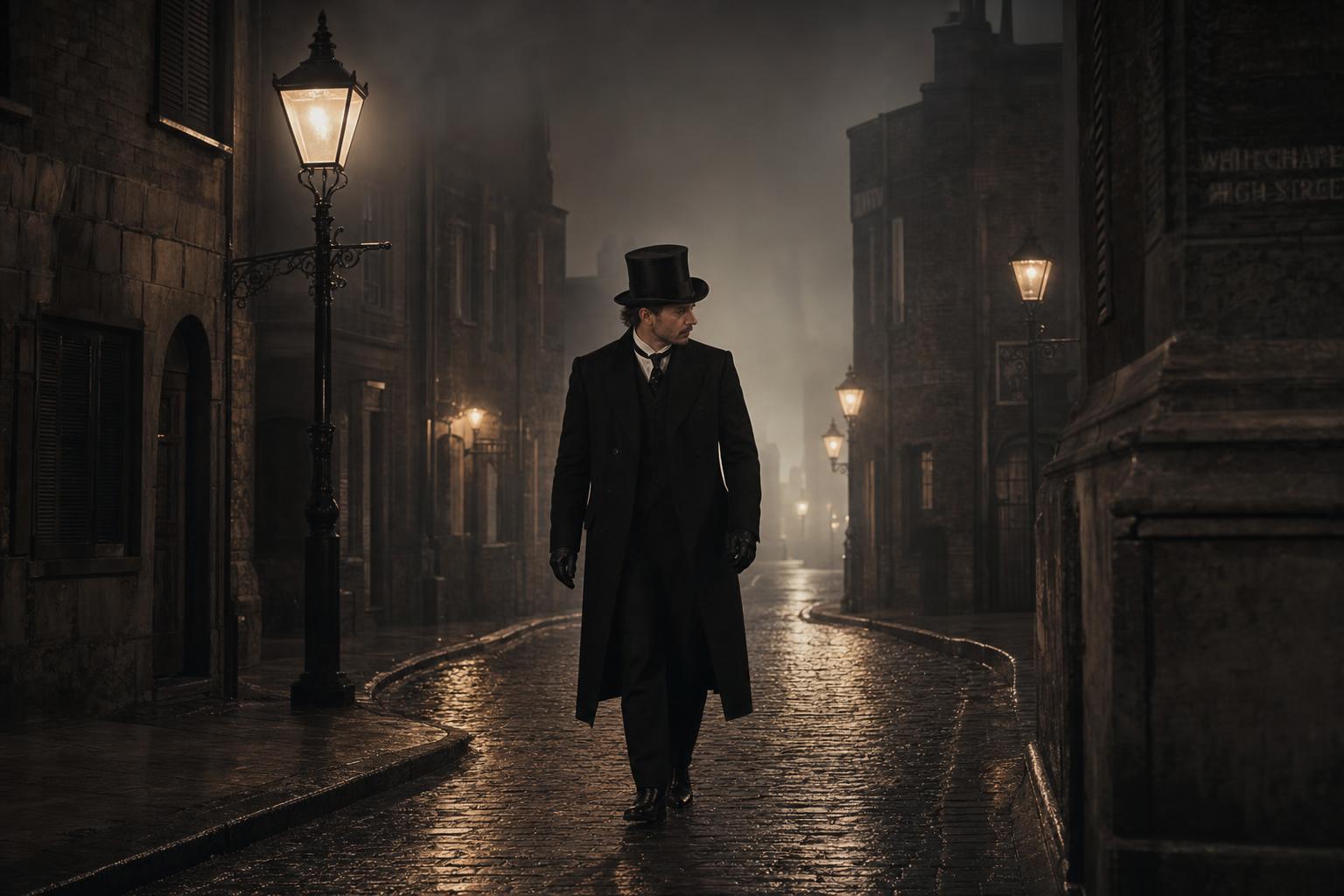
Introduction to Jack the Ripper
A Shadow Over Victorian London
Jack the Ripper remains one of the most infamous unidentified killers in modern history. The name refers to an unknown murderer who terrorized London’s East End in 1888, targeting women in the impoverished Whitechapel district. More than a century later, the case still fascinates historians, criminologists, and the public because it combines brutal violence, social inequality, and a mystery that has never been definitively solved.
The murders took place during the late Victorian era, a period often associated with imperial confidence and industrial progress. Yet Whitechapel revealed a harsher reality. Overcrowding, unemployment, alcoholism, and extreme poverty shaped daily life for many residents. In this environment, vulnerable women, especially those engaged in casual prostitution, faced constant danger. The Ripper case exposed these conditions to a wider audience and forced respectable society to confront the darker side of London.
The Canonical Murders
Most scholars connect Jack the Ripper to five victims, commonly called the canonical five. These women were Mary Ann Nichols, Annie Chapman, Elizabeth Stride, Catherine Eddowes, and Mary Jane Kelly, all killed between August and November 1888. Their murders shared disturbing features, including throat-cutting and, in several cases, severe abdominal mutilation. These details suggested a killer who acted with speed, confidence, and shocking brutality.
Why the Case Became Legendary
The investigation quickly became a media sensation. Newspapers printed graphic details, published rumors as fact, and helped spread the now-famous name “Jack the Ripper,” likely taken from a letter sent to the press. The Metropolitan Police and City of London Police received criticism for failing to catch the murderer, despite interviewing witnesses and pursuing numerous leads. At the time, forensic science was limited, and investigators lacked tools such as fingerprint databases, DNA analysis, and modern crime scene preservation.
Mystery, Myth, and Enduring Interest
What keeps the case alive is not only the violence, but the uncertainty. Dozens of suspects have been proposed, ranging from local butchers and doctors to artists and members of the upper class. None has been proven beyond doubt. As a result, Jack the Ripper exists at the intersection of true crime, urban history, and cultural myth, making the story far more than a simple murder case. Even today, the crimes continue to inspire books, documentaries, museum exhibits, and ongoing debate among researchers worldwide.
Victorian London and Whitechapel
A City of Wealth and Misery
Victorian London was the largest city in the world by the late nineteenth century, a global capital of trade, finance, and empire. By 1888, its population had grown to well over 4 million people, and the city embodied striking contradictions. Grand government buildings, fashionable West End streets, and prosperous commercial districts existed alongside overcrowded slums where poverty shaped everyday life. To understand the fear surrounding Jack the Ripper, it is essential to understand the environment in which the murders occurred.
London’s rapid expansion during the Victorian era brought opportunity, but it also created severe social strain. Industrialization drew workers from across Britain and abroad, especially from Ireland and Eastern Europe. Many arrived with few resources and settled in the East End, where rents were low and employment was uncertain. The result was a dense urban landscape marked by unstable wages, poor sanitation, and inadequate housing. In this setting, crime was not simply a matter of individual behavior; it was deeply connected to deprivation and social neglect.
Whitechapel in 1888
Whitechapel, in London’s East End, had become one of the most notorious districts in Britain by the time of the Ripper murders. Although the area was economically active, with docks, workshops, markets, and small factories nearby, prosperity was unevenly distributed. Thousands of laborers depended on casual work, meaning they might be hired for a single day and then dismissed without security. Historians estimate that tens of thousands of people in the East End lived in extreme poverty, and Whitechapel became a symbol of that hardship.
The streets of Whitechapel were crowded both day and night. Lodging houses offered a bed for only a few pennies, but even that small amount could be difficult to obtain. Many residents moved constantly between shelters, workhouses, and the street. Families often lived in single rooms, and common lodging houses packed strangers together in unhealthy conditions. This instability created a neighborhood where anonymity was easy and vulnerability was constant.
Housing, Sanitation, and Daily Survival
Living conditions in Whitechapel were harsh. Narrow courts and alleyways were poorly lit, and many buildings were dilapidated. Basic sanitation remained inadequate despite Victorian public health reforms. Open drains, overflowing cesspits, and contaminated water had long contributed to disease in poorer districts. While improvements had been made by the 1880s, overcrowding still encouraged the spread of illness such as tuberculosis and cholera-related infections.
For many women, survival depended on precarious and low-paid labor such as sewing, charring, hawking goods, or taking in laundry. When work disappeared, some turned to prostitution to pay for food or a bed. This reality is crucial to the Whitechapel murders, because several of the Ripper’s victims lived on the edge of destitution and were exposed to danger simply by trying to survive the night.
Crime, Policing, and Public Anxiety
Whitechapel already had a reputation for drunkenness, theft, assault, and vice before the murders began. However, much of this reputation was amplified by sensational journalism, which often portrayed the East End as morally corrupt and alien. Newspapers competed fiercely for readers, and lurid reporting transformed local crimes into national drama. The Ripper case became one of the earliest examples of a media frenzy shaping public understanding of violence.
Limits of Victorian Policing
Policing in 1888 faced serious limitations. The Metropolitan Police and the City of London Police shared responsibility in different jurisdictions, which complicated investigations. Officers had no access to modern forensic science, no fingerprint databases, and no reliable system for criminal profiling. Street lighting was inconsistent, witnesses were often unreliable, and fear spread quickly through rumor. In a district as crowded and transient as Whitechapel, a killer could move with alarming ease.
Public anxiety intensified because the murders seemed to reveal the fragility of urban order. If someone could kill repeatedly in the heart of London without capture, then the authority of the police, the press, and the state itself appeared weakened. Whitechapel was therefore more than a backdrop to the crimes. It was a place where poverty, overcrowding, social prejudice, and institutional weakness combined to create the conditions in which the Ripper legend took hold.
The East End as Symbol
Whitechapel came to represent Victorian fears about everything respectable society preferred not to confront: class inequality, violence against women, immigration, alcoholism, and the failures of urban reform. The district was real, complex, and full of working people trying to endure difficult lives, yet it was also turned into a symbol of darkness by outsiders. That symbolic power helped make the Jack the Ripper case unforgettable, embedding Whitechapel permanently in criminal history and popular imagination.
The Canonical Five Victims
The phrase “Canonical Five” refers to the five women most commonly accepted by historians as the likeliest victims of Jack the Ripper. They were murdered in London’s Whitechapel district between 31 August and 9 November 1888, during a period of intense fear, poverty, and social instability in the East End. Although some researchers argue for a wider or narrower victim list, these five cases are grouped together because they share striking similarities in location, timing, method, and mutilation.
The women were Mary Ann Nichols, Annie Chapman, Elizabeth Stride, Catherine Eddowes, and Mary Jane Kelly. All lived precarious lives shaped by economic hardship, unstable housing, and limited options for survival. Their stories are often overshadowed by the mythology of the killer, yet understanding who they were is essential to understanding why these crimes shocked Victorian Britain so deeply.
Why These Five Are Considered Canonical
The idea of a canonical set emerged from later police interpretation and historical study rather than from a formal declaration made during the murders themselves. Investigators in 1888 were dealing with overlapping assaults, uncertain witness statements, and sensational newspaper reporting. Over time, the five cases became linked because each involved a woman killed in or near Whitechapel, usually in the early hours of the morning, with evidence of throat-cutting followed by abdominal mutilation.
Another reason these five are grouped together is the apparent escalation in violence. The first two murders showed brutal cutting and postmortem injuries. The later cases suggested increasing confidence, speed, and anatomical focus. This pattern has led many criminologists and Ripper scholars to treat the five murders as the clearest core sequence attributable to one offender, even though absolute certainty remains impossible.
Mary Ann Nichols
Mary Ann “Polly” Nichols was the first of the canonical five, murdered on 31 August 1888 in Buck’s Row, now Durward Street. She was 43 years old and had experienced years of instability after separating from her husband. Like many women in Whitechapel, she drifted between lodging houses and occasional work, often relying on casual earnings to secure a bed for the night.
The Nature of the Attack
Nichols was found with her throat cut and severe abdominal injuries. The attack appears to have been swift, suggesting the killer could overpower a victim in darkness and escape before discovery. Her murder established several features later associated with the Ripper: a vulnerable victim, a public yet secluded location, and mutilation beyond what was necessary to kill.
Annie Chapman
Annie Chapman was murdered on 8 September 1888 in the backyard of 29 Hanbury Street. She was 47 years old, had suffered serious health problems, and lived in deep poverty. Witness accounts placed her alive shortly before dawn, making her case one of the most closely examined in the entire investigation.
Escalation and Surgical Debate
Chapman’s injuries were more extensive than Nichols’s, including the removal of part of the uterus. This detail fueled the long-running theory that the killer possessed anatomical or surgical knowledge. Modern experts remain divided. Some argue the organ removal indicates skill under pressure, while others note that even a determined amateur with a sharp knife could inflict such wounds. Regardless, Chapman’s murder intensified public panic and made it harder for authorities to dismiss the crimes as isolated acts.
Elizabeth Stride
Elizabeth Stride was killed on 30 September 1888 in Dutfield’s Yard, off Berner Street. She was 44 years old and originally from Sweden. Unlike the other canonical victims, Stride’s body showed no abdominal mutilation, only a fatal cut to the throat. This difference has made her inclusion the most debated of the five.
The Interrupted Attack Theory
Many historians believe Stride was indeed a Ripper victim because her murder occurred on the same night as Catherine Eddowes’s, in what became known as the “double event.” The prevailing theory is that the killer was interrupted before he could carry out the mutilations seen in the other cases. Witness activity in the yard and the relatively exposed setting support this possibility, though some researchers still suspect a different assailant.
Catherine Eddowes
Less than an hour after Stride’s murder, Catherine Eddowes was found in Mitre Square in the City of London. She was 46 years old and had been released from police custody earlier that night after sobering up. Her murder is one of the strongest links in the canonical chain because it combined throat-cutting, severe facial disfigurement, and abdominal mutilation.
A Crime That Expanded the Investigation
Eddowes’s injuries were exceptionally severe, and part of a kidney and the uterus were removed. Because Mitre Square fell under the jurisdiction of the City of London Police rather than the Metropolitan Police, her death complicated coordination between forces. It also led to one of the case’s most discussed clues: a bloodstained piece of her apron found in Goulston Street near writing on a wall. Whether that message had any connection to the killer remains unresolved, but the episode deepened the sense that the murderer was taunting authorities.
Mary Jane Kelly
Mary Jane Kelly, generally believed to be about 25 years old, was the youngest of the canonical five and the final victim in the accepted sequence. She was murdered on 9 November 1888 in her room at Miller’s Court. Unlike the others, Kelly was killed indoors, giving the murderer time and privacy unavailable in the street attacks.
The Most Extreme Mutilation
Kelly’s body was mutilated far more extensively than the others, with injuries so severe that contemporary reports described the scene as almost unrecognizable. Because the killer had shelter and time, many scholars see this murder as the culmination of the pattern established in the earlier cases. It also marked a turning point: after Kelly’s death, the series of murders most confidently attributed to Jack the Ripper effectively ended.
Why Their Identities Matter
The canonical five are not important only because of how they died, but because their lives reveal the harsh realities of Victorian London. Whitechapel in the late nineteenth century was overcrowded and impoverished. Census and social survey data from the era show thousands living in common lodging houses, with casual labor, alcoholism, and chronic illness shaping daily life. These women were not merely symbols in a murder mystery; they were individuals navigating a city that offered little protection to the poor, especially poor women.
Remembering the canonical five as people rather than props changes the story. It shifts attention from the killer’s legend to the social conditions that made such crimes possible and so difficult to solve.
Timeline of the 1888 Murders
A City on Edge in Late Summer
The sequence of killings linked to Jack the Ripper unfolded over a few terrifying months in 1888, primarily in Whitechapel, a densely populated district in London’s East End. At the time, the area was marked by severe poverty, overcrowded lodging houses, and limited street lighting, conditions that made violent crime easier to commit and harder to investigate. Although historians still debate which murders should be definitively attributed to the killer, the most widely accepted timeline centers on the “canonical five” victims killed between August and November.
The murders did not occur in isolation. Whitechapel had already seen a rise in assaults against women, and police were under intense pressure to restore order. As each new body was discovered, fear spread rapidly through the neighborhood, amplified by newspaper coverage and public criticism of the Metropolitan Police.
August 31, 1888: Mary Ann Nichols
The first canonical victim, Mary Ann “Polly” Nichols, was found in the early hours of August 31 in Buck’s Row, now Durward Street. Nichols, aged 43, had been living a precarious life and was known to sleep in common lodging houses when she could afford a bed. Her throat had been cut, and her abdomen showed signs of mutilation.
This murder immediately alarmed investigators because of its brutality. While violent attacks were not unknown in Whitechapel, the combination of throat-cutting and abdominal injuries suggested a level of ferocity that stood out even in a district familiar with hardship and crime.
September 8, 1888: Annie Chapman
Just over a week later, Annie Chapman, aged 47, was discovered in the backyard of 29 Hanbury Street. Her injuries were even more severe than those inflicted on Nichols. In addition to her throat being cut, Chapman had suffered extensive abdominal mutilation, and part of her body had been removed.
Escalation and Public Panic
Chapman’s murder marked a clear escalation. The killer appeared more confident, and the injuries suggested either anatomical knowledge or at least a deliberate pattern. This second killing intensified public panic and led to increased police patrols, civilian vigilance committees, and widespread speculation about the murderer’s identity.
September 30, 1888: The “Double Event”
The night of September 30 became one of the most infamous in the case, later known as the “Double Event.” Within roughly an hour, two women were murdered in different locations.
Elizabeth Stride, aged 44, was found in Dutfield’s Yard off Berner Street. Her throat had been cut, but unlike other victims, her body showed no major abdominal mutilation. Many researchers believe the killer may have been interrupted before he could continue.
Less than an hour later, Catherine Eddowes, aged 46, was discovered in Mitre Square within the City of London jurisdiction. Her injuries were severe, including facial disfigurement and abdominal mutilation. Part of a kidney and part of the uterus were reportedly removed, making this one of the most shocking crimes in the series.
A Critical Turning Point
The Double Event transformed the investigation. Because Eddowes was killed within the City of London police area rather than Metropolitan Police territory, coordination between forces became even more important. It also strengthened the belief that a single offender was operating with alarming speed and boldness.
November 9, 1888: Mary Jane Kelly
The final canonical victim, Mary Jane Kelly, was killed on November 9 in her room at Miller’s Court. Kelly was younger than the other canonical victims, probably about 25, and her murder was by far the most extreme. Unlike the earlier street killings, this attack occurred indoors, giving the murderer more time and privacy. The mutilations were extensive and deeply disturbing, far beyond those seen in the previous cases.
Why the Timeline Matters
The chronology of these murders reveals a pattern of increasing violence, shifting locations, and growing public terror. Between August 31 and November 9, 1888, five women were killed in a span of just 70 days. That compressed timeframe helps explain why the crimes had such a profound impact on Victorian society. Each murder seemed to demonstrate that the killer remained uncaught, mobile, and capable of striking again despite mounting police attention.
Murders Outside the Canonical Five
Some timelines also include earlier or later Whitechapel victims such as Martha Tabram, killed on August 7, 1888, and Alice McKenzie, killed in July 1889. However, these cases remain disputed because the injuries and circumstances do not align as closely with the accepted pattern. The uncertainty surrounding these additional victims continues to shape debates about the killer’s methods, victim selection, and possible duration of activity.
How the Killer Operated
A Pattern of Opportunism and Control
Jack the Ripper’s method appears to have combined careful victim selection, rapid violence, and an intimate knowledge of East London’s streets. Most of the canonical five victims were women living in extreme poverty, and several survived through casual prostitution, which often meant meeting strangers late at night in dimly lit alleys, courtyards, or lodging-house passages. This environment gave the killer access to vulnerable targets while reducing the chance of immediate interruption.
The attacks usually occurred in the early hours, when Whitechapel was quieter but not empty. That timing mattered. It allowed the murderer to blend into the normal nighttime movement of laborers, drinkers, market workers, and residents returning to common lodging houses. Rather than luring victims over long distances, he likely exploited brief encounters, moving them only a short way to a dark corner or enclosed yard.
The Sequence of the Attacks
Speed and Precision
Medical reports from 1888 suggest that the killer acted with striking speed. In several cases, the victim’s throat was cut first, probably to silence her within seconds. This was often followed by abdominal mutilation, indicating that the murderer either had a specific fixation or sought to shock anyone who discovered the body. The combination of swift incapacitation and postmortem mutilation points to a killer who understood he had only minutes before discovery.
In the case of Annie Chapman, for example, the injuries were severe enough that some contemporary doctors speculated the killer possessed anatomical knowledge. Modern historians remain divided on that point. While the mutilations were extensive, they do not prove formal surgical training. They do, however, show confidence with a knife and a willingness to work in horrifyingly close contact with the victim.
Use of the Environment
Whitechapel as Hunting Ground
The geography of Whitechapel helped the killer operate repeatedly. The district was densely populated, poorly lit, and full of narrow passages, shared yards, and overcrowded housing. In 1888, parts of the East End had some of the worst living conditions in London, with thousands of people packed into lodging houses and tenements. This created both anonymity and confusion. A man leaving a murder scene could disappear quickly into the surrounding streets without drawing much attention.
The killer also seems to have relied on the fact that blood, noise, and disorder were not always unusual in the area. Street violence, drunkenness, and public disturbance were common enough that brief sounds of struggle may not have prompted immediate alarm. That social backdrop gave him a practical advantage.
Escalation and Psychological Signature
Beyond Simple Murder
What made these crimes especially infamous was not only the killing itself but the escalating mutilation. In later murders, particularly those of Catherine Eddowes and Mary Jane Kelly, the injuries became more extensive, suggesting either growing confidence, increasing compulsion, or both. Kelly’s murder, committed indoors in Miller’s Court, gave the killer more time and privacy than the street attacks, resulting in the most extreme mutilation of all.
This pattern has led many criminologists to argue that the murderer was driven by more than opportunity alone. His actions suggest ritualized behavior, rage directed at the body, and a desire to dominate completely. Even without knowing his identity, the operational pattern reveals a predator who used darkness, poverty, and fear as tools, turning the chaos of Victorian Whitechapel into cover for a series of calculated, brutal attacks.
The Police Investigation
A Murder Hunt Under Intense Pressure
The police investigation into the Jack the Ripper murders became one of the most famous and frustrating criminal inquiries in British history. Between August and November 1888, a series of brutal killings in London’s Whitechapel district exposed the limits of Victorian policing. Detectives faced public panic, political pressure, and a lack of reliable forensic science, all while trying to identify a killer who moved through overcrowded streets with apparent ease.
At the time, responsibility for the case was divided. The Metropolitan Police handled most of Whitechapel, while the City of London Police investigated the murder of Catherine Eddowes, whose body was found within their jurisdiction. This split complicated communication and coordination. Senior figures such as Metropolitan Police Commissioner Sir Charles Warren, Assistant Commissioner Robert Anderson, Chief Inspector Donald Swanson, and Inspector Frederick Abberline all became associated with the inquiry, though not always in agreement over methods or suspects.
Investigative Methods in 1888
Victorian detectives worked without many of the tools considered essential today. There was no DNA testing, no fingerprint database, no CCTV, and no modern offender profiling. Investigators relied heavily on witness statements, door-to-door inquiries, patrol patterns, and medical examinations of the victims. In a densely populated slum district, that was a major disadvantage. Whitechapel housed tens of thousands of poor residents, many living in lodging houses or unstable conditions, making it difficult to track movements or verify identities.
The Role of Patrols and Interviews
Police increased street patrols after the early murders, especially at night, and questioned local residents, lodging-house keepers, butchers, dock workers, and men known to carry knives for work. Officers also checked hospitals, workhouses, and common lodging houses for suspicious injuries or behavior. Despite these efforts, descriptions of possible suspects varied widely. Witnesses often saw only fleeting figures in poor light, and many accounts contradicted one another.
The Whitechapel Vigilance Committee
As fear spread, local businessmen and residents formed the Whitechapel Vigilance Committee in September 1888. Led by George Lusk, the group criticized the police response and organized private patrols. They also offered rewards and distributed leaflets. Their involvement reflected a growing belief that official efforts were failing. However, the committee also added to the confusion by generating more tips, rumors, and public speculation, much of it impossible to verify.
Letters, Hoaxes, and Media Frenzy
One of the greatest obstacles in the investigation was the flood of correspondence claiming to come from the killer. The most famous letters, including the “Dear Boss” letter and the “From Hell” message, helped popularize the name “Jack the Ripper.” Historians still debate whether any were genuine. Police received hundreds of letters, postcards, and false confessions, forcing officers to spend valuable time sorting hoaxes from potentially meaningful evidence.
Press Influence on the Case
Newspapers played a powerful role in shaping the investigation. Sensational reporting increased circulation but also intensified public hysteria. Journalists published leaked details, criticized police leadership, and sometimes printed unverified claims as fact. This environment made it harder for detectives to control information. It also encouraged false witnesses and amateur theories, problems that continue to surround the case more than a century later.
Why the Killer Was Never Caught
Several factors explain why the investigation failed to produce a conviction. First, the murders happened quickly and often in dark, narrow spaces where the killer could escape before police arrived. Second, forensic limitations meant that blood evidence, trace material, and victim contact could not be analyzed in meaningful ways. Third, the social conditions of Whitechapel created investigative blind spots. Extreme poverty, alcoholism, homelessness, and distrust of authority reduced the reliability of testimony and made witnesses reluctant to come forward.
There was also disagreement over the suspect pool. Some officials believed the killer was a local working-class man who blended into the neighborhood. Others suspected a foreigner, a butcher, a doctor, or a mentally unstable individual. Over time, names such as Montague Druitt, Aaron Kosminski, Michael Ostrog, and George Chapman entered discussion, though the evidence against each remained incomplete or speculative.
Lasting Impact on Criminal Investigation
The Ripper inquiry exposed weaknesses in late nineteenth-century policing and influenced later reforms. It highlighted the need for better record-keeping, stronger interdepartmental coordination, and more systematic detective work. The case also demonstrated how media pressure can distort an active investigation, a lesson still relevant today. Even though the police never identified the killer with certainty, the Whitechapel murders became a defining moment in the history of criminal investigation, shaping both public expectations and modern detective mythology.
Letters, Press, and Public Panic
How the Ripper Letters Shaped the Case
The Whitechapel murders became more than a local criminal investigation because letters sent to police and newspapers transformed the killings into a national obsession. In late September 1888, the Central News Agency received the now famous “Dear Boss” letter, signed “Jack the Ripper.” Although many historians believe it was a hoax, the name stuck with extraordinary force. A second message, the “Saucy Jacky” postcard, appeared to reference the double event of September 30, when Elizabeth Stride and Catherine Eddowes were killed within hours of each other. Whether authentic or fabricated, these communications gave the unknown murderer a public identity.
The effect was immediate. Before the letters, the killer was one among many violent offenders in a crowded Victorian city. After them, “Jack the Ripper” became a character in the public imagination, a shadowy figure who seemed to taunt authorities and move freely through London’s poorest streets. This branding mattered. It made the crimes easier to report, easier to sensationalize, and far harder for police to control in the public mind.
The Role of the Victorian Press
By 1888, London had a fiercely competitive newspaper culture. Cheap daily papers, expanding literacy, and telegraph-based reporting created ideal conditions for sensational crime coverage. Editors understood that murder sold copies, and the Whitechapel killings offered every dramatic element: poverty, sex work, mutilation, and apparent police failure. Reports often mixed fact with rumor, and speculation frequently outran evidence.
Sensation Over Certainty
Newspapers printed witness claims, anonymous tips, and vivid descriptions that were not always reliable. Some accounts exaggerated the killer’s surgical skill, while others promoted theories involving foreign sailors, butchers, doctors, or aristocrats. The press also helped spread anti-immigrant suspicion, especially against Jewish residents of the East End, despite the lack of proof. In a district already marked by overcrowding and deprivation, such reporting intensified fear and social tension.
The volume of correspondence was staggering. Police reportedly received hundreds of letters related to the murders, and journalists received many more. Modern estimates often suggest that the vast majority were hoaxes. Yet each new letter or report kept the story alive, feeding a cycle in which public anxiety generated coverage, and coverage generated more anxiety.
Public Fear in Whitechapel and Beyond
For residents of Whitechapel, panic was not abstract. Women feared walking alone at night, lodging houses buzzed with rumors, and vigilance committees formed to patrol the streets. Rewards were debated, suspects were chased, and strangers were watched with suspicion. The murders exposed the fragility of public trust in law enforcement, especially when the Metropolitan Police appeared unable to prevent further attacks.
Panic as a Social Mirror
The hysteria also revealed wider Victorian anxieties. Middle-class readers saw in Whitechapel a world of urban disorder that seemed both near and unknowable. The Ripper scare became a lens through which Britain confronted poverty, prostitution, policing, and the limits of modern city governance. In that sense, the panic was not only about one killer. It was about a society realizing that even in the heart of the empire, fear could spread faster than facts.
Main Suspects and Theories
Why the Case Produced So Many Suspects
Few criminal investigations have generated as many competing theories as the Jack the Ripper murders. Part of the reason is the fragmentary nature of the evidence. In 1888, forensic science was limited, crime scenes were often contaminated, witness statements conflicted, and press reporting frequently blurred fact with rumor. As a result, later writers, detectives, and amateur researchers have built cases around incomplete records, ambiguous timelines, and circumstantial details.
The canonical five victims, usually identified as Mary Ann Nichols, Annie Chapman, Elizabeth Stride, Catherine Eddowes, and Mary Jane Kelly, were killed within a span of roughly ten weeks in Whitechapel. The speed and brutality of the murders intensified public fear and encouraged speculation that the killer possessed unusual medical skill, local knowledge, or social privilege. Those assumptions shaped many of the suspects who emerged over the following decades.
Montague John Druitt
Montague John Druitt remains one of the most frequently cited suspects, largely because senior police officials mentioned him after the murders. Druitt was a barrister and schoolteacher whose body was found in the Thames in December 1888, about a month after the murder of Mary Jane Kelly. This timing led some investigators to suspect that the killer had died by suicide, ending the murder series.
The Case For Druitt
Supporters of the Druitt theory point to memoranda written by figures such as Sir Melville Macnaghten, who described a suspect said to be sexually insane and believed by his family to be the murderer. Druitt’s apparent mental instability and death soon after the final canonical murder make him attractive to theorists seeking a neat endpoint to the crimes.
The Case Against Druitt
The evidence against Druitt is largely indirect. He had no proven connection to Whitechapel, no documented history of violence against women, and no contemporary evidence placing him near the crime scenes. Modern historians often note that Macnaghten’s account contained factual errors, suggesting that the case against Druitt may have been built on rumor rather than hard evidence.
Aaron Kosminski
Aaron Kosminski, a Polish Jewish immigrant and barber, is another major suspect and one of the few named in police-related documents. He lived in the East End and was later committed to an asylum, where records described severe mental illness, including paranoia and auditory hallucinations.
Why Kosminski Attracts Attention
Kosminski fits several elements that investigators considered significant. He was a local man, likely familiar with Whitechapel’s streets and courts, and police officials such as Macnaghten and Assistant Chief Constable Donald Swanson later referred to a suspect widely understood to be him. Swanson’s marginal notes, discovered decades later, suggested that a witness identified Kosminski but refused to testify.
Limits of the Evidence
Despite this, the case remains unproven. The alleged identification was never tested in court, and surviving records do not establish that Kosminski was violent. Modern DNA claims linked to a shawl associated with Catherine Eddowes have drawn headlines, but many experts dispute the item’s provenance and the scientific interpretation. The Kosminski theory is important, but far from settled.
George Chapman and Other Violent Offenders
George Chapman, born Seweryn Kłosowski, was a Polish-born barber-surgeon who later became a convicted murderer. In 1903, he was executed for poisoning three women. Some former detectives believed that a man capable of serial murder in one context might also have been the Ripper.
Chapman had medical experience of a basic kind, lived in the East End, and had a documented pattern of cruelty. However, poisoning differs sharply from the frenzied knife attacks seen in the Ripper murders. While criminal versatility is possible, many scholars argue that Chapman’s known methods and personality do not strongly match the Whitechapel killer’s profile.
Francis Tumblety and the Outsider Theory
Francis Tumblety, an American quack doctor, represents the theory that the killer may have been a transient outsider rather than a settled Whitechapel resident. Tumblety was in London during the murders and was arrested in November 1888 on charges of gross indecency unrelated to the killings. He fled to France and then the United States while still under suspicion.
Investigators were intrigued by reports that Tumblety harbored misogynistic views and possessed anatomical specimens. Yet the evidence remains weak and heavily anecdotal. His foreignness, eccentricity, and scandalous reputation may have made him suspicious in the eyes of police and journalists, but suspicion alone does not amount to proof.
Royal Conspiracy and Medical Theories
Some of the most famous theories move beyond individual suspects and into conspiracy. One enduring claim alleges involvement by members of the royal family, usually Prince Albert Victor, Duke of Clarence, or a cover-up orchestrated by powerful officials. These stories became especially popular in the twentieth century through books and films.
Why Conspiracy Theories Persist
Conspiracy theories thrive because they offer dramatic explanations for why the murders were never solved. They also exploit real Victorian anxieties about class, secrecy, and institutional power. However, historians have repeatedly shown that many royal conspiracy timelines do not work. In several cases, the individuals accused were verifiably elsewhere when murders occurred.
Medical theories have also endured. Because some victims suffered abdominal mutilation, early observers speculated that the killer had surgical training. Yet later analysis suggests that the injuries did not necessarily require a doctor’s expertise. In poor lighting, under intense time pressure, a determined killer with a sharp knife could inflict devastating wounds without advanced anatomical knowledge.
The Most Plausible Theory
For many modern researchers, the most plausible explanation is also the least sensational: the killer was probably a local man of ordinary background, familiar with Whitechapel, comfortable moving through its lodging-house districts, and able to blend into the neighborhood after each attack. This theory aligns with the geography of the murders, the rapid escape windows, and the social invisibility available in the East End’s overcrowded streets.
What keeps the mystery alive is that no suspect fully satisfies the evidence. Druitt offers timing but little connection, Kosminski offers police interest but no decisive proof, Chapman offers criminal violence but the wrong method, and conspiracy suspects offer drama more than documentation. The enduring debate reflects not only the horror of the crimes, but also the gaps in the historical record that continue to invite reinterpretation.
Legacy in Crime and Culture
A Blueprint for Modern Serial Killer Mythology
Jack the Ripper’s enduring legacy lies not only in the brutality of the Whitechapel murders, but in how the case shaped public ideas about serial crime. In 1888, London’s East End became the setting for one of history’s first media-saturated murder investigations. Newspapers printed lurid details, speculative letters, and dramatic sketches, helping transform an unidentified killer into a global symbol of urban terror. The name “Jack the Ripper,” likely popularized through the infamous “Dear Boss” letter, became more powerful than any confirmed suspect.
The Birth of Ripperology
The case also gave rise to what is now called Ripperology, a field of amateur and professional study devoted to the murders, suspects, and Victorian context. More than a century later, researchers still debate evidence from police files, witness statements, and forensic claims. This lasting obsession reflects the unusual combination of mystery, violence, and historical uncertainty. Unlike many solved murder cases, the Ripper story remains open-ended, allowing each generation to reinterpret it through new methods and cultural anxieties.
Influence on Literature, Film, and Popular Imagination
The Ripper’s shadow extends deeply into fiction and entertainment. Writers in the late nineteenth and early twentieth centuries drew on the case to create darker visions of the modern city, where anonymity and poverty concealed danger. Elements of the Ripper legend can be traced through crime novels, horror fiction, graphic novels, television dramas, and films. The killer has been portrayed as everything from a mad doctor to a member of the aristocracy, showing how the case adapts to changing social fears.
Crime, Class, and Memory
Culturally, the murders also exposed Victorian inequalities, especially the vulnerability of poor women in the East End. Modern historians increasingly emphasize the lives of the victims rather than the mythology of the killer. This shift matters because it reframes the case as more than a sensational mystery; it becomes a window into class division, policing limits, media ethics, and gendered violence in nineteenth-century Britain. In that sense, Jack the Ripper remains both a criminal enigma and a cultural mirror.
Conclusion: Why the Mystery Endures
An Unsolved Crime That Refuses to Fade
More than a century later, Jack the Ripper remains embedded in public memory because the case combines brutal violence, social inequality, media sensationalism, and enduring uncertainty. The murders exposed the harsh realities of Victorian London, especially poverty in Whitechapel, while the killer’s anonymity invited endless speculation. Historians still debate evidence, suspects, and police failures, and each new theory renews interest rather than settling the question.
The Power of the Unknown
What keeps the story alive is not only what is known, but what was never proven. In that unresolved space, fear, myth, and fascination continue to grow.
FAQ About Jack the Ripper
Why is Jack the Ripper still famous?
Jack the Ripper remains infamous because the killer was never identified, despite intense investigation in London’s Whitechapel district in 1888. The case combined brutal murders, public panic, and heavy newspaper coverage, creating one of history’s earliest true crime sensations.
How many victims were there?
Most historians link five canonical victims to Jack the Ripper, murdered between August and November 1888. Their names were Mary Ann Nichols, Annie Chapman, Elizabeth Stride, Catherine Eddowes, and Mary Jane Kelly.
Were any suspects proven guilty?
No suspect was ever conclusively proven guilty. Over the decades, police records, letters, and forensic theories have produced many suspects, but no definitive evidence has solved the case.


