
Introduction to the Zodiac Killer Case
The Zodiac Killer case remains one of the most infamous unsolved criminal investigations in American history. Emerging in Northern California during the late 1960s, the killer combined brutal violence with a calculated desire for publicity. Unlike many serial offenders who tried to avoid attention, the Zodiac actively sought it, sending letters, threats, and coded messages to newspapers and law enforcement. This unusual behavior transformed the case from a regional murder investigation into a national obsession that still fascinates criminologists, historians, and true crime audiences today.
The Murders That Started the Fear
The case is generally linked to a series of attacks between 1968 and 1969, although some researchers believe the killer may have been responsible for additional crimes. The first widely accepted attack occurred on December 20, 1968, near Lake Herman Road, where teenagers Betty Lou Jensen and David Faraday were shot and killed. On July 4, 1969, another young couple, Darlene Ferrin and Michael Mageau, were attacked in Vallejo. Ferrin died, while Mageau survived and later provided an account of the shooting.
A Killer Who Wanted an Audience
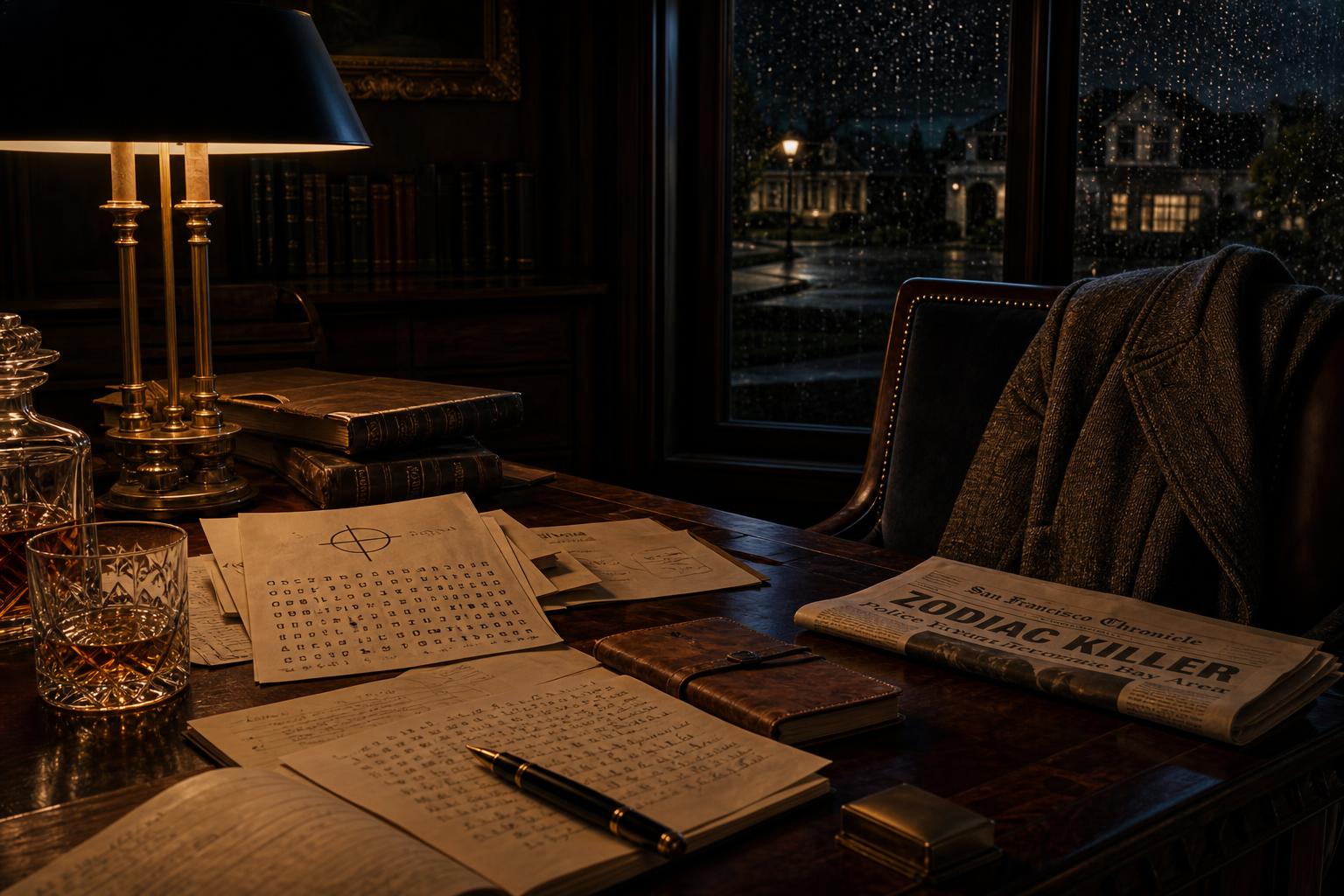
What set the Zodiac apart was not only the violence, but the deliberate creation of a public identity. In August 1969, several newspapers received letters from a man claiming responsibility for the shootings. Each letter included part of a 408-symbol cipher, and the writer demanded publication on the front page. This was a striking tactic. Rather than hiding, the killer used the media as a stage, crafting an image designed to spread fear across communities.
The Origin of the Name “Zodiac”
In subsequent letters, the writer began identifying himself as “Zodiac.” He marked his correspondence with a crosshair-like symbol that became one of the most recognizable icons in criminal history. The name and symbol helped build a persona that was both theatrical and threatening. By turning himself into a brand, the killer increased public anxiety and made every new letter an event.
The Role of Ciphers and Communication
The Zodiac’s ciphers became central to the mystery. The first cipher was solved within days by a California schoolteacher and his wife, revealing disturbing statements about killing and collecting victims for the afterlife. Later messages were more complex, and some remained unsolved for decades. In 2020, a team of private codebreakers solved the 340-character cipher, originally mailed in 1969. Its solution did not reveal the killer’s identity, but it confirmed his pattern of taunting authorities and manipulating public attention.
Why the Case Endures
Part of the case’s lasting power comes from its unresolved nature. Despite extensive investigations by multiple police departments, the FBI, and countless independent researchers, no suspect was ever definitively charged. The combination of confirmed murders, possible additional victims, cryptic letters, and media spectacle created a case that sits at the intersection of criminal investigation and cultural mythology. Understanding this background is essential before examining the evidence, suspects, and ciphers that continue to define the Zodiac mystery.
Northern California in the Late 1960s
A Region in Rapid Transition
Northern California in the late 1960s was a place of dramatic social change, economic growth, and cultural experimentation. The region included booming urban centers such as San Francisco, expanding suburban communities in Vallejo and Napa County, and quieter rural stretches that created sharp contrasts in daily life. This mix of crowded cities and isolated roads shaped the atmosphere in which fear could spread quickly. Between 1960 and 1970, California’s population grew from roughly 15.7 million to nearly 20 million, reflecting the state’s powerful draw for workers, students, and young people seeking new identities.
Counterculture and Social Unrest
San Francisco stood at the center of the national counterculture movement. The 1967 Summer of Love had turned Haight-Ashbury into a symbol of youth rebellion, anti-war activism, and alternative lifestyles. At the same time, the broader Bay Area was marked by political tension. Protests against the Vietnam War, civil rights struggles, and distrust of government institutions created a climate in which authority was often questioned. This atmosphere mattered, because public confidence in police and official communication was not as strong or unified as it had been in earlier decades.
Media, Fear, and Public Attention
The late 1960s also saw newspapers play an enormous role in shaping public understanding of crime. Major regional papers such as the San Francisco Chronicle and the San Francisco Examiner reached wide audiences and could turn local violence into a regional obsession almost overnight. Television news was influential as well, but print media remained especially powerful in circulating letters, threats, and coded messages. In a period before digital communication, a front-page story could dominate conversation across multiple counties for days.
Geography and Vulnerability
Northern California’s geography added another layer of complexity. Highways connected cities efficiently, yet many lovers’ lanes, park areas, and waterfront roads remained poorly lit and lightly patrolled. A person could move between jurisdictions with relative ease, especially at night. This fragmented law-enforcement landscape often complicated investigations, since city police departments, county sheriffs, and highway patrol officers did not always share information seamlessly.
Why the Setting Mattered
The late 1960s in Northern California combined mobility, media reach, and social anxiety in a way that made violent crime feel both intimate and unpredictable. Young couples sought privacy in secluded areas, newspapers amplified every development, and communities were already living through a decade of uncertainty. That environment helps explain why a taunting, elusive killer could capture such intense public attention and leave a lasting mark on American criminal history.
The First Confirmed Attacks
Lake Herman Road: The Case Begins
The Zodiac Killer’s first confirmed attack took place on December 20, 1968, on Lake Herman Road, a secluded stretch between Benicia and Vallejo, California. The victims were 17-year-old David Faraday and 16-year-old Betty Lou Jensen, a young couple on their first date. Sometime between 10:15 and 11:00 p.m., their car was parked in a gravel turnout commonly used by local teenagers. When police arrived, they found Faraday shot inside or just outside the vehicle and Jensen lying several feet away, having been shot multiple times while apparently trying to flee.
What made this crime especially chilling was its apparent lack of motive. There was no clear sign of robbery, no evidence of sexual assault, and no obvious personal connection between the killer and the victims. Investigators concluded that the attacker had likely approached the car, forced the couple out, and then opened fire with a .22 caliber weapon. Jensen was struck five times in the back, strongly suggesting she was running when she was killed. Faraday suffered a fatal shot to the head at close range.
Early Investigative Challenges
At the time, local law enforcement did not know they were dealing with a serial killer. The murders were treated as a tragic but isolated double homicide. Detectives interviewed friends, classmates, and possible suspects, but the rural setting and lack of witnesses made progress difficult. Physical evidence was limited, and forensic science in the late 1960s lacked many of the tools available today, such as DNA profiling and advanced digital databases.
Why the Scene Was So Difficult to Solve
The Lake Herman Road turnout was dark, remote, and exposed to the elements. Tire tracks and shell casings offered some clues, but not enough to identify a suspect. Witness timelines were inconsistent, and several cars had reportedly passed through the area that night. This created a confusing sequence of events that investigators struggled to reconstruct with certainty.
Blue Rock Springs: The Pattern Emerges
The second confirmed attack occurred on July 4, 1969, at Blue Rock Springs Park in Vallejo, roughly seven months after the first murders. This time, the victims were 22-year-old Darlene Ferrin and 19-year-old Michael Mageau. The couple had parked in Ferrin’s brown Corvair shortly before midnight. According to Mageau’s later account, another car pulled into the lot, left, and then returned about ten minutes later. The driver got out, approached their vehicle with a flashlight, and opened fire.
At first, Mageau believed the man might be a police officer because of the bright light and direct approach. Instead, the attacker fired several rounds through the passenger side window using a 9mm handgun. After hearing Mageau’s cries, the gunman briefly returned and fired additional shots into the car. Ferrin was struck multiple times and died shortly after arriving at the hospital. Mageau survived despite serious injuries to his face, neck, and chest.
The Phone Call That Changed Everything
Less than an hour after the shooting, a man called the Vallejo Police Department from a payphone located only a few blocks away. In a calm, measured voice, he reported the crime and then added a shocking statement: he also claimed responsibility for the Lake Herman Road murders. This call was the first direct link between the two attacks and marked the beginning of the killer’s campaign of psychological terror.
A Killer Seeking Recognition
The phone call revealed something crucial about the murderer. He did not simply want to kill; he wanted credit. That desire for recognition would later define the Zodiac case, especially through the letters and ciphers he mailed to newspapers. By connecting the two shootings himself, the killer transformed separate investigations into what authorities now understood could be a serial pattern.
Similarities Between the Two Attacks
Although the weapons differed, investigators identified several important similarities. Both attacks targeted young couples in parked cars at night in relatively isolated locations. In each case, the assault was sudden, unprovoked, and brutally efficient. The victims appeared to have been selected for vulnerability rather than personal significance, suggesting a predator driven by control, thrill, and anonymity.
These first confirmed attacks established the core features of the Zodiac’s method. He hunted in quiet places, struck with little warning, and left behind confusion rather than clear evidence. Just as importantly, he began shaping his own legend, ensuring that the crimes would not remain ordinary murder cases but become part of one of America’s most infamous unsolved investigations.
The Killer Adopts the Zodiac Name
A Calculated Reinvention
In the summer of 1969, the unknown murderer responsible for a series of attacks in Northern California transformed from a shadowy local threat into a self-created public figure. This shift occurred when he began using the name “Zodiac”, a label that would become one of the most infamous identities in American criminal history. Before adopting that title, the killer had already been linked to the shootings at Lake Herman Road in December 1968 and Blue Rock Springs in July 1969. Yet it was not only violence that distinguished him. It was his deliberate understanding of media, fear, and symbolism.
The name first appeared in letters sent to Bay Area newspapers in late July and early August 1969. In these communications, the killer demanded publication of coded messages and claimed responsibility for the attacks. By signing himself “This is the Zodiac speaking,” he introduced a persona that sounded theatrical, controlled, and eerily confident. The phrase was memorable by design. It turned anonymous brutality into a branded menace, giving the public and investigators a single identity to fear and pursue.
Why the Name Mattered
The adoption of the Zodiac name marked a crucial escalation in the case. Murderers often attempt to avoid detection by remaining invisible, but Zodiac appeared to want the opposite. He sought recognition, not in the ordinary sense of fame, but as a way to amplify terror. By naming himself, he seized control of the narrative. Police no longer dictated how the crimes were discussed; the killer inserted himself directly into headlines.
A Symbol Built for Attention
The chosen name likely drew power from astrology and the circular crosshair-like symbol he used in his letters. That emblem became his signature and was reproduced repeatedly in newspapers and police files. Whether the symbol reflected a fascination with celestial imagery, weapon sights, or both, it gave his communications a distinct visual identity. In an era before digital media, such a mark was especially effective. A simple symbol could be recognized instantly across printed pages, making each letter feel like a continuation of an unfolding campaign.
The Role of the Letters
The killer’s letters were central to the creation of the Zodiac persona. On July 31, 1969, three nearly identical letters were mailed to the San Francisco Chronicle, the San Francisco Examiner, and the Vallejo Times-Herald. Each included one-third of a 408-symbol cipher and demanded front-page publication. The tactic worked. Newspapers printed the material, and the killer gained exactly what he wanted: mass attention.
From Criminal to Author of Fear
These letters did more than claim crimes. They established tone, rhythm, and character. Zodiac wrote with arrogance, issuing threats and presenting himself as intellectually superior. He treated murder as performance and correspondence as a stage. This combination of violence and communication separated him from many serial offenders of the period. According to FBI records and later case reviews, dozens of letters and cards were eventually attributed to Zodiac, though not all remain universally accepted as authentic.
Public Reaction and Investigative Impact
Once the name entered circulation, public anxiety intensified. Residents across the Bay Area followed each new message closely, and law enforcement faced mounting pressure. The killer’s self-naming complicated the investigation because it encouraged copycat claims, hoaxes, and overwhelming media scrutiny. At the same time, it gave detectives a consistent framework for linking crimes, letters, and ciphers.
By adopting the Zodiac name, the killer did more than sign his messages. He created a lasting mythology around himself, one that fused murder, code, and spectacle into a case that still commands attention decades later.
The Ciphers and Letters
A Killer Who Wanted an Audience
What set the Zodiac Killer apart from many other serial murderers was not only the violence of the crimes, but the deliberate way he turned communication into part of the terror. Beginning in 1969, newspapers in Northern California received letters that appeared to come from the killer, each written in a tone that mixed bragging, threats, and mockery. These messages transformed the case from a local homicide investigation into a public spectacle. The writer demanded front-page coverage and used coded messages to suggest that he possessed intelligence and control beyond that of the police pursuing him.
The letters were sent primarily to the San Francisco Chronicle, the San Francisco Examiner, and the Vallejo Times-Herald. In several early messages, the author included details about crime scenes that had not yet been widely released, which helped investigators believe the correspondence was authentic. He also adopted the now infamous crosshair-like symbol that became his signature. This emblem appeared repeatedly, functioning almost like a brand identity for the killer and making each letter instantly recognizable.
The First Major Cipher
In July 1969, three nearly identical letters arrived at the three newspapers, each containing one-third of a 408-symbol cipher. The writer demanded that the papers print the cipher on their front pages, threatening further violence if they refused. Once the three parts were combined, the full cryptogram became one of the most famous unsolved-case documents in American criminal history.
How the 408 Cipher Was Solved
The 408-character cipher was cracked within days by Donald and Bettye Harden, a schoolteacher and his wife from Salinas, California. Their solution revealed a message that was unsettling not because it contained a hidden identity, but because it exposed the killer’s mindset. Rather than naming himself, the text described how much he enjoyed killing people and claimed that murder was “more fun than killing wild game in the forest.” It also introduced the bizarre idea that his victims would become his servants in the afterlife.
This outcome surprised many observers. People expected a cipher to conceal a name or a practical clue. Instead, the message offered psychological theater rather than useful evidence. Even so, it established a pattern that would continue throughout the Zodiac correspondence: the codes were designed as much to provoke fear and fascination as to communicate information.
The Unsolved 340 Cipher
If the 408 cipher made the Zodiac famous, the 340 cipher deepened the mystery. Mailed in November 1969, this cryptogram contained 340 characters arranged in a square-like grid. For more than 50 years, it resisted efforts by professional cryptographers, amateur codebreakers, law enforcement, and computer analysts. Its longevity helped cement the Zodiac case in popular culture, because an unsolved code always suggests that a final secret may still be hidden.
In December 2020, an international team consisting of David Oranchak, Sam Blake, and Jarl Van Eycke announced that they had solved it. Their solution showed that the cipher did not contain the killer’s name either. Instead, it included more taunting language, stating that he was not afraid of the gas chamber because it would send him to “paradice” sooner, where he would have enough slaves to work for him. The message also referenced a television appearance in which someone had falsely claimed to be the Zodiac.
Why the 340 Cipher Mattered
The solution was historically significant because it demonstrated that the cipher was genuine and structured, not random nonsense. It also showed how the killer manipulated public attention over decades. Yet, like the 408 cipher, it yielded very little direct investigative value. The text reinforced the image of a murderer obsessed with performance, domination, and mythmaking.
Other Codes and Their Uncertain Meaning
Not every Zodiac cipher has been solved. The so-called 13-symbol cipher, sent in April 1970, was accompanied by a claim that it contained the killer’s name. Because it is so short, experts have long argued that it may be impossible to solve with certainty. Short ciphers provide too little data, allowing many possible interpretations. This means any proposed solution remains speculative rather than definitive.
Another message, often called the 32-symbol cipher, referenced a bomb and allegedly included coded directions. Like the 13-symbol message, it has never been conclusively solved. These unsolved fragments continue to attract independent researchers, but they also illustrate a central problem in the case: the Zodiac may have used ciphers less as containers of truth than as instruments of confusion.
The Letters Beyond the Codes
The non-coded letters were just as important as the ciphers. In them, the Zodiac claimed responsibility for murders, threatened schoolchildren, described methods for building bombs, and mocked police efforts to catch him. Some letters included disturbing physical tokens, such as a piece of shirt taken from victim Paul Stine, which strongly supported authenticity. This blending of text, evidence, and threat gave the correspondence unusual power.
Media, Fear, and Control
The letters exploited the media environment of the late 1960s and early 1970s. Newspapers competed for sensational stories, and the Zodiac understood that every published message expanded his reach. By writing directly to the press, he bypassed normal investigative channels and inserted himself into public life. His words spread fear far beyond the actual crime scenes, affecting schools, neighborhoods, and daily routines across the Bay Area.
The ciphers and letters remain central to the Zodiac legend because they reveal a killer who did not merely commit crimes. He constructed a persona, used language as a weapon, and ensured that mystery itself became part of his legacy.
How Police and Cryptographers Responded
The Immediate Law Enforcement Reaction
From the moment the Zodiac Killer began mailing letters and ciphers to Bay Area newspapers in 1969, police faced a case that was unusual in both public visibility and technical complexity. Homicide investigations already depend on witness statements, forensic evidence, and timelines, but Zodiac added a new battlefield: coded communication. Each letter was not only a threat or confession, but also a challenge aimed directly at investigators, reporters, and the public.
Local police departments, including those in Vallejo, Napa, San Francisco, and later Solano County, were forced to coordinate across jurisdictions. That was difficult in an era before digital databases, shared intelligence platforms, or modern case management systems. Evidence often moved slowly, and communication between agencies could be fragmented. Because the killer operated in multiple locations, this lack of centralized coordination likely complicated efforts to build a unified suspect profile.
The Pressure of a Public Case
The Zodiac case became a media spectacle almost immediately. Newspapers published portions of the killer’s letters, and in some cases printed the ciphers themselves after Zodiac demanded front-page attention. This created enormous pressure on law enforcement. Officers had to investigate active murders while also responding to a criminal who was shaping public fear through the press.
The killer’s strategy worked. By turning his messages into headline material, he gained control over the narrative. Police were put in the difficult position of deciding how much information to release. Sharing too much risked encouraging copycats or giving Zodiac satisfaction. Sharing too little could limit public assistance. This tension remains familiar in high-profile investigations today, but in the late 1960s and early 1970s, agencies had fewer established protocols for handling a serial offender who used media manipulation so effectively.
Cryptographers Enter the Story
The First Cipher Breakthrough
The most famous early response came not from a government code unit, but from private citizens. In August 1969, schoolteacher Donald Harden and his wife Bettye Harden solved the Zodiac’s 408-symbol cipher. Their solution revealed a chilling message in which the killer claimed he enjoyed murdering people because it was “so much fun.” The breakthrough showed that amateur cryptanalysis, when combined with patience and pattern recognition, could succeed where official channels had not yet produced results.
The Hardens used logical assumptions about language frequency and repeated symbol patterns. They guessed that the message might begin with the word “I,” then built outward from there. Their work demonstrated a basic truth of substitution ciphers: once enough repeated structures are identified, the code can begin to collapse. Even so, the final 18 characters of the 408 cipher remained unresolved, fueling debate for decades.
Why Later Ciphers Were Harder
Not all of Zodiac’s coded messages were so approachable. Some were shorter, more irregular, or possibly designed to resist straightforward decryption. The infamous 340-character cipher, mailed in November 1969, remained unsolved for 51 years. Its complexity came partly from the possibility that Zodiac had rearranged text diagonally or in unusual reading patterns, making traditional substitution analysis far less effective.
In 2020, a team consisting of software developer David Oranchak, mathematician Sam Blake, and programmer Jarl Van Eycke finally cracked the 340 cipher. They combined computational testing with human insight, showing how modern cryptography often depends on both machine power and interpretive reasoning. Their solution did not reveal the killer’s identity, but it confirmed that Zodiac’s codes were crafted to prolong attention and frustrate investigators.
Investigative Limits and Evolving Methods
Forensics Then and Now
Police in the Zodiac era did collect fingerprints, handwriting samples, ballistics evidence, and witness descriptions. However, forensic science was far more limited than it is today. DNA profiling did not exist in practical criminal investigation until the mid-1980s, and even then it took years to become widespread. That meant many clues could not be tested with the precision modern investigators would expect.
Handwriting analysis and document examination played a major role because Zodiac wrote so often. Yet these methods are inherently interpretive and rarely decisive on their own. Cryptanalysis could decode messages, but it could not automatically identify the sender. In that sense, police and cryptographers were solving different parts of the same puzzle: one group tried to understand the killer’s words, while the other tried to prove who wrote them.
A Lasting Collaboration Between Disciplines
The Zodiac case remains a striking example of how criminal investigations can extend beyond traditional policing. Detectives, journalists, amateur codebreakers, mathematicians, and later computer-assisted cryptographers all contributed pieces of understanding. Police pursued the man; cryptographers pursued the mind behind the symbols.
Major Suspects and Theories
Why the Zodiac case produced so many suspects
Few criminal investigations in American history have generated as many competing suspect theories as the Zodiac case. Part of the reason is structural: the killer communicated directly with newspapers and police, creating a public trail of letters, ciphers, and threats, while leaving behind only limited physical evidence that could conclusively identify him. The confirmed attacks in Northern California between 1968 and 1969 offered witness statements, ballistics, and partial descriptions, yet none produced a definitive match that ended the mystery.
The uncertainty invited decades of amateur investigation, media speculation, and renewed law-enforcement review. In the late 1960s, forensic science lacked many tools now considered standard. DNA testing did not emerge as a practical criminal-investigation method until the 1980s, and even then, old evidence often posed contamination and preservation problems. As a result, suspect theories have often relied on circumstantial patterns such as geography, handwriting, military background, cryptography knowledge, or resemblance to composite sketches rather than courtroom-level proof.
Arthur Leigh Allen
Among all proposed suspects, Arthur Leigh Allen remains the most widely discussed. Allen came to police attention in the early 1970s and was investigated repeatedly over the years. He lived in California, reportedly owned a Zodiac-brand watch featuring the crosshair-like symbol associated with the killer, and was alleged by acquaintances to have made disturbing comments involving violent fantasies and the name “Zodiac.” These details made him a compelling figure for investigators and later for popular culture.
Evidence that fueled suspicion
Allen’s profile seemed to overlap with several popular assumptions about the killer. He had been accused of troubling behavior in other contexts, and some investigators believed his personality fit the taunting, attention-seeking tone of the Zodiac letters. Search warrants executed against him reportedly uncovered weapons and other items that kept suspicion alive. In addition, one surviving victim, Mike Mageau, later identified Allen as a possible attacker, though that identification came years after the crime and under conditions critics considered unreliable.
Why the case against him weakened
Despite the attention, the case against Allen never became conclusive. Handwriting comparisons did not match him to the Zodiac letters, and fingerprint evidence reportedly failed to identify him as the killer. Later DNA discussion also did not firmly place him behind the letters. For many researchers, Allen remains the strongest circumstantial suspect; for others, he demonstrates the central problem of the case: a suspect can appear highly plausible while still lacking decisive forensic confirmation.
Lawrence Kane
Lawrence Kane is another frequently cited suspect, especially in books and documentaries. Kane had a criminal history, lived in areas relevant to the investigation, and was linked by some theorists to surviving victim Kathleen Johns, who believed he resembled the man who abducted and threatened her in 1970. Some investigators also noted that Kane had suffered injuries in an earlier accident, leading to speculation that neurological damage may have affected his behavior.
The theory around Kane gained traction because he seemed to fit a drifter-like, deceptive profile. He also reportedly used aliases, which added to the aura of secrecy around him. Yet, as with Allen, the evidence remained largely inferential. There was no universally accepted forensic link tying Kane to the murders or authenticated letters. His candidacy rests more on behavioral suspicion than demonstrable proof, which has kept him in the conversation without elevating him beyond that.
Rick Marshall and media-driven theories
Rick Marshall emerged as a suspect largely through independent investigation and media attention rather than official police consensus. He worked in projection and had interests that some theorists connected to the theatrical and coded nature of the Zodiac persona. Supporters of the theory argued that his background, appearance, and possible access to certain locations made him worth scrutiny.
However, the Marshall theory illustrates how easily a high-profile unsolved case can attract narrative-driven speculation. Investigators did examine him, but no evidence publicly established him as the killer. In many respects, Marshall became notable because the Zodiac story itself encouraged pattern-seeking. When a suspect seems to fit the mythology of the case, public fascination can outpace evidentiary strength.
Other recurring names
Several additional names appear regularly in Zodiac discussions, including Donald Lee Bujok, Richard Gaikowski, and Earl Van Best Jr. Each has supporters who point to selected overlaps in timeline, appearance, ideology, or alleged coded references. Some theories focus on military experience, arguing that the killer’s use of firearms and cryptic messaging suggested training. Others emphasize education or technical skill, especially because one of the Zodiac ciphers, the 340-character cipher, resisted solution for 51 years before being cracked in 2020 by a team of private citizens.
The problem with suspect accumulation
The long list of suspects reveals an important truth: an abundance of theories does not equal an abundance of evidence. In cold cases, especially famous ones, confirmation bias can become a major obstacle. Once a researcher becomes convinced of a suspect, ordinary coincidences may begin to look meaningful. This has happened repeatedly in the Zodiac case, where timelines are stretched, ambiguous statements are treated as confessions, and weak visual similarities are elevated into major claims.
Leading theories beyond individual suspects
Not all explanations center on a single named suspect. Some researchers argue that the Zodiac may have been someone never publicly identified, perhaps a man questioned briefly and then overlooked. Others suggest that not every crime or letter attributed to Zodiac came from the same person. This “multiple offender or mixed authorship” theory attempts to explain inconsistencies in witness descriptions, writing style, and victim selection.
Another major theory concerns the killer’s motive. Rather than killing for conventional gain, the Zodiac appeared driven by control, publicity, and psychological terror. His letters transformed murder into performance, forcing police and the press into a public game. That dynamic may explain why suspect theories often focus on men who craved attention, resented authority, or enjoyed manipulation. Even so, motive theory can only narrow possibilities; it cannot substitute for hard evidence.
Why the mystery persists
More than five decades later, the Zodiac case remains open in the public imagination because it sits at the intersection of violent crime, media spectacle, and forensic limitation. The strongest suspects all suffer from the same weakness: none has been tied to the crimes with evidence strong enough to settle the matter beyond serious dispute. Until a verified forensic breakthrough or authenticated confession emerges, the major suspects remain possibilities rather than answers, and the theories surrounding them continue to shape how the case is remembered.
Media Panic and Public Fear
How the Zodiac Turned Crime into Spectacle
The Zodiac case did not terrify Northern California through violence alone. Media coverage amplified the fear, transforming a series of murders and cryptic letters into a public spectacle that reached far beyond the crime scenes. Newspapers printed portions of the killer’s ciphers, reproduced his symbol on front pages, and reported his threats in dramatic detail. In the late 1960s and early 1970s, when television news was becoming more immediate and newspapers remained a primary source of information, this kind of exposure gave the Zodiac exactly what he wanted: attention, mystery, and power over the public imagination.
His letters were not merely confessions. They were performances designed to provoke panic. By claiming future attacks and demanding publication, the Zodiac manipulated both journalists and law enforcement. Editors faced a difficult choice. Publishing his messages could inform the public and potentially generate leads, but it also risked spreading fear and rewarding the killer’s behavior. That tension helped make the case one of the earliest modern examples of a murderer using mass media as a weapon.
Fear in Everyday Life
The psychological impact on ordinary people was profound. The Zodiac’s attacks appeared random enough to make many residents feel vulnerable in everyday settings, especially young couples and people traveling at night. Because several attacks occurred in parked cars or isolated areas, routine activities suddenly seemed dangerous. Public fear often grows fastest when victims appear to be ordinary people, and that pattern was central to the Zodiac panic.
Parents became more protective, teenagers changed social habits, and communities treated unfamiliar cars or strangers with heightened suspicion. In some areas, local businesses and public venues reportedly felt the effects of anxiety, particularly after highly publicized threats. Even people who were never in direct danger absorbed the fear through repeated headlines and televised reports. The killer’s unpredictability made him seem omnipresent, which is often more frightening than a clearly defined threat.
The Role of Uncertainty
Uncertainty intensified the panic. Authorities could not quickly identify the killer, and conflicting witness descriptions added to the confusion. The Zodiac’s ciphers and taunting letters created the impression of a criminal mastermind, even though some of his claims may have exaggerated his reach. When information is incomplete, the public often fills the gaps with worst-case assumptions. That dynamic helped the case grow into a cultural obsession.
Lasting Effects on Public Trust
The media frenzy also influenced how people viewed police effectiveness. Each new letter suggested that the killer remained in control, while every unsolved lead reinforced the sense that authorities were falling behind. This damaged public confidence and increased pressure on investigators. In that environment, rumor spread easily, suspicion widened, and the Zodiac became more than a murderer. He became a symbol of how fear, once magnified by media attention, can unsettle an entire society.
Why the Case Remains Unsolved
A Maze of Fragmented Evidence
The Zodiac case remains unsolved because investigators faced a rare combination of limited forensic technology, inconsistent evidence, and a highly mobile offender. The murders occurred in Northern California between 1968 and 1969, with later communications extending the mystery. At the time, crime scene processing lacked the precision available today. DNA profiling did not become a practical investigative tool until the 1980s, and many original samples were partial, contaminated, or too degraded to produce definitive results.
Compounding the problem was the uneven nature of the crimes themselves. Some attacks occurred in isolated outdoor locations, leaving little physical evidence. In other instances, surviving witnesses could offer only brief or traumatic recollections. Descriptions of the suspect varied, and while several sketches were created, none led to a conclusive identification. Without a consistent forensic trail, police were forced to rely heavily on circumstantial links.
The Challenge of the Ciphers and Letters
Public Taunts, Private Confusion
A defining feature of the Zodiac case was the killer’s use of letters and coded messages sent to newspapers and police. These communications generated enormous publicity, but they also complicated the investigation. Some ciphers were solved, including the famous 408-character cipher, while others remained unsolved for decades. The 340-character cipher, for example, was not cracked until 2020 by private codebreakers.
Even when decoded, the messages offered psychological theater more than actionable evidence. They revealed arrogance, a desire for attention, and possible patterns of thought, but they did not clearly identify the killer. Investigators also had to determine which letters were authentic and which were hoaxes, a task made harder by intense media coverage and public fascination.
Multiple Jurisdictions, Limited Coordination
The Zodiac operated across several counties, including Solano, Napa, and San Francisco. In the late 1960s, coordination between agencies was far less streamlined than it is today. Records were often maintained separately, communication systems were slower, and data sharing was inconsistent. This created opportunities for crucial details to remain siloed.
Suspects Without Resolution
Strong Theories, Weak Proof
Over the decades, numerous suspects have emerged, with Arthur Leigh Allen becoming the most widely discussed. Yet despite circumstantial suspicion, investigators never found conclusive physical evidence tying him to the murders or letters. Other suspects have similarly failed to meet the evidentiary threshold required for a definitive charge.
The case also suffers from the passage of time. Witnesses have died, memories have faded, and evidence has deteriorated. What remains is a case built from fragments: chilling letters, scattered forensic traces, and a killer who seemed to understand exactly how to stay just beyond the reach of law enforcement for decades.
The Zodiac Killer in Popular Culture
A Case That Shaped Modern Crime Storytelling
The Zodiac Killer has become one of the most enduring figures in American true crime, not only because of the unsolved murders but also because of the calculated media manipulation behind them. Active in Northern California in the late 1960s and early 1970s, the killer sent letters and ciphers to newspapers, turning criminal violence into a public spectacle. That combination of mystery, symbolism, and fear made the case especially influential in popular culture.
Film, Television, and Literary Influence
The case has inspired numerous books, documentaries, and dramatizations. Among the most notable is David Fincher’s 2007 film Zodiac, based on Robert Graysmith’s investigative books. The film was praised for its procedural realism and meticulous recreation of events, helping introduce the case to a new generation. Television has also drawn heavily from Zodiac imagery, with crime dramas frequently borrowing the trope of the taunting serial killer who communicates through coded messages.
The Power of the Cipher Motif
One reason the Zodiac story remains culturally powerful is the cipher itself. Codes suggest intelligence, control, and hidden meaning, which makes them compelling narrative devices. The killer’s 408-symbol cipher was solved in 1969, while the 340-character cipher remained unsolved until 2020, decades later. That long gap kept public fascination alive and reinforced the image of Zodiac as a criminal mastermind, even though many experts caution against romanticizing him.
Legacy in Public Imagination
In popular culture, the Zodiac Killer often represents more than a single criminal case. He symbolizes the fear of the unknown, the limits of law enforcement, and the unsettling appeal of unsolved mysteries. This lasting presence has helped shape how audiences consume true crime, especially stories where ambiguity is as gripping as evidence.
Conclusion: Legacy of a Taunting Murderer
A Case That Outlived Its Era
The Zodiac Killer remains one of the most haunting figures in American criminal history, not only because at least five murders were definitively linked to him, but because he transformed violence into spectacle. Through letters, threats, and ciphers sent to newspapers and police, he built a public identity that extended far beyond the crime scenes of Northern California in the late 1960s and early 1970s. His ability to manipulate fear ensured that the case became larger than a conventional homicide investigation.
Why the Mystery Endures
Part of the Zodiac’s enduring legacy lies in the unresolved nature of the investigation. Despite decades of forensic advances, suspect comparisons, and codebreaking efforts, no court ever delivered a final answer. The 2020 solution of the 340-character cipher demonstrated that modern collaboration can unlock pieces of the puzzle, yet it also underscored how much remains unknown. This tension between discovery and uncertainty keeps the case alive for historians, criminologists, and the public.
Cultural and Investigative Impact
The Zodiac case reshaped how people think about serial offenders, media influence, and law enforcement communication. It inspired books, documentaries, films, and ongoing debate, while also exposing the limits of investigative coordination in a pre-digital age. More than a killer, Zodiac became a symbol of unanswered questions, and that unsettling legacy continues to shadow every discussion of his crimes.
FAQ: Common Questions About the Zodiac Killer
Who was the Zodiac Killer?
The Zodiac Killer was an unidentified serial murderer who operated in Northern California during the late 1960s and early 1970s. He is linked definitively to five murders and two attempted murders, though he claimed in letters to newspapers that his victim count was much higher. What made the case especially notorious was not only the violence, but the killer’s habit of sending taunting letters and cryptograms to the press and police, demanding publication and threatening further attacks.
How many victims were officially confirmed?
Investigators generally attribute five deaths to the Zodiac Killer: David Faraday, Betty Lou Jensen, Darlene Ferrin, Cecelia Shepard, and Paul Stine. Two other victims, Mike Mageau and Bryan Hartnell, survived their attacks and provided important witness testimony. The killer, however, claimed responsibility for 37 murders in correspondence, a figure that has never been verified by law enforcement.
Why is there uncertainty about the total number?
The uncertainty exists because the Zodiac often mixed truth with possible fabrication. Some letters contained details only the killer likely knew, strengthening their credibility. Others may have been exaggerations intended to spread fear, increase media attention, and complicate the investigation.
What were the Zodiac ciphers?
The Zodiac sent several coded messages, the most famous being the 408-character cipher, solved in 1969 by schoolteachers Donald and Bettye Harden. Its message included chilling statements about killing and the afterlife. Another cipher, the 340-character cipher, remained unsolved for 51 years until an international team cracked it in 2020. That solution revealed more taunting language, though it did not identify the killer.
Was the Zodiac Killer ever caught?
No. Despite decades of investigation by local police departments, the FBI, and independent researchers, the Zodiac Killer has never been conclusively identified. Numerous suspects have been examined, with Arthur Leigh Allen becoming the most publicly discussed. However, physical evidence, handwriting analysis, and DNA findings have never definitively tied him to the crimes.
Did modern forensic methods help?
Modern forensic tools have renewed interest in the case, especially through DNA analysis and digital codebreaking techniques. Even so, the available evidence is limited, degraded, or disputed, making certainty difficult. Unlike some cold cases solved through genetic genealogy, the Zodiac investigation has not yet produced a legally reliable match.
Why does the case still fascinate people?
The case remains compelling because it combines unsolved murders, cryptography, media manipulation, and public fear. The killer’s letters turned the investigation into a psychological spectacle, while the lack of resolution keeps speculation alive. Books, documentaries, and films continue to revisit the mystery, reflecting how the Zodiac became not just a criminal case, but a lasting cultural obsession.


