

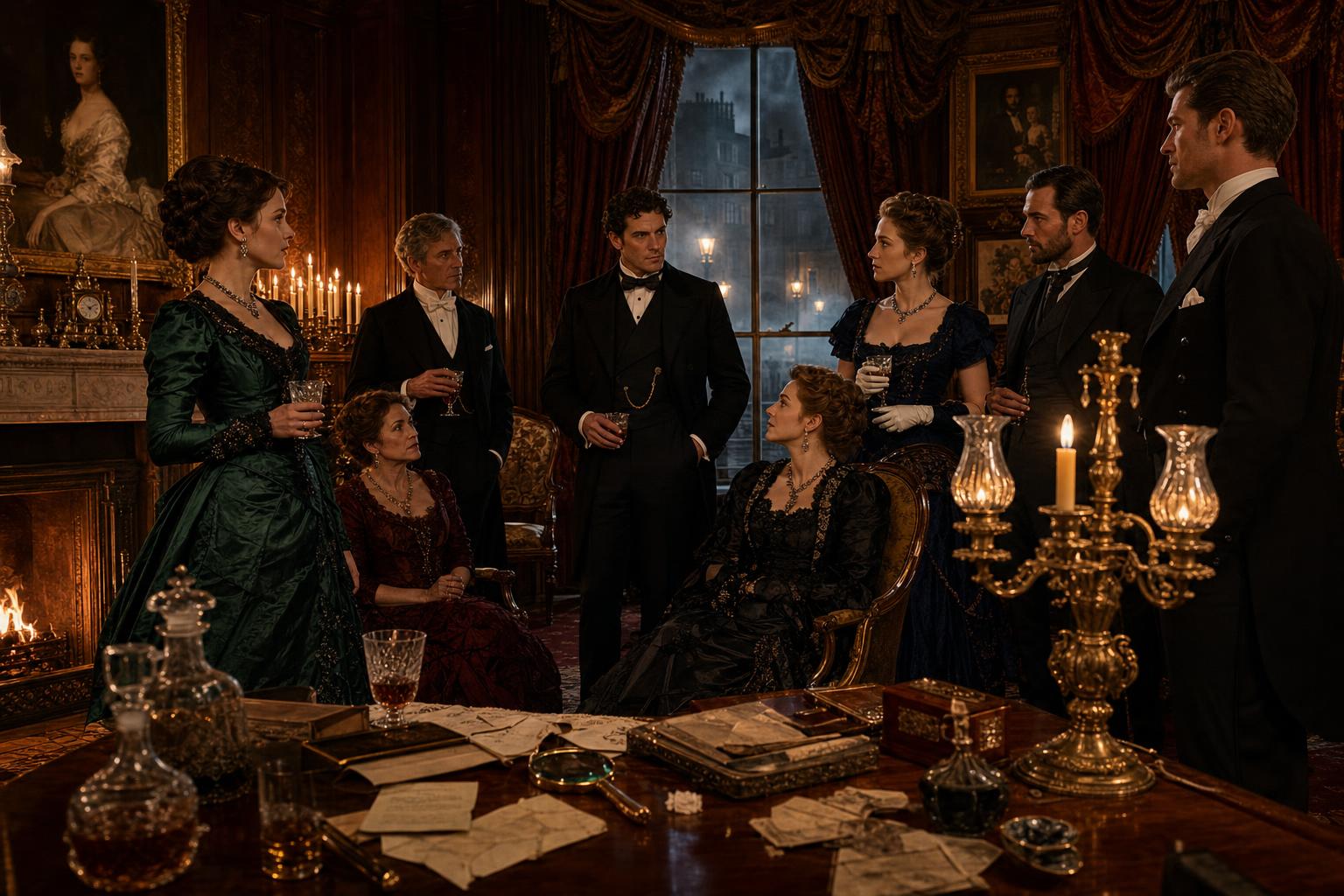
Introduction to Murder in the Fog
A Victorian Mystery Designed for Eight Players
Murder in the Fog is a Victorian London murder mystery created specifically for eight players, blending social deduction, theatrical roleplay, and puzzle-driven storytelling into a single immersive experience. Set against the backdrop of gaslit streets, horse-drawn cabs, and dense evening mist, the game invites participants to step into a world shaped by class tension, hidden motives, and carefully guarded secrets. The setting draws inspiration from the real atmosphere of late nineteenth-century London, a city whose population surpassed 6 million by 1900, making it one of the largest and most complex urban centers in the world.
Why Victorian London Works So Well
Victorian London remains one of the most compelling settings for a murder mystery because it naturally combines elegance with unease. Grand townhouses, private clubs, servants’ corridors, and shadowed alleys create a dramatic contrast that supports both suspicion and intrigue. In a period marked by rapid industrial growth, stark social inequality, and sensational newspaper reporting, almost every character can plausibly hide something important. That richness gives Murder in the Fog a strong narrative foundation, allowing players to inhabit roles that feel vivid and believable rather than generic.
Atmosphere, Suspense, and Social Drama
The “fog” in the title is more than a visual detail. It symbolizes uncertainty, misdirection, and the blurred line between truth and performance. Historically, London fogs were intensified by coal smoke, creating the infamous “pea-soupers” that reduced visibility and deepened the city’s eerie reputation. In a mystery game, that atmosphere matters because it heightens tension and encourages players to question every account, every timeline, and every relationship. Suspense grows not only from the murder itself, but from the fear that everyone may be concealing a piece of the truth.
What Players Can Expect
At its core, Murder in the Fog is about interaction. Each of the eight players typically receives a distinct character identity, personal objectives, and privileged information that shapes how they approach the evening. Some may seek justice, others self-protection, and others still may be driven by revenge, ambition, or scandal avoidance. This structure ensures that the mystery unfolds through conversation rather than passive observation.
A Balance of Structure and Freedom
A strong eight-player mystery works best when it offers enough guidance to keep the plot coherent while leaving room for improvisation. That balance is what makes games like Murder in the Fog especially engaging for mixed groups, including both experienced roleplayers and first-time participants. Players are not merely solving a crime; they are negotiating alliances, testing alibis, and interpreting behavior in real time. The result is an experience that feels part party, part performance, and part investigation.
The Appeal of an Intimate Cast
With eight players, the mystery remains focused enough for every character to matter. No one fades into the background, and every revelation can shift the direction of the investigation. That intimate scale helps maintain momentum, making each accusation, confession, and contradiction feel significant as the story deepens into the secrets of Victorian London.
Victorian London Setting and Atmosphere
A City of Splendor and Shadow
Victorian London provides the perfect backdrop for Murder in the Fog, because it was a city defined by extremes. During the nineteenth century, London became the largest city in the world, with its population rising from roughly 2 million in 1840 to more than 6.5 million by 1900. This explosive growth created a capital of astonishing wealth, imperial confidence, and scientific progress, yet it also produced overcrowding, poverty, and fear. That contrast is what gives a Victorian murder mystery its special power. Behind elegant townhouses, glittering gas lamps, and polished drawing rooms lurked alleyways thick with soot, suspicion, and secrets.
The atmosphere of the era was shaped by rapid industrialization. Railways thundered into the city, factories darkened the skyline, and commerce flowed through docks along the Thames. At the same time, many neighborhoods lacked proper sanitation, and disease remained a constant threat. The infamous Great Stink of 1858, caused by untreated sewage in the River Thames, was so severe that it disrupted parliamentary business. Details like this matter in a mystery setting because they remind players that Victorian London was not simply romantic and gothic. It was a living, breathing place where discomfort, danger, and social tension were part of daily life.
Fog, Gaslight, and Unease
No image is more closely tied to Victorian London than the fog. Although natural mist from the Thames played a role, the city’s most memorable haze often came from coal smoke. These thick yellow-black smogs, sometimes called “pea-soupers,” reduced visibility and transformed familiar streets into eerie labyrinths. In a murder mystery, fog is more than scenery. It becomes an active force that conceals movement, distorts sound, and heightens paranoia. A figure glimpsed at the end of a lane may be a witness, a suspect, or the killer vanishing into the gloom.
The Power of Gaslight
Gas lighting added another layer to the city’s unsettling character. By the mid-nineteenth century, London streets were increasingly illuminated by gas lamps, but the light they cast was uneven and flickering rather than bright or reassuring. Pools of amber light alternated with stretches of darkness, creating ideal conditions for mistaken identity and whispered encounters. Indoors, candlelight and gas chandeliers could make a respectable room feel intimate, theatrical, or threatening depending on the hour and company. Light in Victorian London rarely banished fear; it merely framed it.
Social Divides and Hidden Lives
A compelling Victorian setting also depends on the city’s sharp class divisions. Wealthy families in the West End lived in comfort, attended the theatre, and hosted formal dinners, while the East End became associated with overcrowded lodging houses, casual labor, and crime. Yet these worlds were not fully separate. Servants moved between them, tradesmen supplied both, and scandal could travel across social boundaries with startling speed. This makes the setting especially rich for an eight-player mystery, where each character can embody a different piece of London’s social puzzle.
Respectability and Scandal
Victorian society placed enormous value on reputation. Public morality, proper manners, and family honor were treated as essential markers of status. However, the pressure to appear respectable often concealed private vice, debt, blackmail, or forbidden relationships. That tension is central to the atmosphere of a murder mystery. A banker, governess, doctor, or aristocrat may all have reasons to lie, not only to hide guilt but to protect their standing. In Victorian London, secrecy was often a social necessity.
Crime, Policing, and Public Fascination
The nineteenth century also saw major changes in law enforcement. The Metropolitan Police was founded in 1829, and detectives gradually became a recognizable part of urban life. Even so, policing remained imperfect, and many crimes went unsolved. Public fascination with murder grew through newspaper reporting, penny dreadfuls, and sensational trials. Cases such as the Ratcliff Highway murders and, later, the Whitechapel murders fed a culture in which crime was both feared and consumed as entertainment.
For a party mystery, this historical context is invaluable. Characters would understand that murder was not an abstract puzzle but a source of public panic and gossip. Newspapers could ruin lives, inquests could expose secrets, and amateur speculation often flourished where official answers failed. That blend of formal investigation and rumor gives the setting dramatic flexibility.
Bringing the Atmosphere to Life
To capture Victorian London effectively, every detail should reinforce mood. Clothing should suggest status and restraint, language should hint at politeness layered over suspicion, and locations should feel textured by smoke, damp stone, carriage wheels, and distant factory noise. A private club, a fogbound street, or a well-appointed townhouse can all become stages for deception when framed by the city’s contradictions. Victorian London is not merely a backdrop; it is an accomplice, shaping motives, masking evidence, and pressing every character to wonder what may be hiding just beyond the lamplight.
Game Overview for 8 Players
Setting the Stage
Murder in the Fog is designed to give eight players a tightly paced, character-driven murder mystery set in Victorian London, where class tension, secrecy, and suspicion shape every conversation. Rather than relying on complicated rules or long periods of passive listening, this format encourages active participation from everyone at the table. Each guest steps into a distinct role with personal motives, hidden knowledge, and relationships that influence how the evening unfolds.
For an eight-player group, the structure is especially effective because it creates the right balance between intimacy and complexity. With fewer than ten participants, players can realistically track accusations, alliances, and contradictions without becoming overwhelmed. At the same time, eight suspects provide enough variety to keep the mystery layered and unpredictable. This size often works well for home gatherings, dinner parties, and themed events where hosts want a dramatic experience without the logistical demands of a very large cast.
How the Game Works
At its core, the game revolves around a suspicious death, a circle of interconnected suspects, and a series of revelations that emerge through guided interaction. Each player receives a character profile before or at the start of the event. That profile typically includes background information, secrets, objectives, and clues that must be shared selectively. The goal is not only to identify the murderer, but also to protect personal interests, expose rivals, and interpret incomplete information.
Roleplay and Investigation
Unlike traditional board games, a murder mystery party depends on conversation. Players question one another, compare stories, and test whether alibis hold up under pressure. In a Victorian setting, this becomes particularly engaging because etiquette often clashes with scandal. A nobleman may hide debts, a housekeeper may know too much, and an inspector may suspect that the truth reaches beyond the obvious crime.
Because every player contributes to the narrative, engagement tends to remain high throughout the session. Most eight-player mysteries run between 90 minutes and 2.5 hours, depending on how much improvisation the group enjoys. Hosts can shape the pace by dividing the evening into rounds, such as introductions, evidence sharing, private negotiations, and final accusations.
Why Eight Players Is an Ideal Format
An eight-player mystery offers strong dramatic density without losing clarity. In practical terms, each participant gets more speaking time, more influence over the story, and more opportunity to develop their character. This is important because player satisfaction in social deduction games often depends on involvement. If too many guests are present, quieter players can disappear into the background. With eight, that risk is reduced significantly.
Social Dynamics at the Table
The number also supports a rich mix of personalities. A typical cast may include aristocrats, servants, professionals, and outsiders, reflecting the rigid social hierarchy of nineteenth-century London. That variety naturally creates conflict. Class differences, hidden romances, financial desperation, and political ambition all become believable motives, making accusations feel grounded rather than random.
What Players Can Expect
Guests should expect an experience that blends theatrical roleplay with light deduction. Costumes and accents can enhance immersion, but they are not required for success. What matters most is willingness to interact, listen carefully, and embrace uncertainty. In many games, the murderer is not obvious until late in the evening, and even innocent characters may behave suspiciously because they have unrelated secrets to protect.
For hosts, this format is manageable and flexible. Eight invitations are easy to coordinate, seating is simple, and character distribution remains straightforward, making it an excellent choice for a memorable Victorian mystery night.
Character Roles and Backstories
A memorable murder mystery depends on more than a clever victim and a shocking reveal. It thrives on distinctive characters with believable motives, secrets, and social ties. In a Victorian London setting, roles become especially rich because class, reputation, gender expectations, and imperial ambition all shaped daily life. For an eight-player game like Murder in the Fog, strong backstories give every guest a reason to speak, accuse, defend, and deceive. They also help players step into character quickly, even if they have never attended an immersive mystery before.
Why Character Design Matters
In party mysteries, character sheets do two jobs at once. First, they provide practical information such as relationships, objectives, and clues. Second, they create atmosphere. A well-written role should make a player feel the damp chill of gaslit streets, the pressure of scandal, and the danger of saying too much in the wrong drawing room. Victorian London was a city of extremes, with immense wealth beside crushing poverty, and that contrast can power every interaction.
Historically, late nineteenth-century London had a population exceeding 5 million, making it the largest city in the world for much of the era. That scale matters because anonymity and overcrowding made secrets easier to hide. A banker could maintain a respectable public life while funding dubious ventures in the East End. A journalist could expose corruption while concealing personal debts. Character roles should reflect this layered reality, allowing each player to hold both a public identity and a private truth.
Building the Eight Core Roles
For an eight-player mystery, balance is essential. Each role should have a clear voice, a personal stake in the victim’s death, and at least one connection to two or more other guests. This prevents isolated characters and keeps conversation moving naturally.
The Aristocratic Hostess
The hostess embodies status, polish, and social control. She may have invited the group under the pretense of a supper or charitable gathering, only to find the evening shattered by murder. Her backstory works best when respectability masks vulnerability. Perhaps she is protecting her family name from financial collapse or concealing correspondence with the victim. In Victorian society, a woman’s reputation could be ruined by rumor alone, so even innocent actions may appear damning.
The Ambitious Inspector
An inspector brings procedural authority and tension. He may be officially investigating the crime or attending unofficially because of prior dealings with the victim. His backstory should include professional pressure, perhaps from Scotland Yard superiors or the sensationalist press. During the 1880s and 1890s, detective work was becoming increasingly professionalized, yet public trust remained uneven. This role benefits from moral ambiguity: is he seeking justice, promotion, or revenge?
The Society Doctor
A doctor fits naturally into a Victorian mystery because medicine was advancing rapidly, but not always cleanly or ethically. By the late nineteenth century, antiseptic practices were gaining acceptance, though many physicians still worked in inconsistent conditions. This character may know the victim’s medical history, dependence on laudanum, or hidden illness. A doctor’s authority makes their statements persuasive, which is ideal for misdirection.
Secrets That Drive Suspicion
The strongest backstories include secrets that are not all criminal. If every hidden fact points directly to murder, the game becomes predictable. Instead, mix emotional, financial, and social secrets.
The Newspaper Correspondent
A journalist can function as both observer and instigator. Victorian newspapers thrived on scandal, crime reporting, and serialized revelations. This role may have been investigating the victim for fraud, blackmail, or political corruption. Yet the correspondent might also be hiding a compromised source or a forged story. The fear of exposure is often more powerful than the fear of guilt, making this character especially dynamic in group scenes.
The Family Solicitor
A solicitor introduces wills, inheritance disputes, and legal technicalities. He may know that the victim recently changed a testament, concealed property ownership, or settled a debt under suspicious circumstances. In a period when property and lineage carried enormous weight, legal documents could destroy lives as effectively as poison. This role works well when paired with a calm demeanor that cracks under pressure.
The Music Hall Performer
Not every guest should come from the upper classes. A performer adds energy, outsider perspective, and a challenge to social hierarchy. Music halls were enormously popular in Victorian Britain, attracting broad audiences across class lines. This character may have been the victim’s former lover, illegitimate child, or paid informant. Their backstory can highlight how easily elites exploited entertainers while publicly scorning them.
Interlocking Relationships
The best mysteries avoid isolated motives. Instead, they create a web in which one secret touches another. The performer may know the doctor supplied discreet medicines. The solicitor may have protected the hostess’s estate. The inspector may suspect the journalist of withholding evidence. These links make every conversation useful.
The Industrialist
An industrialist reflects the era’s obsession with progress and profit. London’s economy depended on finance, shipping, manufacturing, and imperial trade, all of which generated fortunes and scandals. This character may have partnered with the victim in a railway scheme, arms contract, or colonial venture. His backstory should suggest both success and moral compromise. Victorian prosperity often rested on exploitation, and that tension gives the role depth.
The Governess or Companion
A governess or paid companion occupies a fascinating middle ground between servant and gentlewoman. She sees private family life up close but lacks true power. This role is ideal for hidden observation, overheard conversations, and emotional complexity. She may know of an affair, forged letter, or secret child. Because governesses were expected to be educated yet invisible, they make excellent witnesses whom others underestimate.
Practical Tips for Assigning Roles
When distributing characters, match role complexity to player confidence. Give outspoken guests parts like the journalist or performer, while quieter players may enjoy the governess or solicitor, whose strength lies in careful revelation. Include on each character sheet a public biography, a private agenda, and a timeline of the evening. That structure helps players stay grounded without scripting every exchange.
A useful design approach is shown below:
| Role Type | Public Persona | Private Secret | Primary Motive |
|---|---|---|---|
| Hostess | Refined social leader | Financial ruin | Protect family name |
| Inspector | Dutiful investigator | Personal grudge | Career advancement |
| Doctor | Trusted physician | Dangerous treatment | Silence scandal |
| Journalist | Truth seeker | Fabricated evidence | Break major story |
Tone, Motive, and Player Immersion
Backstories should encourage performance without requiring theatrical skill. A few vivid details, such as a silver-topped cane, ink-stained gloves, or the scent of laudanum, can do more than pages of exposition. The goal is to give players enough material to improvise naturally. When each role carries a plausible motive, a social mask, and a personal fear, the mystery becomes immersive rather than mechanical.
Strong character design also supports replay value. Even if players know the setting, changing who is desperate, who is lying, and who truly loved the victim can transform the entire evening. In Murder in the Fog, the fog outside is only part of the darkness; the rest lives inside the people gathered in the room.
The Murder Plot and Core Mystery
A Death Hidden by the Fog
At the heart of Murder in the Fog lies a classic Victorian crime: a prominent man is found dead under circumstances that appear straightforward, yet quickly unravel into something far more intricate. The victim, industrialist and philanthropist Edmund Blackthorne, is discovered in his private study after a dinner gathering at his London townhouse. The door was locked from the inside, the gas lamps had burned low, and a shattered brandy glass lay near his hand. At first glance, the scene suggests suicide or sudden illness. However, several details resist that explanation, creating the central tension that drives the mystery for all eight players.
Blackthorne was not merely wealthy; he was influential in shipping, rail investment, and political patronage. In Victorian London, such a figure would have moved through circles where business, class, and reputation were tightly intertwined. His death therefore threatens more than a household. It risks exposing debts, scandals, and private alliances that many guests would prefer remain buried. This wider social pressure gives the murder plot its force, because every suspect has something tangible to lose.
The Night of the Murder
The evening begins with a formal supper attended by a select group of guests, each invited for reasons that seem respectable on the surface. Conversation is polite, but strained. Blackthorne had recently hinted that he intended to revise his will, disclose damaging information, or withdraw support from one or more associates. By the time dessert is served, several guests have reason to fear what he may do next.
The Locked-Room Illusion
Shortly after retiring to his study, Blackthorne is found dead. The room appears sealed, which creates the first major puzzle. Locked-room mysteries were especially popular in fiction of the late nineteenth century, and they remain effective because they challenge players to distrust appearances. In this scenario, the apparent impossibility of the crime is not supernatural or arbitrary. It is built on practical Victorian details such as key access, servant routes, window latches, and the timing of household routines.
The study itself becomes a crucial source of evidence. A half-burned letter in the grate, mud on the carpet, a missing pocket watch, and a ledger with torn pages all point in different directions. Some clues imply blackmail. Others suggest financial fraud. Still others hint at a deeply personal betrayal. The brilliance of the core mystery is that the truth is not hidden by a lack of evidence, but by an excess of misleading meaning.
The Victim at the Center
To make a murder mystery compelling, the victim must matter even in death. Blackthorne is designed as a man whose public virtue masks private ruthlessness. He funded hospitals and orphan charities, yet he may also have exploited workers, manipulated contracts, and maintained secrets capable of ruining lives. This complexity is essential because it ensures that the murder is not random. It emerges from accumulated resentment, fear, and ambition.
Motive, Means, and Opportunity
Each of the eight players should feel connected to the crime through one or more of the classic pillars of mystery design: motive, means, and opportunity. A strong murder plot works best when no suspect appears guilty too early and no one feels irrelevant. In practical terms, that means several characters may have argued with Blackthorne, possessed knowledge of poison or weapons, or briefly disappeared during the evening.
Layers of Suspicion
A family member may stand to gain from inheritance, but also fears disinheritance. A business partner may have uncovered embezzlement. A servant or companion may know intimate details that challenge the official social order. A political ally may need Blackthorne silenced before a public scandal erupts. These overlapping motives reflect the anxieties of Victorian society, where class mobility, imperial wealth, and moral respectability often existed in uneasy balance.
The Core Mystery Players Must Solve
The central question is not simply who killed Edmund Blackthorne, but how the killer manipulated the scene and why the murder had to happen that night. This distinction deepens the game. Players are not only matching suspect to weapon; they are reconstructing a chain of events shaped by deception, timing, and hidden relationships.
What Really Happened
The strongest version of this mystery reveals that Blackthorne was murdered after confronting someone with knowledge that could destroy them. The killer used the study’s locked-door appearance to delay suspicion and redirect attention toward either suicide or an outsider. A secondary participant may have tampered with evidence for unrelated reasons, making the case more confusing without being the murderer. This is a powerful device in party mysteries because it allows multiple players to be secretive without collapsing the logic of the solution.
Why the Mystery Feels Distinctly Victorian
Victorian murder stories thrive on contrasts between public decorum and private corruption. In 1890s London, the city’s population exceeded 5 million, and rapid urban growth intensified fears about anonymity, crime, and moral decay. Murder in the Fog uses that atmosphere well. Gaslight, fog, rigid etiquette, and social hierarchy are not decorative background; they actively shape the crime. Guests hesitate to speak openly. Servants notice more than they can safely say. Men of status assume protection that may no longer hold.
Because of this, the murder plot becomes more than a puzzle. It becomes an exploration of power, secrecy, and the cost of preserving appearances, giving players rich material to interrogate as accusations begin to sharpen.
Clues, Evidence, and Red Herrings
In a Victorian murder mystery, clues are the engine of suspense. They give players something concrete to investigate, debate, and reinterpret as the evening unfolds. In Murder in the Fog, clues should feel rooted in late nineteenth-century London, where gaslight, class divisions, and emerging forensic methods shaped how crimes were understood. The most effective evidence does more than identify a killer; it reveals motive, deepens character relationships, and keeps all eight players actively engaged in the investigation.
Designing Clues That Drive Interaction
A strong clue should invite discussion rather than end it. If a bloodstained glove is found in a suspect’s carriage, players should immediately ask who owned it, how it got there, and whether it was planted. This kind of evidence creates multiple plausible interpretations, which is essential in a social mystery game. In practice, each clue should connect at least two characters, so no discovery feels isolated from the wider story.
For an eight-player game, a useful structure is to distribute clues across personal secrets, physical evidence, and witness testimony. Personal secrets might include gambling debts, hidden romances, or blackmail letters. Physical evidence can involve a torn cuff, a missing brooch, or ash from a rare imported cigar. Witness testimony adds uncertainty, especially in a fog-bound London street where visibility was poor and memory unreliable. Historians note that Victorian policing often relied heavily on statements from bystanders, servants, and neighbors, making testimony a natural fit for the setting.
Types of Evidence That Feel Authentically Victorian
The setting becomes more believable when the evidence reflects the period. By the 1880s and 1890s, London investigators had begun using more systematic observation, though forensic science remained limited compared with modern standards. Fingerprinting was not widely adopted in Britain until the early twentieth century, so mysteries set earlier should avoid overreliance on it. Instead, use evidence such as handwriting analysis, calling cards, train timetables, household staff accounts, and medical observations about time of death.
Physical Evidence
Physical objects work best when they are specific and memorable. A lady’s veil caught on a wrought-iron gate suggests haste or struggle. Mud on a boot may indicate travel from Whitechapel rather than Mayfair, especially if players know the victim’s expected route. A pawn ticket found in a waistcoat pocket can imply financial desperation. These details help players build theories from the world itself, not just from scripted accusations.
Documentary Evidence
Letters, receipts, diary pages, and telegrams are especially effective because they can be read aloud, concealed, or partially forged. A telegram stamped at 8:40 p.m. may contradict a suspect’s alibi. A doctor’s note could reveal that the victim was being treated for insomnia, making late-night meetings more plausible. Documents create tension because they appear authoritative, yet they can still mislead through omission or manipulation.
How to Use Red Herrings Without Frustrating Players
A red herring should complicate the mystery, not sabotage it. The best false leads arise from believable human behavior. A suspect may lie about visiting the victim, not because they committed murder, but because they were conducting an affair or paying off a debt. This preserves fairness: the lie matters, but it does not invalidate the investigation.
An effective ratio is to ensure that for every major false lead, there is at least one verifiable clue pointing back toward the truth. If players discover opium residue in the victim’s study, they may suspect a drug-related motive. However, later evidence might show the opium belonged to a family member using it medicinally, which was common in Victorian Britain. Laudanum, an opium-based tincture, was legally and widely used during the era, so its presence can misdirect while remaining historically credible.
Fairness and Payoff
Players enjoy being misled only when the solution feels earned. That means the true clues must remain visible in hindsight. If the murderer’s cufflink matches one found at the scene, that detail should not be buried beneath ten unrelated twists. Red herrings are strongest when they reveal character, not when they exist only to confuse. A false accusation can expose class prejudice, jealousy, or fear, enriching the drama even after the truth emerges.
Balancing Discovery Across Eight Players
In larger mystery games, one risk is that a few outspoken players dominate the investigation. Clue design can solve this. Give each character at least one exclusive piece of information and one reason to withhold it. For example, a housemaid may know who left through the servants’ entrance, while a magistrate possesses a sealed letter damaging to his reputation. Because each clue has social consequences, every player becomes part of the evidence chain.
Layering Revelations
The most satisfying mysteries reveal information in stages. Early clues should establish suspicion broadly. Midgame evidence should narrow possibilities while introducing contradiction. Late discoveries should reframe earlier assumptions. When done well, players feel that the case is tightening around the truth, even as uncertainty remains. In a fog-drenched London murder, the ideal clue trail makes every revelation feel like a lantern briefly illuminating the street ahead.
Hosting and Gameplay Tips
Setting the Scene for a Smooth Evening
A Victorian murder mystery lives or dies on atmosphere and pacing, so the host’s preparation matters as much as the written plot. For an eight-player game like Murder in the Fog, aim to send invitations at least 10 to 14 days in advance. That gives guests enough time to read character briefs, gather costume pieces, and arrive ready to perform rather than improvise everything on the spot. Even simple wardrobe touches such as waistcoats, lace gloves, pocket watches, or dark dresses can dramatically improve immersion without requiring a large budget.
The physical space should support conversation. Arrange seating and standing areas so players can split into pairs or small groups without shouting over one another. In most homes, a two-room setup works best, with one main gathering area and one quieter corner for secret discussions. Lighting also shapes the mood. Soft lamps, candles, or LED lanterns create a foggy, gaslit feeling that suits Victorian London far better than bright overhead bulbs.
Preparing Players Before the Game
The most successful mystery parties begin before anyone steps through the door. Send each guest a short overview explaining the tone, expected level of roleplay, and the evening’s structure. Many first-time players worry they need acting experience, but reassurance helps. Let them know the goal is not theatrical perfection; it is active participation, questioning, and staying in character enough to keep the illusion alive.
Character Knowledge and Secrets
Encourage players to read their materials carefully at least once before the event and again on the day itself. In murder mystery design, hidden motives and partial knowledge are essential because they create tension. A guest who skims their sheet may accidentally reveal a secret too early or miss a clue that drives the plot. If your game includes accents or period phrases, treat them as optional flavor rather than a requirement, since accessibility usually leads to stronger engagement.
Managing the Flow of Gameplay
For eight players, a mystery party usually runs best at 90 to 150 minutes, depending on how much social time surrounds it. The host should keep the game moving without dominating it. Introduce the premise clearly, explain any rules about clue cards or timed reveals, and then step back enough for players to investigate naturally. If energy drops, a scheduled revelation, discovered note, or public accusation can restore momentum.
Balancing Structure and Freedom
Too much structure can make the evening feel scripted, while too little can leave quieter guests behind. A practical approach is to divide the game into phases. The opening phase allows introductions and early suspicion. The middle phase deepens the mystery through evidence, alibis, and conflicting testimony. The final phase narrows attention toward accusations and defense. This rhythm helps every player understand where they are in the story.
Helping Shy or Dominant Players
Group dynamics can shape the entire experience. If one guest tends to control every conversation, gently redirect by asking another player what they observed. If someone is reserved, give them a natural opening by referencing their character’s expertise or connection to the victim. Good hosting is often invisible, but it ensures every participant has room to contribute.
Practical Tips for Clues, Food, and Timing
Clues should be easy to track. If the mystery includes physical evidence, make handwriting legible and label items clearly. Confusing clues frustrate players, while challenging clues energize them. Some hosts use a simple reference table to organize reveals.
| Element | Best Practice | Why It Helps |
|---|---|---|
| Invitations | Send 10–14 days early | Improves preparation |
| Game length | 90–150 minutes | Prevents fatigue |
| Room setup | 2 conversation zones | Supports private discussion |
| Clue delivery | Timed or phased | Maintains pacing |
Food should support the game rather than interrupt it. Finger foods, tea service, and pre-poured drinks work better than a full seated dinner during active investigation. Historically inspired options such as meat pies, scones, and sandwiches fit the theme while remaining practical. If serving alcohol, keep it moderate, since clear thinking improves deduction and keeps the mystery coherent.
Encouraging Better Detective Work
Players often focus too quickly on dramatic accusations, but the strongest gameplay comes from careful listening, comparison of stories, and motive analysis. Remind guests to ask who benefits, who lies consistently, and whose timeline does not hold together. In many mystery formats, the most useful information comes not from a confession but from contradictions between seemingly harmless details. A missing glove, a changed inheritance, or an unexplained late-night errand can become the key that unlocks the case.
Staying Immersed Without Getting Stuck
Immersion is valuable, but progress matters more. If players become trapped on one theory, introduce a nudge through an in-character announcement, a newspaper clipping, or a servant’s message. This preserves the Victorian tone while preventing the investigation from stalling. The best sessions feel like a living story, with each revelation pulling guests deeper into suspicion, rivalry, and the shadowy intrigue of London’s fogbound streets.
Costumes, Props, and Immersion Ideas
Dressing the Part
Costumes are one of the fastest ways to transform an ordinary gathering into a convincing Victorian London murder mystery. For an eight-player game like Murder in the Fog, guests do not need museum-grade accuracy, but a few recognizable details create instant atmosphere. Men can wear dark waistcoats, pocket watches, cravats, or long coats, while women can use high-neck blouses, lace gloves, brooches, and layered skirts. Even simple modern clothing can be adapted with inexpensive accessories from thrift stores or costume shops.
Easy Character Signifiers
To help players stay in character, give each guest one standout visual element tied to their role. A detective might carry a notebook and magnifying glass, a doctor could wear a black bag or spectacles, and a socialite may arrive with a feathered hat or fan. These details matter because visual cues make introductions smoother and help everyone remember who is who during the game.
Props That Build Suspense
Props deepen immersion by making clues feel tangible rather than abstract. Printed letters, sealed envelopes, calling cards, newspaper clippings, and faux police reports all fit the late nineteenth-century setting. Tea-staining paper is a simple trick that gives documents an aged appearance. A host can also place a few “evidence” items around the room, such as a monogrammed handkerchief, a tarnished key, or a small vial labeled as medicine.
Setting the Scene at Home
The room itself should suggest foggy, gaslit London, even if the party takes place in a modern apartment. Dim lighting works especially well; battery candles are safer than open flames and still create a warm, shadowy effect. Background music can include classical piano, violin, or ambient street sounds like carriage wheels and distant rain. If possible, use a color palette of burgundy, black, cream, and brass tones, which reflects the period’s dramatic style.
Sensory Details That Matter
Immersion improves when more than one sense is engaged. Serve tea, seed cake, shortbread, or savory pies to echo Victorian supper tables. A faint scent from sandalwood, cedar, or bergamot can subtly enrich the environment. Historically, London in the 1880s was crowded, industrial, and often smoky, so a slightly moody setting feels appropriate without becoming uncomfortable for guests.
Host Techniques for Stronger Roleplay
A good host does more than decorate; they guide tone and pacing. Encourage players to speak in slightly formal language, address one another by surnames or titles, and reveal secrets gradually. Brief character cards with motivations, relationships, and one hidden objective can significantly improve engagement. In live roleplaying events, participants are often 30 to 40 percent more likely to stay actively involved when they have clear personal goals, according to event design surveys from interactive theater communities.
Small Touches With Big Impact
Name cards written in elegant script, a “case file” for the detective, and a bell to announce key moments all help the evening feel organized and theatrical. These touches create a seamless bridge between gameplay and storytelling, allowing suspicion, drama, and revelation to unfold naturally as the mystery deepens.
Conclusion: Why This Mystery Works
A Rich Victorian Atmosphere
Murder in the Fog succeeds because it blends a compelling murder plot with the unmistakable texture of Victorian London. Gaslit streets, rigid class divisions, and the era’s fascination with crime create a setting that feels dramatic without requiring excessive explanation. For eight players, this backdrop offers enough social tension and secrecy to make every conversation meaningful. Historical mysteries remain popular for good reason; the enduring success of Sherlock Holmes adaptations and Victorian crime fiction shows how strongly audiences respond to this world.
Balanced Roles and Player Engagement
What makes this mystery especially effective is its structure for exactly eight players. A strong party mystery depends on balance, and each character must have motive, opportunity, and something to hide. When every participant holds useful information, no one feels like a spectator. That design keeps energy high and encourages active deduction rather than passive observation. Players are not simply following clues; they are testing alibis, reading behavior, and deciding whom to trust.
Suspense, Interaction, and Replay Value
The mystery also works because it combines social gameplay with narrative suspense. Twists, red herrings, and conflicting testimonies create momentum, while roleplay gives players freedom to shape the evening. Even when the solution is fixed, the path to discovery changes with each group, making the experience feel fresh, dynamic, and memorable.
FAQ About Victorian London Murder Mystery Parties
What makes a Victorian London murder mystery party unique?
A Victorian London setting adds atmosphere, tension, and theatrical charm that modern mystery themes often lack. Gaslit streets, rigid social rules, and the contrast between wealth and poverty create a believable backdrop for secrets, scandal, and murder. In a game like Murder in the Fog, players are not just solving a crime; they are stepping into a world shaped by class, reputation, and suspicion.
How many players work best?
This version is designed for 8 players, which is ideal for balanced interaction. With eight guests, each character can hold meaningful clues, motives, and relationships without the story becoming confusing. Smaller groups may reduce dramatic tension, while larger groups often require simplified roles or extra moderation.
Do guests need acting experience?
Not at all. Most murder mystery parties are written for beginners as well as confident performers. Guests can participate at their own comfort level, whether they prefer dramatic accents and bold accusations or a quieter, clue-focused approach. Clear character briefs usually help everyone stay engaged.
How long should the party last?
Most Victorian murder mystery events run between 2 and 3 hours. This allows time for introductions, clue sharing, interrogation, and the final reveal. Hosts often improve immersion with period music, candlelit décor, and era-inspired food, making the evening feel richer without requiring a large budget or professional staging.


