

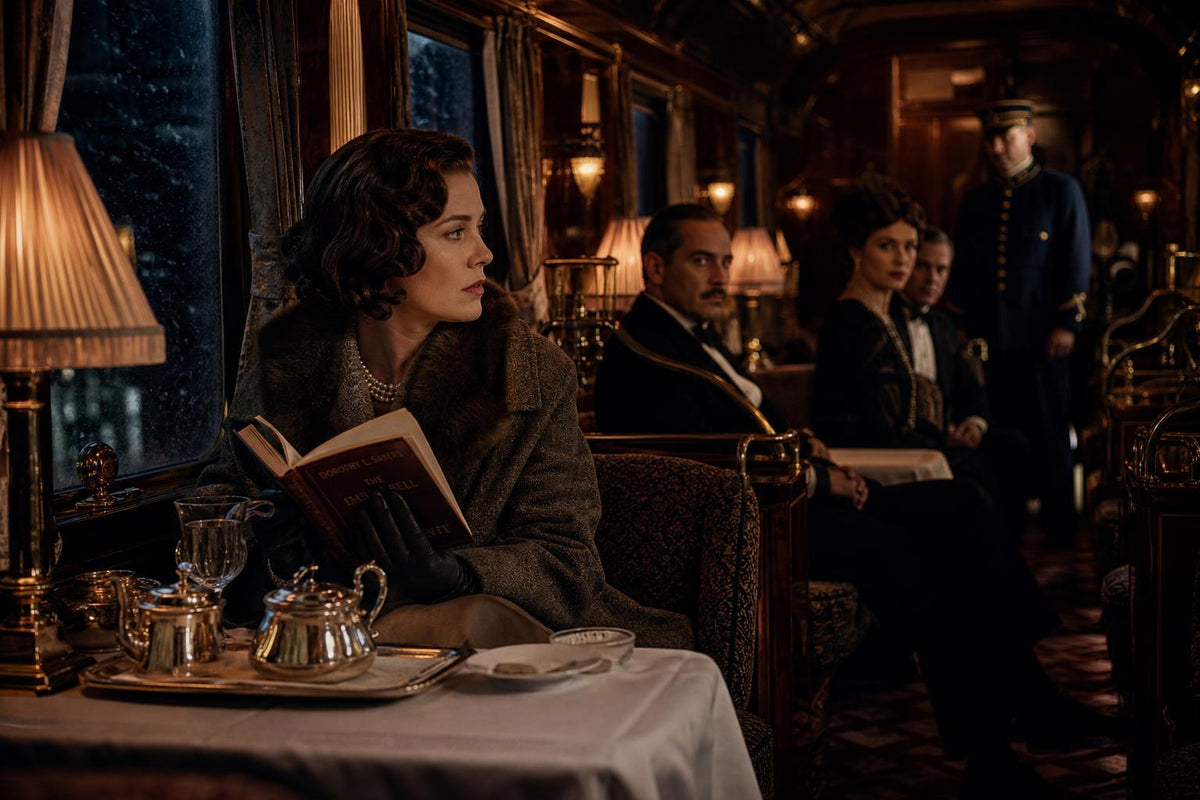
Introduction: A Mystery That Endures
Few detective novels have achieved the lasting cultural presence of Murder on the Orient Express. First published in 1934, Agatha Christie’s celebrated mystery continues to attract new readers nearly a century later. Its appeal is not based on nostalgia alone. The novel combines an ingenious puzzle, a glamorous setting, and a moral dilemma that feels surprisingly modern. In a genre crowded with clever crimes and brilliant sleuths, this story still stands apart as one of the most discussed and revisited works in crime fiction.
A Classic Built on Suspense
At the center of the novel is Hercule Poirot, Christie’s meticulous Belgian detective, traveling aboard the luxurious Orient Express when a passenger is found murdered. The setup is elegantly simple, yet the execution is anything but ordinary. Christie turns a confined train carriage into a pressure chamber of suspicion, where every conversation, gesture, and alibi matters. Because the train is trapped by snow, the suspects are physically contained, intensifying the sense of claustrophobia and urgency.
What makes the story especially compelling is the balance between order and uncertainty. Poirot represents logic, precision, and rational inquiry, but the case he faces is layered with deception and emotional complexity. Readers are invited to solve the crime alongside him, only to discover that the truth is far more intricate than expected.
Why the Novel Still Resonates
A Setting That Feels Timeless
The Orient Express itself plays a major role in the novel’s enduring fascination. Long associated with elegance, wealth, and international intrigue, the train offers more than a backdrop; it creates an atmosphere of isolation wrapped in luxury. That contrast gives the story much of its power. Fine dining, polished compartments, and cosmopolitan passengers exist alongside violence and hidden motives, reminding readers that danger can emerge even in the most refined spaces.
A Mystery with Moral Weight
Many detective stories focus solely on identifying the culprit, but Christie goes further. The novel raises questions about justice, revenge, and the limits of the law. This ethical dimension helps explain why the book remains relevant. Readers do not simply ask who committed the murder; they also ask whether the final resolution feels right. That tension transforms the novel from a clever whodunit into a story that invites debate.
Enduring Popularity Across Generations
The book’s influence can be measured not only by its reputation but also by its repeated adaptations for stage, radio, television, and film. Each version introduces the mystery to a new audience, proving the durability of Christie’s storytelling. Scholars often cite her as one of the best-selling authors in history, with estimated global sales exceeding two billion copies across her works. Within that extraordinary legacy, Murder on the Orient Express remains a defining title, admired for both its craftsmanship and its emotional complexity.
Its continued popularity suggests that readers are drawn not just to the solution, but to the unsettling questions left in its wake.
Agatha Christie and the Novel’s Origins
Christie at the Height of Her Powers
When Murder on the Orient Express appeared in 1934, Agatha Christie was already one of the most recognizable names in crime fiction. By then, she had published more than a dozen detective novels and had firmly established Hercule Poirot as a distinctive literary sleuth. The book emerged during what is often called the Golden Age of Detective Fiction, a period between the two world wars when intricate plotting, closed-circle suspects, and intellectual puzzle solving dominated the genre. Christie did not simply participate in that tradition; she helped define it.
The novel’s origins are closely tied to Christie’s fascination with travel, modernity, and the social tensions of interwar Europe. Rail travel in the 1920s and 1930s carried a glamorous reputation, especially luxury services such as the Orient Express, which connected Western Europe with the East. To contemporary readers, the train represented both sophistication and vulnerability: a moving world of strangers, status, and secrets. Christie recognized that such a setting offered the perfect stage for a murder mystery, combining elegance with confinement.
Real Journeys Behind the Fiction
Christie’s inspiration was not purely imagined. She had personal experience with long-distance rail travel and had ridden the Orient Express herself while journeying to the Middle East, where her archaeologist husband, Max Mallowan, worked on excavations. These trips exposed her to the rhythms of international travel, the mixture of passengers from different nations, and the practical realities of delays caused by weather or border crossings. Those observations gave the novel its convincing texture.
A particularly important real-world influence was an incident in 1929, when the famous train became stranded by heavy snow in Turkey for several days. Christie transformed that kind of disruption into a brilliant narrative device. In the novel, the snowdrift does more than halt the train; it creates a sealed environment in which the murderer must still be present. This setting intensifies suspense while eliminating outside interference, allowing Poirot’s investigation to unfold with almost theatrical precision.
The Lindbergh Case and Emotional Resonance
Another major source for the novel’s emotional core was the 1932 kidnapping and murder of Charles Lindbergh’s infant son, a crime that shocked the world. Christie drew on public outrage surrounding that case when creating the backstory of Daisy Armstrong, the child whose death motivates the events aboard the train. While she altered the details, the resemblance was clear enough for many readers to recognize. This connection gave the story unusual moral weight, grounding its puzzle structure in grief, injustice, and revenge.
Why the Premise Was So Effective
Christie’s genius lay in combining these influences into a premise that felt both timely and timeless. The train’s international passenger list reflected a Europe still marked by class divisions, national identities, and postwar unease. At the same time, the mystery appealed to universal questions about justice, guilt, and collective responsibility. Rather than relying only on a shocking crime, Christie built a scenario in which every clue, accent, alibi, and social performance mattered.
A Setting That Became Iconic
The result was a novel whose origins were rooted in real travel, real crime, and real historical anxieties, yet shaped by Christie’s unmatched control of structure. The Orient Express itself became more than a backdrop; it turned into one of literature’s most memorable enclosed worlds, a place where luxury and danger travel side by side. That powerful origin story helps explain why the novel continues to captivate new generations of readers and remains central to Christie’s enduring legacy.
The Plot Setup and Locked-Room Appeal
A Journey That Becomes a Trap
Agatha Christie builds Murder on the Orient Express on an irresistibly simple premise: a luxurious train, a winter journey across Europe, and a murder that occurs when no outsider could possibly have entered or escaped. The novel begins with detective Hercule Poirot traveling from the Middle East toward Western Europe aboard the famous Orient Express, a real train service that, in the 1930s, symbolized glamour, wealth, and international sophistication. Christie uses that reputation brilliantly. What should be a smooth, elegant trip becomes a sealed stage for suspicion, fear, and deduction.
The setup gains power from its precision. Poirot boards the train unexpectedly, finds it unusually full for the season, and soon notices a collection of passengers from different countries, classes, and temperaments. This variety matters because Christie is not merely assembling suspects; she is creating a miniature society in motion. The train carries aristocrats, servants, professionals, and travelers with hidden histories, all compressed into a narrow, inescapable space. Once the murder occurs, every corridor, compartment, and dining car becomes charged with meaning.
Why the Locked-Room Structure Works So Well
The novel’s central mystery has the classic appeal of a locked-room puzzle, one of detective fiction’s most enduring forms. In such stories, the crime appears impossible. The victim, Samuel Ratchett, is found dead in his compartment after the train has been halted by heavy snow in Yugoslavia. His door was locked, the setting is isolated, and the weather has cut the passengers off from the outside world. These conditions immediately narrow the field of possibilities while making the crime seem even more baffling.
What makes this structure so satisfying is the balance between limitation and complexity. On one hand, readers know the killer must be among a finite group of people. On the other, Christie fills the scene with contradictory clues: a handkerchief, a pipe cleaner, a mysterious uniform button, and wounds that suggest conflicting levels of strength and intent. The result is a puzzle that feels both constrained and expansive. The physical setting is small, yet the interpretive possibilities are enormous.
The Train as a Perfect Mystery Machine
A train is uniquely suited to detective fiction because it combines movement with confinement. Unlike a country house, which can feel static, a train suggests progress, schedule, and destination. Yet once snowdrifts stop the Orient Express, that movement is suspended. The passengers are stranded between places, neither arriving nor escaping. This interruption creates psychological pressure. Time stretches, routines break down, and every interaction acquires urgency.
Christie also benefits from the train’s architecture. Compartments, connecting doors, shared passageways, and sleeping arrangements all matter to the investigation. Poirot can reconstruct movements with unusual exactness because the environment is so controlled. Readers are invited to think spatially: who was where, at what hour, and how could they have passed unnoticed? The setting becomes not just a backdrop but an active mechanism in the mystery.
Suspicion, Fair Play, and Reader Engagement
Another reason the plot setup remains compelling is Christie’s commitment to fair-play detection. She gives readers access to the same interviews, objects, and timelines that Poirot studies. Although the solution is famously ingenious, it does not emerge from hidden evidence or arbitrary twists. Instead, it grows from careful observation of behavior, language, and inconsistency. That fairness keeps readers engaged because they feel challenged rather than manipulated.
The locked-room appeal also depends on how Christie distributes suspicion. Nearly every passenger has something to conceal, but not every secret is identical in weight. Some lies are defensive, some emotional, and some strategic. This layering prevents the mystery from becoming mechanical. Readers are not simply asking who committed the murder; they are also asking why so many people seem invested in obscuring the truth.
A Puzzle with Emotional Stakes
Many locked-room mysteries succeed intellectually but remain emotionally distant. Murder on the Orient Express avoids that problem by tying its setup to a deeply human crime. Ratchett is quickly revealed to be connected to the kidnapping and murder of Daisy Armstrong, a child whose death destroyed an entire family. This revelation transforms the investigation. The murder is no longer just a technical puzzle inside a sealed compartment; it becomes a moral drama involving grief, justice, and revenge.
That emotional dimension intensifies the locked-room appeal because the solution matters beyond cleverness. Readers want to understand not only how the impossible crime was committed, but what ethical meaning it carries. Christie uses the enclosed setting to sharpen that tension. In the snowbound train, the suspects cannot disperse into ordinary life. They must remain present with one another, and with the consequences of the past, while Poirot uncovers the pattern connecting them.
Enduring Fascination in a Controlled World
The plot setup continues to fascinate because it delivers one of mystery fiction’s greatest pleasures: a world with clear boundaries but hidden depths. The train is finite, the suspect list is limited, and the crime scene is contained. Yet within those limits, Christie creates extraordinary richness. National identities, personal loyalties, class performance, and private trauma all intersect in a setting measured in compartments and corridors.
That combination of order and uncertainty is central to the novel’s enduring power. Readers enter a tightly controlled environment where every detail seems capable of explanation, then discover that human motives are far less tidy than the physical space suggests. The locked-room structure promises logic, but Christie fills that logic with feeling, ambiguity, and surprise
Hercule Poirot as the Perfect Detective
A Detective Built on Precision
Hercule Poirot remains one of the most recognizable detectives in world literature because he represents order in the face of chaos. In Murder on the Orient Express, a novel first published in 1934, Agatha Christie places him inside a locked, snowbound train filled with suspects, secrets, and conflicting loyalties. The setting is dramatic, but it is Poirot’s method that gives the story its enduring power. He does not rely on speed, violence, or dramatic intuition alone. Instead, he studies human behavior with almost scientific care.
What makes Poirot feel “perfect” is not that he is superhuman, but that he is consistently disciplined. He notices details others dismiss, from the arrangement of objects in a compartment to the emotional tone of a witness’s answer. Christie designed him as a detective who trusts reason above all else, and that rationality gives readers confidence even when the mystery appears impossible.
The Power of the “Little Grey Cells”
Poirot famously solves crimes using his “little grey cells,” a phrase that has become central to his identity. Unlike detectives who chase suspects through dark streets or depend heavily on forensic technology, Poirot’s greatest tool is his mind. This is especially significant in a novel written before modern DNA analysis, digital surveillance, or computerized databases transformed criminal investigation. Christie proves that intellect can be more compelling than machinery.
In Murder on the Orient Express, Poirot gathers testimony, compares contradictions, and reconstructs motives with extraordinary patience. He understands that facts alone do not solve a crime unless they are arranged into a meaningful pattern. Readers are invited to admire not just the final answer, but the elegance of the reasoning that produces it. That intellectual pleasure is one reason the novel still attracts audiences nearly a century after publication.
Observation Beyond the Obvious
Poirot’s brilliance lies in the fact that he observes both physical clues and psychological ones. A handkerchief, a pipe cleaner, or a misplaced uniform button matters, but so do hesitation, resentment, grief, and fear. He recognizes that people often reveal themselves indirectly. In this way, he becomes more than a puzzle-solver; he is an interpreter of character.
This balance makes him especially effective in a story like Murder on the Orient Express, where nearly every passenger has something to hide. The mystery depends not only on who could have committed the murder, but on why so many people seem emotionally connected to it. Poirot sees beneath performance, and that ability elevates him above ordinary investigators.
A Distinctive Moral Intelligence
Another reason Poirot feels like the perfect detective is that he is not merely logical; he is morally alert. Many fictional detectives are defined by detachment, but Poirot combines analysis with ethical reflection. In Murder on the Orient Express, this becomes crucial because the case is not a simple battle between innocence and guilt. The victim, Samuel Ratchett, is revealed to be the criminal responsible for the kidnapping and death of Daisy Armstrong, a child whose tragedy destroyed an entire family.
Justice Versus Law
Poirot’s final decision is unforgettable because it forces readers to consider whether legal justice and moral justice are always the same. He uncovers the truth, yet he also understands the emotional and ethical complexity behind the crime. This depth separates him from detectives who exist only to expose culprits. Poirot weighs human suffering, social failure, and the limits of formal law.
That complexity helps explain why he continues to fascinate modern readers. According to UNESCO’s Index Translationum, Agatha Christie is among the most translated authors in the world, and Poirot is central to that global appeal. Readers return to him because he offers not just solutions, but thoughtful judgment.
Style, Personality, and Lasting Appeal
Poirot’s perfection also comes from his unforgettable personality. His meticulous grooming, formal manners, and occasional vanity could have made him ridiculous, yet Christie turns these traits into strengths. His attention to symmetry and neatness reflects the mental order he brings to disorderly crimes. He is distinctive without losing credibility.
A Detective Readers Trust
Because Poirot is so self-assured, readers trust him to navigate even the most bewildering mystery. He creates a sense that truth can be found, no matter how cleverly it has been buried. In Murder on the Orient Express, that assurance matters enormously. The case seems unsolvable, yet Poirot proves that careful thought can uncover even a conspiracy hidden in plain sight.
His perfection, then, lies not in cold infallibility, but in the rare combination of intelligence, humanity, and moral courage that keeps the mystery alive far beyond its final revelation.
Why the Suspects Are So Memorable
A Cast Built on Contradiction
One reason Murder on the Orient Express continues to captivate readers is the unforgettable nature of its suspects. Agatha Christie does not present them as simple puzzle pieces waiting to be arranged. Instead, she creates a group of people who feel distinct, layered, and emotionally charged. Each passenger carries a recognizable social identity, yet each also hides something that complicates first impressions. That tension between appearance and reality makes the suspect list far more engaging than a standard lineup of possible killers.
The novel gathers individuals from different nations, classes, professions, and generations inside one luxurious but claustrophobic setting. A countess, a governess, a colonel, a princess, a businessman, a valet, and a missionary all occupy the same train car, and that variety immediately gives the story dramatic energy. Christie understood that readers remember characters more vividly when they are not interchangeable. Every suspect has a voice, a manner, and a social role, which helps the mystery feel populated by real personalities rather than generic archetypes.
Distinct Personalities in a Confined Space
The train setting intensifies the impact of these characters. Because the suspects cannot simply disappear into a city or fade into the background, every conversation matters. Readers encounter them in interviews, observations, and small behavioral details, all of which sharpen their individuality. Hercule Poirot notices accents, clothing, posture, and word choice, and Christie uses those details to make each suspect stand out.
Small Details Create Lasting Impressions
Memorability often comes from precision. Princess Dragomiroff’s imperious dignity, Mary Debenham’s controlled composure, Colonel Arbuthnot’s stiffness, and Mrs. Hubbard’s theatrical chatter all create immediate mental images. These are not vague descriptions. They are sharply drawn traits that allow readers to identify each person quickly, even in a crowded cast. Christie’s economy of characterization is one of her greatest strengths. With only a few carefully chosen details, she makes each suspect feel vivid.
This technique also serves the mystery structure. When readers can clearly remember who each person is, they can better follow the clues, contradictions, and shifting suspicions. In many detective novels, a large cast can become confusing. Here, the opposite happens. The suspects remain memorable because their personalities are so clearly differentiated.
More Than Red Herrings
Another reason the suspects endure in readers’ minds is that they are not merely distractions placed in Poirot’s path. Christie gives them emotional weight. As the investigation unfolds, the passengers gradually become connected to the Armstrong kidnapping case, a crime that had destroyed an innocent family years earlier. That revelation transforms the suspects from isolated strangers into participants in a shared moral history.
Sympathy Complicates Suspicion
This is where Christie’s characterization becomes especially powerful. Readers may begin by asking which passenger is lying, but they soon start asking why each person is lying. The suspects become memorable because they are tied to grief, loyalty, trauma, and justice. Their deception is not always selfish. In many cases, it is protective or deeply personal. That complexity makes them harder to dismiss as stock mystery figures.
For example, characters who initially seem suspicious because of secrecy or nervousness often become sympathetic once their motives are understood. Christie uses this reversal masterfully. She encourages readers to judge quickly, then forces them to reconsider. That process leaves a strong impression because it mirrors real human behavior, where people are rarely as simple as they first appear.
A Reflection of Social Performance
The suspects are also memorable because so many of them are performing roles. The novel repeatedly explores how identity can be constructed through costume, language, class markers, and etiquette. Several passengers present polished versions of themselves, and Poirot’s task is to see beyond those surfaces. This theme gives the suspects intellectual depth as well as narrative intrigue.
Masks, Manners, and Motives
On the Orient Express, refinement often acts as camouflage. Respectability, foreignness, femininity, military discipline, and religious gentleness all become possible masks. Christie invites readers to notice how easily social assumptions can mislead perception. The suspects stay with readers because they embody both character and disguise at once. They are people, but they are also performances.
That duality is especially effective in a classic detective story, where hidden truth drives the plot. The suspects are memorable not only because they might have committed the murder, but because each one reveals something about how society reads innocence, guilt, and respectability. Their lasting appeal comes from the fact that they function on multiple levels at once: as individuals, as clues, and as moral witnesses within one of Christie’s most daring mysteries.
Justice, Morality, and the Novel’s Big Twist
A Solution That Changes the Meaning of the Mystery
One reason Murder on the Orient Express remains so compelling is that its final revelation does more than identify a killer. It redefines the moral universe of the novel. Readers begin with what appears to be a classic locked-room murder: a wealthy American passenger, Samuel Ratchett, is found stabbed to death in his compartment while the train is stranded by snow. The investigation promises a familiar reward, namely the restoration of order through logic. Yet Agatha Christie uses that familiar structure to lead readers toward a far more unsettling question: what happens when legal justice fails so completely that private citizens decide to create justice for themselves?
The answer arrives in the novel’s famous twist. Ratchett is revealed to be Cassetti, the criminal responsible for the kidnapping and death of Daisy Armstrong, a child from a prominent and beloved family. In the backstory, the crime destroyed multiple lives. Daisy’s mother died after childbirth, her father took his own life, a maid was wrongly accused and then killed herself, and the entire household collapsed under grief and scandal. Christie carefully builds this history so that the murder on the train no longer appears as an isolated act of violence. Instead, it becomes the delayed consequence of an earlier atrocity that the legal system failed to punish adequately.
The Armstrong Case and the Failure of Law
The Armstrong case is central because it gives the novel its emotional and ethical force. Christie modeled aspects of it on the real-life Lindbergh kidnapping, a case that shocked the world in 1932. By invoking a crime that resembles a widely known tragedy, she grounds the story in recognizable public fears about innocence, wealth, media attention, and the vulnerability of children. The effect is immediate: readers understand that Cassetti is not merely unpleasant or suspicious. He is morally monstrous, and his escape from formal punishment creates the vacuum in which vigilante justice becomes imaginable.
Why Readers Sympathize with the Conspirators
Christie’s brilliance lies in making nearly every suspect connected to the Armstrong family in some intimate way. A governess, a valet, a secretary, a doctor, and others are not random accomplices but wounded survivors of the same moral disaster. Their shared act of revenge is framed not as greed or impulse but as a ritual of collective judgment. The twelve participants even echo the structure of a jury, suggesting that they are symbolically correcting the verdict that society failed to deliver.
This design matters because it complicates the reader’s allegiance. In many detective novels, the detective exposes guilt and thereby reassures the audience that truth and law can work together. Here, truth emerges clearly, but law becomes unstable. Once Poirot understands what happened, the question is no longer whether he can solve the crime. It is whether solving it should automatically lead to legal punishment.
Poirot’s Moral Dilemma
Hercule Poirot is often associated with precision, order, and rational certainty. He believes in method, psychology, and the disciplined use of the “little grey cells.” In this novel, however, his intellect leads him into a moral conflict that logic alone cannot resolve. He presents two solutions: one implausible version involving an outside assassin, and the true one, in which the passengers acted together. By allowing the false solution to stand, Poirot effectively chooses mercy over strict legal duty.
Justice Versus Legality
This moment is what elevates the novel from an ingenious puzzle to a lasting ethical drama. Justice and legality are not treated as identical. The law, in principle, should protect the innocent and punish the guilty. But Christie shows that institutions can fail, especially when wealth, influence, and corruption intervene. Cassetti had already escaped proper accountability once. The passengers’ conspiracy is therefore presented as both criminal and understandable, even to the detective whose role is usually to defend official truth.
Poirot’s choice does not erase the violence of what occurred. Ratchett was stabbed twelve times, and the act is deliberately excessive, suggesting rage, grief, and symbolic participation rather than simple execution. Christie does not pretend that revenge is clean. Instead, she asks whether readers can acknowledge the horror of murder while still recognizing the emotional and moral logic behind it.
Why the Twist Still Feels Modern
The ending continues to resonate because contemporary audiences remain deeply interested in cases where legal outcomes feel inadequate. Public debates about corruption, privilege, and systemic failure make Christie’s central question feel current: when institutions fail, what do ordinary people owe to justice, and what are they forbidden to do in its name? The novel offers no easy doctrine, which is precisely why it invites discussion across generations.
A Twist Built on Ethics, Not Shock Alone
Many modern twists aim primarily to surprise. Christie’s twist endures because it changes the reader’s ethical position, not just the plot. The revelation forces a reassessment of every clue, every interview, and every assumption about innocence and guilt. More importantly, it transforms the detective story from a game of deduction into a meditation on punishment, grief, and moral responsibility.
That complexity helps explain the novel’s lasting power. Readers do not finish the book merely admiring its cleverness. They finish it debating whether Poirot was right, whether the conspirators were justified, and whether justice can ever be complete when innocence has already been destroyed. In that unresolved tension, Christie finds something richer than a simple solution: she finds the enduring human drama at the heart of crime fiction.
Themes of Class, Grief, and Revenge
Class divisions inside a luxury train
One reason Murder on the Orient Express continues to resonate is its sharp attention to class. The novel places a murder inside one of the most glamorous symbols of early twentieth-century travel: the Orient Express. In the 1930s, this train represented wealth, status, and international sophistication. Christie uses that setting carefully. The polished dining cars, private compartments, and formal manners create an atmosphere of privilege, yet beneath that elegance lies suspicion, secrecy, and moral decay.
Class matters because the passengers initially appear to fit recognizable social types. There are aristocrats, servants, professionals, and foreigners, each carrying assumptions about respectability. Hercule Poirot must look past accents, titles, and clothing to understand who these people really are. Christie shows how easily society confuses social position with moral worth. A well-dressed passenger may be deceptive, while a servant or governess may possess greater dignity and loyalty.
Grief as the emotional engine of the plot
If class shapes the surface of the novel, grief drives its emotional core. The murder investigation leads back to the kidnapping and death of Daisy Armstrong, a child whose case devastated an entire family. Christie modeled aspects of this fictional crime on the real Lindbergh kidnapping of 1932, a case that shocked the world and dominated headlines. That historical echo gives the Armstrong tragedy unusual emotional force.
The lasting damage of loss
The novel makes clear that grief does not remain confined to one victim. Daisy’s death destroys a network of lives. Her mother dies after giving premature birth, her father takes his own life, and others connected to the household suffer ruin, shame, or heartbreak. This wider pattern of suffering matters because it transforms the mystery from a simple puzzle into a study of collective trauma. Ratchett’s murder is not just retaliation against one criminal; it emerges from years of unresolved pain.
Christie presents grief as something that alters identity. Several characters are living under assumed names, changed circumstances, or emotional disguises. Their hidden connections to the Armstrong family suggest that mourning can become a lifelong burden. Poirot is not merely uncovering clues; he is uncovering wounds that never healed.
Revenge and the challenge of justice
The theme of revenge gives the novel its enduring moral complexity. Ratchett, revealed to be the criminal Cassetti, escaped legal punishment for Daisy Armstrong’s murder. That failure of the justice system creates the central ethical question: what happens when the law cannot or will not deliver justice? Christie refuses to offer an easy answer.
A murder with many hands
The famous solution, in which multiple people participate in the killing, remains startling because it turns revenge into a communal act. Instead of one avenger, Christie presents a group bound by grief and loyalty. The act is carefully staged, almost ritualistic, suggesting that the murder is meant to balance a moral scale the courts left broken.
This structure complicates readers’ responses. Cassetti is clearly guilty of a terrible crime, yet murder remains murder. Poirot’s final decision to present an alternative explanation acknowledges that legal truth and moral truth are not always identical. That tension is a major reason the book still invites debate in classrooms, book clubs, and adaptations.
Why these themes still feel modern
Class inequality, public outrage over failed justice, and the long aftereffects of grief remain deeply contemporary concerns. Modern audiences still recognize the anger that follows when wealth or influence appears to shield the guilty. They also understand how private loss can reshape entire communities. By weaving class prejudice, emotional devastation, and revenge into a tightly constructed mystery, Christie gives readers more than a clever solution; she offers a story that speaks to enduring human conflicts.
Adaptations and Cultural Afterlife
From Page to Screen
Few detective novels have enjoyed an afterlife as rich as Murder on the Orient Express. First published in 1934, Agatha Christie’s story quickly moved beyond the page because its premise is inherently cinematic: a luxury train, a snowbound landscape, an international cast, and a murder that turns every compartment into a stage. The novel’s structure, built around interviews, clues, and shifting suspicions, translates especially well to film and television, where visual detail can heighten the tension without altering the puzzle at the center.
The most celebrated screen version remains Sidney Lumet’s 1974 film, starring Albert Finney as Hercule Poirot. That adaptation earned six Academy Award nominations, while Ingrid Bergman won the Oscar for Best Supporting Actress. Its success helped cement the novel’s prestige in popular culture, presenting Christie not merely as a genre writer but as a creator of stories worthy of lavish, star-driven productions. The film’s ensemble cast, including Lauren Bacall, Sean Connery, and Vanessa Redgrave, also reinforced the idea that this mystery could attract major talent across generations.
Reinvention for New Audiences
Later adaptations proved the story was not tied to one era. The 2001 television version and the 2010 episode of Agatha Christie’s Poirot, starring David Suchet, offered different tonal interpretations. Suchet’s version, in particular, emphasized the moral and emotional weight of the ending, showing how the novel can support not only suspense but also ethical drama. This flexibility is one reason the story continues to endure: it invites each generation to reconsider whether justice and law are always the same thing.
Kenneth Branagh’s 2017 adaptation introduced the mystery to a contemporary global audience. The film grossed more than $350 million worldwide, demonstrating that a story written in the interwar period could still compete in a modern blockbuster marketplace. Branagh’s version leaned into visual spectacle and Poirot’s emotional interiority, proving that adaptation does not require strict imitation to remain faithful in spirit. Instead, each retelling highlights a different aspect of the original, whether elegance, psychology, or moral ambiguity.
A Lasting Cultural Footprint
The Twist That Became a Reference Point
The novel’s ending has become one of the most famous twists in crime fiction. Even people who have never read Christie often recognize references to a case in which everyone is implicated. That cultural familiarity has made the book a touchstone for countless homages, parodies, and locked-room style mysteries in novels, television, and film. Writers and screen creators repeatedly borrow its enclosed setting and collective-suspect dynamic because the formula remains instantly compelling.
Why the Story Still Circulates
Its continued presence in classrooms, book clubs, streaming catalogs, and airport bookstores reflects more than nostalgia. The novel survives because it combines accessibility with sophistication. Readers can enjoy it as a fast-moving puzzle, while critics can discuss its treatment of class, trauma, revenge, and transnational modernity. In that sense, Murder on the Orient Express has become more than a bestselling mystery; it is a cultural artifact that keeps generating new interpretations, new performances, and new debates about what audiences want from crime stories.
Why Modern Readers Still Connect
A Mystery Built on Human Truths
Modern readers still connect with Murder on the Orient Express because its appeal goes far beyond a clever puzzle. At its core, the novel explores grief, justice, guilt, and moral ambiguity, themes that remain as powerful today as they were in 1934. While technology, travel, and social customs have changed dramatically, the emotional conflicts driving the story still feel immediate. Readers recognize the pain behind the crime and the uncomfortable question at the center of the novel: what happens when the law fails to deliver justice?
Agatha Christie gives the mystery unusual depth by making the victim, Samuel Ratchett, deeply unsympathetic. This choice shifts attention away from a simple search for the killer and toward a more complex ethical debate. Modern audiences, who often gravitate toward stories with layered morality in prestige television, crime podcasts, and literary thrillers, find this especially compelling. The novel asks readers not only to solve the case, but also to decide how they feel about its resolution.
The Enduring Appeal of Poirot
Hercule Poirot remains one of the strongest reasons the book continues to attract new generations. His method relies less on forensic science and more on psychology, observation, and logic, which gives the story a timeless quality. Unlike many contemporary detectives shaped by violence or personal chaos, Poirot is controlled, precise, and intellectually confident. That distinct personality makes him memorable even for readers already familiar with modern crime fiction.
A Detective for Every Era
Poirot also appeals because he represents order in a confusing world. In a closed environment like the Orient Express, where every passenger may be hiding something, his calm intelligence reassures readers. According to UNESCO, Christie is among the most translated authors in the world, a sign of how broadly her characters and storytelling continue to resonate across cultures.
A Story That Feels Surprisingly Modern
The novel’s structure also helps it connect with present-day audiences. Its confined setting creates tension similar to modern chamber thrillers, while its ensemble cast mirrors the multi-perspective storytelling popular in streaming dramas. Readers enjoy piecing together clues, questioning testimony, and noticing contradictions. Even now, the book feels interactive, inviting active participation rather than passive reading.
That sense of involvement keeps the novel fresh, especially for readers who want a mystery that challenges both the mind and the conscience.
Conclusion: The Lasting Power of the Orient Express
Why the Story Endures
Murder on the Orient Express remains compelling because it blends an ingenious puzzle with deeper moral tension. First published in 1934, the novel has survived changing literary trends, multiple film adaptations, and generations of new readers. Its appeal lies not only in Hercule Poirot’s brilliant investigation, but also in the unsettling question at the heart of the case: whether justice and legality always mean the same thing.
A Mystery Bigger Than Its Setting
The luxurious train is more than a backdrop. It creates a sealed world where class, nationality, grief, and revenge collide under pressure. That enclosed setting gives the novel its famous intensity, while Christie’s precise structure keeps readers questioning every clue and motive.
A Classic That Still Speaks to Modern Readers
What gives the book lasting power is its balance of entertainment, psychology, and ethical ambiguity. Readers come for the murder mystery, but they stay for the human complexity. That rare combination ensures the Orient Express continues to captivate, challenge, and inspire discussion today.
FAQ
Is Murder on the Orient Express still worth reading today?
Absolutely. First published in 1934, Agatha Christie’s novel remains compelling because it combines a locked-room style puzzle with sharp social observation and moral ambiguity. Its structure feels classic, yet the questions it raises about justice, revenge, and truth still resonate with modern readers.
Do I need to know Hercule Poirot beforehand?
No. The book works well as a standalone mystery. Christie provides enough context for new readers to understand Poirot’s methods, personality, and reputation without prior knowledge of the series.
Why is this novel considered so influential?
Its ingenious solution challenged expectations of detective fiction and helped cement Christie’s reputation worldwide.


